Categories
Hamradio from ISS

ISS Ham Video installeras snart

Snart är det dags för amatörradio-video (Ham Video) att installeras och börja användas från ISS:

The ARISS DATV transmitter, dubbed “Ham Video”, already onboard the
International Space Station, will soon be installed in the Columbus module and
commissioned.

Commissioning will be done in several steps, each during a full pass of the
ISS over the Matera ground station (see Bulletin 2). It is not yet known if
these passes will be chosen in close succession, or if they will cover several
weeks. ARISS proposes ESA to operate so called “blank” transmissions during the
commissioning period. If this is accepted, it means that Ham Video will
transmit permanently without camera. The camera will not be used because it is
fed on batteries and servicing it would need prohibitive crew time.
Transmitting recordings is part of a future project, but not available
presently.

Although ground stations will receive a black image without audio, “blank”
transmissions contain all information needed for the setting up and the fine
tuning of the station. Moreover, collected data will be used for a performance
study of the ARISS L/S-band antennas as well as for an evaluation of the global
system.

For this launch campaign, ARISS addresses a call for collaboration to the
amateur radio community, especially to the operators interested in space
communications. Several satellite operators have shown interest.

Ham Video technical characteristics are available at www.ariss-eu.org  .
Suggestions and useful addresses for the setting up of a Ham Video ground
station are also provided.

Among the components of  a satellite ground station, the antenna system is the
most expensive. High gain antennas are needed, moved by azimuth and elevation
motors and driven by an appropriate computer program. For Ham Video reception,
a 1.2m dish with precision tracking is recommended. A station compliant with
the recommendations provided in the aforementioned reference text should be
capable of 3 to 4 minutes of DATV reception during a pass of the ISS. AO-40
operators who still have an S-band dish can now use it for Ham Video.

On the other hand, interesting data can be gathered by stations with a much
simpler setup. A dish with a self made helix feed could be used without motors.
This antenna could be positioned in a fixed direction, determined before a pass
of the ISS, pointing to the position of the ISS at closest approach, which
corresponds to the maximum elevation of the space station during the pass. With
the setup as described hereunder, 1 to 2 minutes of solid reception of the Ham
Video signal should be possible.

Call for participation to the Ham Video launch campaign

ARISS addresses a call to amateur radio experimenters who would like to
participate to the Ham Video launch campaign.

Data gathering during the initial “blank” transmissions is important and the
help of volunteering operators will be most appreciated.
More details to follow.

It is to be noted that builders of the hereunder proposed “Simple Station”
could later update their equipment and add tracking motors. Chained stations
will be needed for ARISS Ham TV school contacts. Video and audio from the ISS
will be web streamed to the schools over the Internet.

We will keep you informed of these developments. For the time being, as a
starter, let us concentrate on receiving “blank” transmissions.

All Ham TV Bulletins are available at www.ariss-eu.org

[ANS thanks Gaston Bertels, ON4WF, and AMSAT-UK, for the above information]
Categories
Ham Satellite news

AMSAT-SM HF-nätet 22/9 2013

Hej!

Deltagare
SM4EFW
SM5HL
SM6NZV
SM7GXR/4Mobil
SM7WSJ

*Ham video

ISS Ham Video launch campaign

*Italiensk minisatellit

http://amsat-uk.org/2012/05/25/italian-microsat-to-deploy-six-amateur-radio-satellites/

*Fri uppskjutning av PSK transponder

If someone will build a linear PSK-31 transponder, I have a launch opportunity in 9 months.

All it needs to be is a PSK31 Linear receiver on 28.120 MHz (3 KHz bandwidth) with AGC coupled to a downlink UHF FM transmitter of about 1 Watt. Should fit on a 3.5″ square card. This is the same as Brno University has built for prior missions of PCSAT2 on the ISS back in 2006 and the two on the shelf awaiting flights. Flight delivery by May 2014 (9 months from now).

Brno, may not have the man power to make a third one for this new flight opportunity.

Jusst a thought for someone looking for a project.

Bob, Wb4aPR

*Nasa TV (skall vara livesändning från dockning med ISS under förmiddagen)

http://www.nasa.gov/multimedia/nasatv/schedule.html

Nästa söndag är undertecknad inte igång på 3740 klockan 10.00 men övriga
finns säkert närvarande.

mvh Håkan SM7WSJ

Categories
Ham Satellite news

Radioloppis i Handen 28/9 kl 10

SK0QO i Haninge ordnar en radioloppis i Handen den 28/9 kl 10.00.  Så här skriver Kalle SM0NUE:

“Samma plats som de senaste åren, skolan Fredrik (yrkesinriktade delen). G:a Dalarövägen nära bussgaraget. Det
börjar kl 10 men dom flesta kommer tidigare för YL-baren med fina mackor öppnar kl 09.00(Säljarna har tillträde kl 8)”

SK0QOs hemsida har tyvärr blivit hackad så därför hjälper vi på AMSAT-SM till och lägger upp informationen här.

Categories
SDR and software

Jämförelse mellan Funcube Dongle Pro+ och RTL-SDR

For english, please see translation at: http://tinyurl.com/FUNcubeDongle-RTL-Comparison
and AMSAT-UK info: http://amsat-uk.org/2013/09/19/amsat-sm-compares-funcube-dongle-pro-and-rtl-sdrs/

—

Jag har fått möjlighet att låna en FunCube Dongle Pro + SDR-mottagare och har gjort några snabba jämförelser med en betydligt billigare RTL-SDR mottagare av modell RTL2832U R820T.

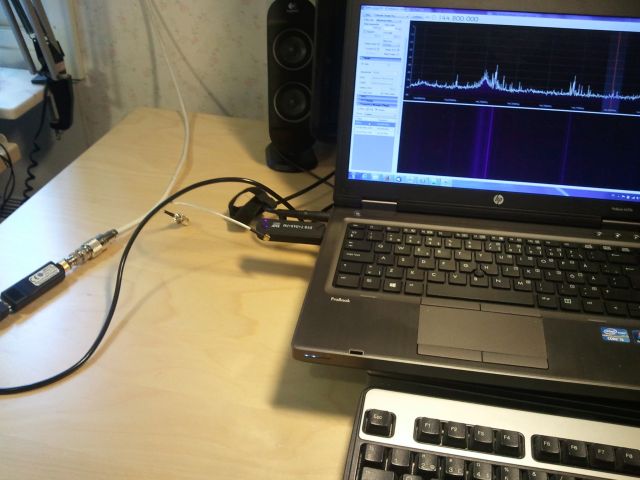
De två USB-stickorna under test

Testutrustning:
– FunCube Dongle Pro+  pris ca. 1500 kr
– RTL2832U R820T  pris ca. 120 kr via eBay.
– Duobands Sim-Jim-antenn
– ca. 20 meter koaxkabel
– SDR# programvara

Och… visst är det skillnad!  Jag har lyssnat på både HO-68 och VO-52 nu med båda USB-stickorna och det är ganska stor skillnad. AO-7 nerlänk på 145 MHz gick riktigt bra att lyssna på trots låg elevation. HO-68 CW-beacon var inga problem att hitta och höra på 435 MHz trots svag signal. Det går att lyssna på dessa signaler även med RTL-SDR men det är skillnad i signalkvalité.

HO-68 CW-beacon mottagen med Funcube Dongle

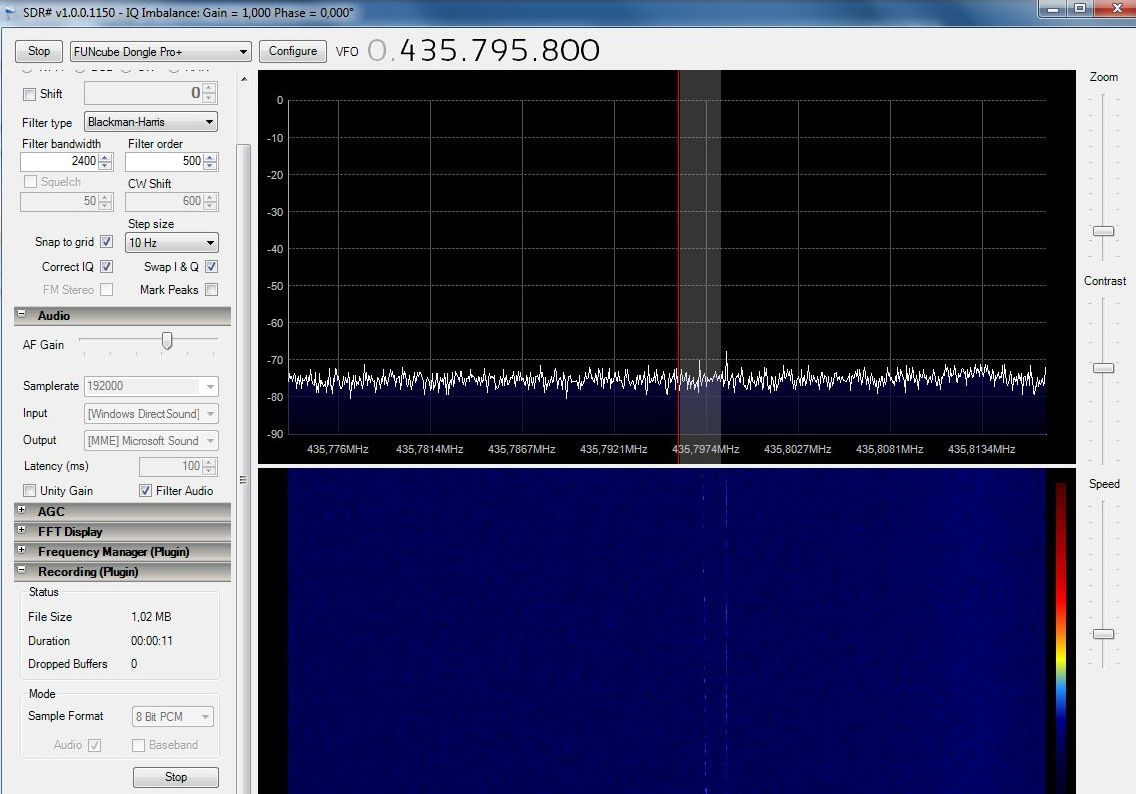
Först och främst är brusnivån mycket lägre med Funcube Dongle så signalen grävs verkligen fram i bruset – signal/brusförhållandet är mycket bättre. Med RTL:en måste man upp med den interna förstärkningen så pass mycket att brusnivån åker upp flera 10-tals dB jämfört med Funcube. Signalen är mycket klarare också då brusnivån är lägre och det beror kanske delvis på den mer påkostade hårdvaran med diskreta filter inbyggt.

Vidare – utan antenn inkopplad så läcker RTL-SDR in via USB-kontakten och antennkabeln – FM-rundradio går att lyssna på utan antenn. Funcube Dongle har inte alls samma problem.

Jag tror att en förförstärkare är ett måste för RTL om man vill lyssna mer seriöst på svagare satelliter. Med Funcube är det faktiskt inte nödvändigt.

Dock, man ska komma ihåg Funcube är 10 gånger dyrare än en RTL-SDR så det är fortfarande en mycket bra nybörjarradio. RTL-SDR är för sitt pris riktigt bra och det märks mindre skillnad på svaga- och medelstarka FM-stationer.

För en mer ingående jämförelse rekommenderas följande länk:
http://www.dx-buddy.net/en/SDR_vs_FCD.php

Categories
Ham Satellite news

AMSAT-SM HF-nätet 15/9 2013

Hej!

Vi körde ett litet nät på 3740 KHz idag.

Inte så många punkter att rapportera men ett intressant ballongprojekt pågår
idag (se länk nedan)

Deltagare
SM0IFP
SM4EFW
SM4JLX
SM5BXC
SM5HL
SM6NZV
SM7WSJ

Vi hörs nästa vecka

mvh Håkan SM7WSJ

Hello All,

At 15 september 2013 a weather balloon will be launched from QTH De Bilt in
the
Netherlands with a transponder, beacon and ATV video transmitter .
This event is a balloon fox hunt organized once in every year.
In the past Dutch amateur radio operators worked stations –
from F/G/ON/DL via the balloon transponder.
145.475Mhz downlink (FM/N).
432.550Mhz uplink (FM/N).

145.450Mhz 100mw beacon (FM/N).
2330Mhz ATV video transmitter with camera looking down.
Live video stream from the balloon camera will be shown on:
http://www.pi6atv.com/
http://www.ch73.net/

At 7.077Mhz (LSB) a special balloon event ground station will be –
active with the callsign PH35BHV.
The special callsign is because it will be the 35th ballon fox hunt event.

The weather balloon will be launched arround 11:00 UTC (it can also be
later).
More information you can find on the balloon fox hunt website.
http://www.ballonvossenjacht.nl/ (click on the English language right side).

73s Cor PD0RKC

Categories
Ham Satellite news

AMSAT-SM HF-nätet 8/9 2013

Hej!

Dagens nät på 3740 KHz.

Deltagare

SM4EFW
SM4JLX
SM6NZV
SM7GXR/M
SM7WSJ

*LADEE på väg till Månen
http://www.nasaspaceflight.com/2013/09/orbitals-minotaur-v-launch-ladee-mission-moon/

*Nya satellitoperatörer (några exempel på hur smidigt det kan vara med god uppfinningsförmåga)

https://picasaweb.google.com/101021064082474580425/PortableSatAntenna?noredirect=1#
http://in3aqk.blogspot.it/2013/08/first-sat-qso.html

*AMSAT-DL (presentation)
http://www.batc.tv/streams/amsat1306

*Mer satelliter

Space.com reports Planet Labs is launching 28 Dove 3U-CubeSats early 2014, presumably like Dove-1/2 using 2400 MHz.

http://www.space.com/22622-planet-labs-dove-satellite-photos.html

*Funcube (snart i en omloppsbana nära dig…)

The AMSAT FUNcube team are delighted to be able to announce that the
FUNcube-1 CubeSat has now completed all its final testing and been placed
into its launch POD. This work was completed during a three day programme
at the premises of ISIS BV in Delft in the Netherlands and was finished, on
time, late this afternoon. FUNcube-1 is actually the middle 1U CubeSat of
three sharing a 3U ISIPOD. It is sharing the ISIPOD with ZACUBE-1 from
South Africa and HINcube from Norway. ZACube-1, in addition to carrying VHF
and UHF communications equipment also has a 20 metre beacon which will
operate on 14.099MHz This ISIPOD, with the spacecraft inside, will be
transported to Russia, early next month,for launch and will eventually be
attached directly to the launch vehicle.

FUNcube-1 carries a U/V linear transponder and the educational telemetry
beacon using 1k2 BPSK for school outreach purposes.

The current launch info has lift off scheduled for November 21st at 07:11:29
UTC

Full intial orbit details and TLE?s, together with decoding sofwtare will be
made available over the next few weeks

best 73

Graham G3VZV ? Wouter PA3WEG ? Jim G3WGM

(Video på länken nedan)

http://www.youtube.com/watch?feature=player_embedded&v=3xT3SDlFUOg

mvh Håkan SM7WSJ