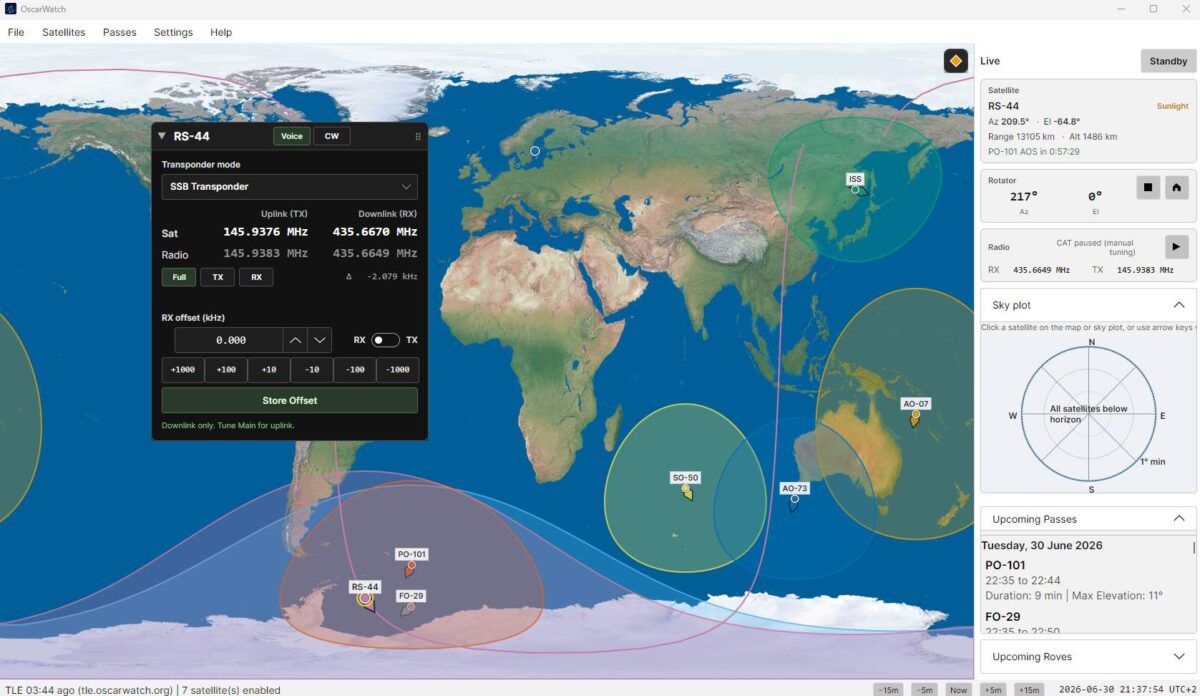
OscarWatch by Peter @mm9sql is a new desktop satellite tracking multi-platform software. It takes all the best parts from all other tracking softwares and bundles it into one package.
Peter have done a lot of work with the radio doppler control part and – as I see it – it is a huge improvement from what you have seen before in older software.
OscarWatch is still under development (summer 2026) and can be downloaded from:
https://github.com/magicbug/OscarWatch-Tracker
This is the current features list 30 Juno 2026, copied from GitHub:
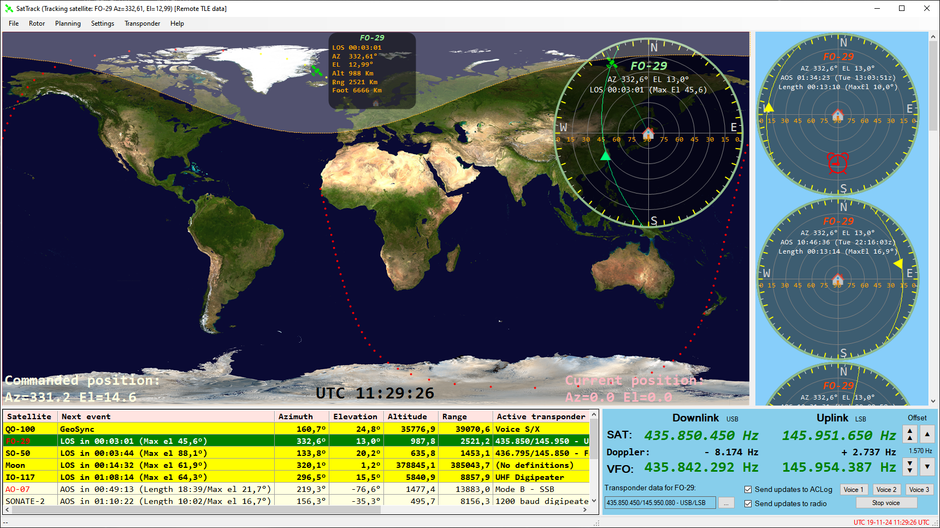
- World map: equirectangular Earth texture with satellite subpoint, ground track, footprint overlays (optional motion arrows), your QTH, and an optional remote DX station grid marker; map time scrubbing from the status bar (hardware tracking stays live)
- Sky plot: polar view of satellite azimuth/elevation relative to your station; click to focus; expand/collapse state is remembered
- TLE catalog: fetched from
https://tle.oscarwatch.org/, cached under%AppData%/OscarWatch/ - TLE auto-update: manual refresh, on startup (if stale), or every 6 hours while running (Settings → Tracking)
- Satellite picker: choose which spacecraft to track
- Pass predictions: upcoming passes with TCA (time of closest approach / max elevation), min-elevation and min-duration filters; sidebar View pass plot for a single-station polar chart
- Pass planner: multi-station profiles (home / portable), pass quality filters, satellite filter, pass radar gallery (polar plots for all upcoming passes of one satellite), and
.icscalendar export for contest or field-day planning - Mutual pass finder: find passes visible from two stations at once (Passes → Mutual pass finder)
- DX station monitor: enter a remote Maidenhead grid on the map; see where that station is and live azimuth/elevation for the focused satellite from their QTH (compact draggable overlay)
- Live telemetry: azimuth, elevation, range, and altitude updated every second (UTC)
- Voice announcements: optional spoken “rising” alerts when a satellite crosses a configurable elevation while ascending (e.g. “Alpha Oscar Zero Seven is rising”); Settings → Voice
- Pass recording: optional automatic WAV capture from a line-in or USB audio device while the focused satellite is above configurable elevation thresholds; Settings → Recording. Files save to
%AppData%/OscarWatch/recordings/by default as{sat-name}-{yy}-{MM}-{dd}-{HH}-{mm}.wav(UTC). A red REC badge appears on the pass row while recording. - Doppler frequencies: draggable overlay on the world map with transponder modes from the satellite database, live radio/sat uplink & downlink, RX offsets (separate stored values for Voice and CW on linear SSB), CTCSS (access/arm), and Voice/CW toggle for linear SSB (header buttons + Ctrl+W; CAT/Cloudlog follow Settings → Radio → Linear CW: keep receive in USB/LSB)
- Transponder database editor: Satellites → Manage transponder database… (add satellites from your TLE catalog or a custom name, Import/Export JSON, edit modes); Satellites → Update transponder database… merges published modes from tle.oscarwatch.org/satellite_database.json (new entries added with your consent; local edits kept on conflicts unless you accept remote). See documents/satellite-database.md

- Radio CAT: doppler tracking, satellite/split setup, Main/Sub VFOs, uplink CTCSS where supported; Settings → Radio (see Supported hardware)
- Rotator control: serial pass tracking, manual park, and manual rotator (az/el dialog in Standby for quick contacts between passes); Settings → Rotator (see Supported hardware)
- Cloudlog: optional Radio API v2 uplink/downlink when tracking (Settings → Cloudlog)
- Appearance: light, dark, or system theme (sky plot adapts; world map image stays light); 12- or 24-hour clock; optional greyline and footprint motion arrows on the map