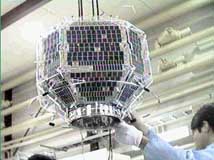
The FO-29 Control team sometimes receives requests regarding the operation of Fuji No.3, but as they have already reported, more than a quarter of a century after its launch, the situation remains unstable. They regret that they are unable to operate Fuji No.3 in accordance with your wishes under these circumstances, and they ask for your understanding and continued use of her.
During February, the control team plans to send a command to turn on the transponder at the following times, but please be advised that if it is not turned on for more than 2 minutes after they start sending the command, they will terminate the command work.
2025 has progressed more or less as usual, with an HF net on 3740 kHz almost every Sunday. The biggest change is probably that SM4EFW has been forced, due to age, to move to different accommodation and has therefore gone QRT.
There are still a few of us left, but it is starting to look like this may be the last year we run a purely AMSAT net.
Lars SM0TGU:
Activities: On April 26, 2025, AMSAT-SM participated in SSA’s 100th anniversary celebration in Västerås and gave a well-received presentation. The presentation was recorded by SSA but is currently only available to SSA members.
In July, we submitted a comment to the FCC (USA) opposing the proposal by “AST & Science” to use the entire 70 cm band for their communication satellites. This was noted, among others, by the AMSAT-NA News Bulletin.
In August, AMSAT-SM sent an open letter to several manufacturers of amateur radio handheld transceivers (HTs), proposing the production of a full-duplex model with good filtering between UHF and VHF. One manufacturer responded and was, for a period, willing to develop a new model, but this fell through because the manufacturer required a pre-order of several hundred units, which is impossible since AMSAT-SM is not a reseller. This was also highlighted by the AMSAT-NA News Bulletin. On X.com, this post became AMSAT-SM’s most read and shared ever (over 7,000 views).
During the autumn, we held a contest in which we raffled off a VHF/UHF Yagi from FW Cubelabs in Spain. The winner was Jan Emanuelsson SM7KOJ.
In November, we held a formally minuted steering group meeting. We adjusted some guidelines to better align with current activities.
Membership status: Five (5) new members joined during 2025. The current number of registered members is 321. During the year, we removed automatic registration due to excessive spam registrations. New member handling is now done manually.
X.com: Via X.com, we continue to see strong growth in followers – currently (January 9, 2026) 2,654 followers compared to 2,271 followers at the end of 2025. This makes us one of the AMSAT groups with the largest number of followers. X.com continues to be AMSAT-SM’s primary information channel together with the website.
Website: In connection with the antenna contest during the autumn, we took the opportunity to ask how our website could be improved. This resulted in several sections of the website being adjusted. A new article on how to get started listening to satellites will also be produced in early 2026. It is also intended that this article will be published in QTC. The cost of the website continues to be sponsored by Lars SM0TGU.
Finances: AMSAT-SM has approximately SEK 32,000 in the account. During 2025, Lars Malmrud SM5TSP also carried out an audit without remarks, which we appreciate.
—
In Swedish
Dags att summera AMSAT-SM aktivitet för 2025:
Håkan SM7WSJ:
2025 har rullat på ungefär som vanligt med ett HF nät på 3740 kHz så gott som varje söndag. Största förändringen är antagligen att vår gamla trotjänare SM4EFW varit tvungen att välja ett annat boende på grund av ålder och därmed QRT.
Vi är fortfarande några kvar men det börjar luta mot att det kan bli sista året vi kör ett rent Amsat nät.
Lars SM0TGU:
Aktiviteter: Den 26:e april 2025 var AMSAT-SM på SSAs 100-årsjubileum i Västerås och höll ett uppskattat föredrag. Föredraget spelades in av SSA men är just nu endast tillgängligt om man är medlem i SSA.
I juli lade vi en kommentar hos FCC (USA) mot “AST & Science” förslag att använda hela 70cm-bandet för deras kommunikationssatelliter. Detta uppmärksammades bla. av AMSAT-NA nyhetsbulletin.
I augusti skickade AMSAT-SM ett öppet brev till ett flertal tillverkare av amatörradio handapparater (HTs) med ett förslag att tillverka en full duplex modell med bra filtrering mellan UHF och VHF. En tillverkare hörde av sig och var under en period villig att utveckla en ny modell men det föll på att tillverkaren krävde en förbeställning på flera hundra exemplar, vilket är omöjligt då AMSAT-SM inte är en återförsäljare. Även detta uppmärksammades av AMSAT-NA nyhetsbulletin. På X.com blev detta inlägg AMSAT-SMs mest lästa och delade någonsin (över 7000 har läst inlägget).
Under hösten hade vi en tävling där vi lottade ut en VHU/UHF yagi från FW Cubelabs i Spanien. Vinnare blev Jan Emanuelsson SM7KOJ.
I november hade vi ett protokollfört styrgruppsmöte. Vi justerade några riktlinjer för att anpassa till rådande verksamhet.
Medlemsstatus: Fem (5) nya medlemmar har tillkommit under 2025. Aktuella registrerade medlemmar är 321 st. Under året har vi tagit bort den automatiska registreringen pga. för många spam-registreringar. Hanteringen av nya medlemmar görs nu manuellt.
X.com: Via X.com har vi en fortsatt stark ökning av följare – just nu (9 jan 2026) 2654 följare jämfört med 2271 följare i slutet av 2025. Det gör oss till en av de AMSAT-grupper med flest följare. X.com fortsätter att vara AMSAT-SM huvudsakliga informationskanal tillsammans med hemsidan.
Hemsidan: I samband med antenntävlingen under hösten passade vi på att fråga hur vår hemsida kunde förbättras. Detta fick till resultat att ett antal delar på hemsidan justerades. En ny artikel om hur man börjar lyssna på satelliter kommer också att tas fram under början av 2026. Det är även tänkt att denna ska publiceras i QTC. Kostnaden för hemsidan fortsätter att sponsras av Lars SM0TGU.
Ekonomi:
AMSAT-SM har ca 32 000 kr i kassan. Under 2025 har även Lars Malmrud SM5TSP gjort en revision utan anmärkning vilket vi uppskattar.
Webbstatistik:
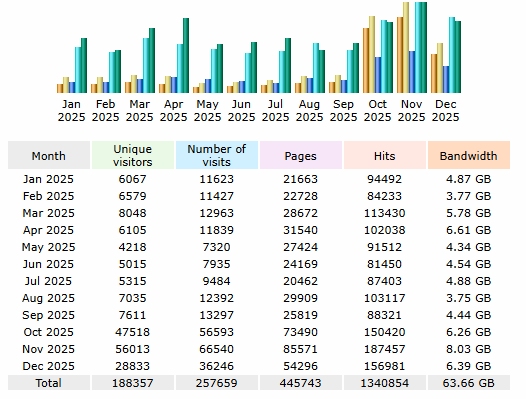
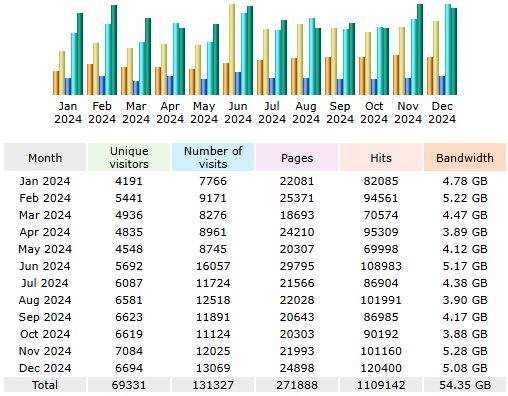
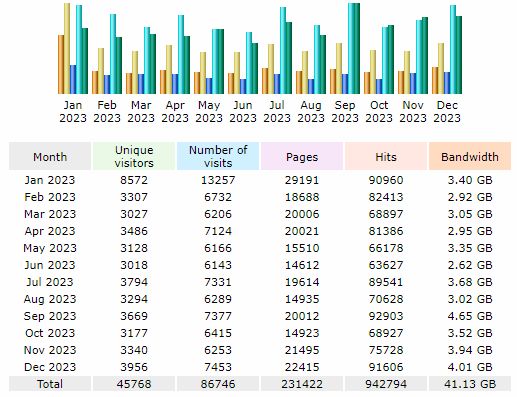
Som vanligt har vi ett stigande besöksantal jämfört med året innan. Nedan är de tre senaste åren.
TinyGS @tiny__GS is an open network of Ground Stations distributed around the world to receive and operate LoRa satellites, weather probes and other flying objects, using cheap and versatile modules. The project is based on the popular ESP32 boards.
The difference from the SatNOGS network is that you can only use the ESP32 LoRa boards with specific frequency range but on the other hand it is much more simple to setup.
So is this amateur radio with satellites? No, not at all, but it is a fun and very simple way to start listening on UHF satellites and maybe some can get interested in ham radio after setting up a station.
This is the way I set up everything and did my first test. It is not a full instruction, you can found everything you need at the TinyGS wiki:
First order a LoRa32 module. 433 MHz is the most used frequency so order that one. Note that the module also covers 400 MHz. I got mine from LILYGO official store on AliExpress.
In order to register on TinyGS you need to have a Telegram account. So register and join the TinyGS community.
Still waiting for the LoRa32 module? Then read the TinyGS wiki and be prepared before the installation.
When you get the LoRa32 module, go to https://installer.tinygs.com/ and just follow the instructions on that page. I followed Automatic Setup that includes how to setup a new station. If everything works fine you get this message:
I recommend that you change the admin password of the station dashboard to your own. Note! I have problem changing the password and it seams like the default password is 12345678 You can find it via the User Console -> Click on you station -> Click on the IP-address (Local IP) and then -> Configure parameters
If you have a TTGO LoRA 32 v2 you have to change the board type. According to the wiki: “…if you have this board, probably it is not detected automatically and you have to select it on the config panel manually. If you don’t do so the Lora communication will not work.”
Connect the LoRa board to an antenna. I just connected it to my UHF Yagi. Then wait a while to see if you get any data from satellites…
Hopefully in the next hours you will see that you have received satellites data!
Amateurs and others around the world may listen in on contacts between amateurs operating in schools and allowing students to interact with astronauts and cosmonauts aboard the International Space Station. The downlink frequency on which to listen is 145.800 MHz worldwide.
Successful Contacts
South-West State University, Kursk, Russia, direct via UB3WCL. The ISS callsign was RSØISS. The crewmember was Sergey Ryzhikov. The ARISS mentor was A.R.C. ENERGIA, RV3DR. Contact was successful on Saturday, November 22, 2025 at 14:54 UTC.
Moscow Aviation Institute, Moscow, Russia direct via R2AS. The ISS callsign was RSØISS. The crewmember was Oleg Platonov The ARISS mentor was A.R.C. ENERGIA, RV3DR. Contact was successful on Mon 2025-11-24 14:56 UTC.
Upcoming Contacts
Lincoln Magnet School, Springfield, Illinois, direct via K9OK. The ISS callsign is presently scheduled to be NA1SS. The scheduled crewmember is Jonathan (Jonny) Kim, KJ5HKP. The ARISS mentor is Charlie Sufana.AJ9N. Contact is go for Friday, December 5, 2025 at 15:29 UTC.
Russian State Agrarian University – Moscow Agricultural Academy named after K.A. Timiryazev, Moscow, Russia, direct via TBD. The ISS callsign is presently scheduled to be RSØISS. The scheduled crewmember is Sergey Kud-Sverchkov. The ARISS mentor is A.R.C. ENERGIA, RV3DR. Contact is go for Friday, December 5, 2025 at 11:00 UTC.
The crossband repeater continues to be active (145.990 MHz up {PL 67} & 437.800 MHz down). If any crewmember is so inclined, all they have to do is pick up the microphone, raise the volume up, and talk on the crossband repeater. So give a listen, you just never know.
The packet system is also active (145.825 MHz up & down).
As always, if there is an EVA, a docking, or an undocking; the ARISS radios are turned off as part of the safety protocol.
Note, all times are approximate. It is recommended that you do your own orbital prediction or start listening about 10 minutes before the listed time.