Categories
Operations

How to setup a TinyGS station

TinyGS @tiny__GS is an open network of Ground Stations distributed around the world to receive and operate LoRa satellites, weather probes and other flying objects, using cheap and versatile modules. The project is based on the popular ESP32 boards.

The difference from the SatNOGS network is that you can only use the ESP32 LoRa boards with specific frequency range but on the other hand it is much more simple to setup.

So is this amateur radio with satellites? No, not at all, but it is a fun and very simple way to start listening on UHF satellites and maybe some can get interested in ham radio after setting up a station.

This is the way I set up everything and did my first test. It is not a full instruction, you can found everything you need at the TinyGS wiki:

  1. First order a LoRa32 module. 433 MHz is the most used frequency so order that one. Note that the module also covers 400 MHz. I got mine from LILYGO official store on AliExpress.
  2. In order to register on TinyGS you need to have a Telegram account. So register and join the TinyGS community.
  3. Still waiting for the LoRa32 module? Then read the TinyGS wiki and be prepared before the installation.
  4. When you get the LoRa32 module, go to https://installer.tinygs.com/ and just follow the instructions on that page. I followed Automatic Setup that includes how to setup a new station.
    If everything works fine you get this message:

  5. I recommend that you change the admin password of the station dashboard to your own.
    Note! I have problem changing the password and it seams like the default password is 12345678
    You can find it via the User Console -> Click on you station -> Click on the IP-address (Local IP) and then -> Configure parameters
  6. If you have a TTGO LoRA 32 v2 you have to change the board type. According to the wiki: “…if you have this board, probably it is not detected automatically and you have to select it on the config panel manually. If you don’t do so the Lora communication will not work.”

  7. Connect the LoRa board to an antenna. I just connected it to my UHF Yagi. Then wait a while to see if you get any data from satellites…

Hopefully in the next hours you will see that you have received satellites data!

Categories
Ham Satellite news

Daily updated Amateur Satellite Database

This is a sat database that I actually have missed and seen for the first time today. It is updated daily with GitHub Action and if you would like more information visit the project on GitHub.

Categories
Telemetry

RS-38S SSTV 2025-12-05

The RS-38S satellite has turned on it’s SSTV transmission on 437.825 MHz FM Robot 36-mode.

Equipment used:

  • RX at 437.825 MHz FM
  • 2 x 13 el LFA X-Yagi (InnovAntenna) at horizontal polarisation during this pass
  • AlfaSpid RAS az/el rotor
  • LNA Mini-70 from SHF Elektronik
  • LMR-400 coax
  • RTL-SDR v3 via IC-9700 with PTRX-9700 panadapter
  • SDR-Console v3 with doppler correction of downlink and satellite tracking, rotor control
  • PstRotator for rotor control interface between SDR-Console and RAS controller
  • RX-SSTV v2.1.5
  • VB-Cable: virtual audio cable for piping audio from SDR Console to RX-SSTV. Set to 96 kHz and 16 bit.
Categories
Hamradio from ISS

ARISS News 2025-12-01

Amateurs and others around the world may listen in on contacts between amateurs operating in schools and allowing students to interact with astronauts and cosmonauts aboard the International Space Station. The downlink frequency on which to listen is 145.800 MHz worldwide.

Successful Contacts

South-West State University, Kursk, Russia, direct via UB3WCL.
The ISS callsign was RSØISS.
The crewmember was Sergey Ryzhikov.
The ARISS mentor was A.R.C. ENERGIA, RV3DR.
Contact was successful on Saturday, November 22, 2025 at 14:54 UTC.

Moscow Aviation Institute, Moscow, Russia direct via R2AS.
The ISS callsign was RSØISS.
The crewmember was Oleg Platonov
The ARISS mentor was A.R.C. ENERGIA, RV3DR.
Contact was successful on Mon 2025-11-24 14:56 UTC.

Upcoming Contacts

Lincoln Magnet School, Springfield, Illinois, direct via K9OK.
The ISS callsign is presently scheduled to be NA1SS.
The scheduled crewmember is Jonathan (Jonny) Kim, KJ5HKP.
The ARISS mentor is Charlie Sufana.AJ9N.
Contact is go for Friday, December 5, 2025 at 15:29 UTC.

Russian State Agrarian University – Moscow Agricultural Academy named after K.A. Timiryazev, Moscow, Russia, direct via TBD.
The ISS callsign is presently scheduled to be RSØISS.
The scheduled crewmember is Sergey Kud-Sverchkov.
The ARISS mentor is A.R.C. ENERGIA, RV3DR.
Contact is go for Friday, December 5, 2025 at 11:00 UTC.

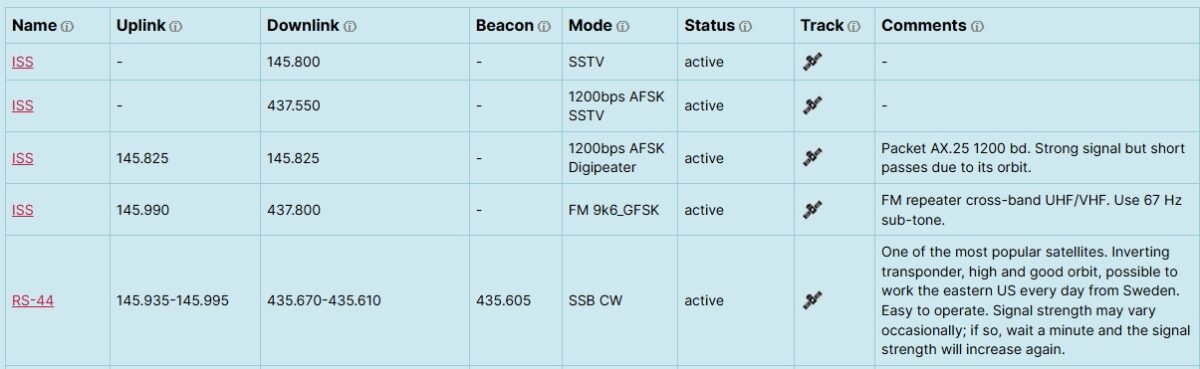
  • The crossband repeater continues to be active (145.990 MHz up {PL 67} & 437.800 MHz down). If any crewmember is so inclined, all they have to do is pick up the microphone, raise the volume up, and talk on the crossband repeater. So give a listen, you just never know.
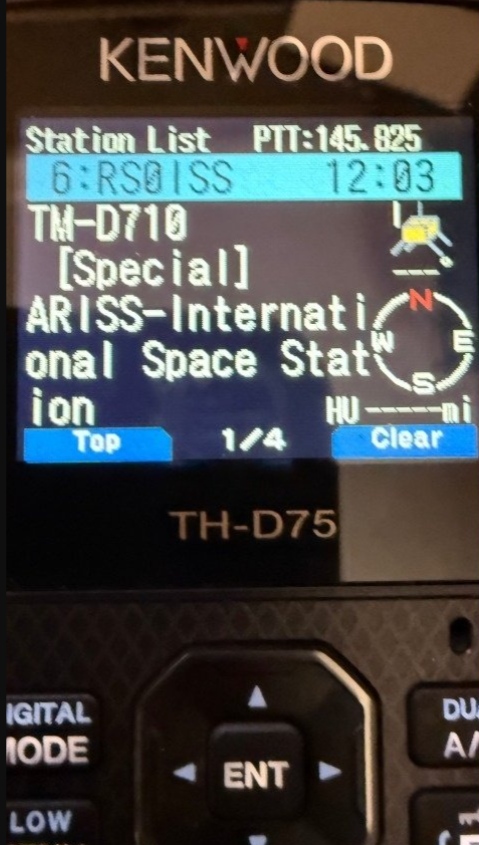
  • The packet system is also active (145.825 MHz up & down).
  • As always, if there is an EVA, a docking, or an undocking; the ARISS radios are turned off as part of the safety protocol.
  • Note, all times are approximate. It is recommended that you do your own orbital prediction or start listening about 10 minutes before the listed time.
  • The latest information on the operation mode can be found at https://www.ariss.org/current-status-of-iss-stations.html .
  • The latest list of frequencies in use can be found at https://www.ariss.org/contact-the-iss.html .

[ANS thanks Charlie Sufana, AJ9N, one of the ARISS operation team mentors for the above information.]

Categories
Ham Satellite news

CatSat 10 GHz Downlink – Successful Reception

Re-post from ANS-327:

Mike Seguin, N1JEz, reports the successful reception of the University of Arizona’s CatSat’s 10 GHz downlink on 10.47 GHz on the morning of November 21, 2025. The satellite’s  linear transponder uses 10 GHz down and 5 GHz up. More information is available at https://catsat.arizona.edu/

Mike reports that signals were quite good in FN34xn in Vermont! His next step is to try the uplink on 5 GHz on 5.663 GHz.

Below is a link to a portion of the pass. It is an I&Q file recorded with HDSDR using the Winrad format.

https://drive.google.com/file/d/15cuuhi-U5WDkVjiKHJeuP_argBhH0Cpz/view?usp=drive_link

Congrats to the CatSat team!!

Categories
Ham Satellite news SDR and software

SkyRoof SDR satellite software

SkyRoof is a Windows application for Hams and satellite enthusiasts by Alex Shovkoplyas VE3NEA.

The main features of SkyRoof are:

  • detailed information about all satellites that transmit in the Ham bands;
  • satellite tracking in real time;
  • pass prediction for the selected satellites;
  • visual representation of the current satellite position and future passes, using:
    • Sky View – the view of the sky from your location;
    • Earth View – the view of the Earth from the satellite;
    • Time Line – the satellite passes on the time scale;
    • Pass List – the details of the predicted passes;
  • SDR-based waterfall display that covers the whole satellite segments on the VHF and UHF bands, with zoom and pan;
  • SDR-based SSB/CW/FM receiver with RIT and Doppler tracking;
  • audio and I/Q output to external programs via VAC or UDP;
  • frequency scale with satellite names and transponder segments, Doppler-corrected;
  • CAT control of an external transceiver;
  • antenna rotator control.

Download at https://ve3nea.github.io/SkyRoof/