Categories
Ham Satellite news

CubeSats Deploy ISS September 19 2025

Repost from ANS-257:

JAXA, the Japan Aerospace Exploration Agency, has announced that five Japanese CubeSats will be deployed from the International Space Station (ISS) on September 19 (though the date and time of the deployment are subject to change due to the ISS schedule modification). The deployment event for those satellites will be broadcast via YouTube JAXA Channel. Four of the CubeSats, carrying scientific and educational payloads, will operate in the amateur bands, and radio amateurs around the world are invited to participate in the projects:

GHS-01 is a 2U size CubeSat equipped with a camera for photographing the earth, a sensor for checking the state of the satellite, and an attitude control device. In response to commands from the ground station, the satellite-mounted camera photographs the earth from space and transmits the image data to the ground. In order for amateur radio users around the world to voluntarily acquire image data taken by this satellite by radio, the date and time of image transmission will be published on the website https://gifuhs2022.wordpress.com/. Also, the satellite carries a digitalker mission. Audio data is transmitted from a ground station and stored in the satellite. The voice data is transmitted from the satellite as an analog FM voice signal, and a message is broadcast from space. The date and time the message will be sent will be published on the website. The satellite was built by Gifu University with technical cooperation for using satellite radio waves with sister schools of universities and high schools such as Lithuania, Australia, Kenya, South Korea, and Taiwan. A downlink on 437.090 MHz has been coordinated with 20 wpm CW, 1k2 AFSK, 9k6 GMSK and digitalker voice.

DRAGONFLY, coordinated by Kyushu Institute of Technology, is part of the Joint Global Multi-Nation Birds Satellite project, BIRDS-X, and funded by Amateur Radio Digital Communications in the U.S. The 2U CubeSat will carry APRS digipeaters on 145.825 MHz, as well as a Store and Forward messaging system. In addition to the VHF APRS frequency, a UHF downlink for CW beacon and telemetry using 4k8 GMSK will transmit at 437.375 MHz. A ground terminal competition will be held on DRAGONFLY. More information is available at https://birds-x.birds-project.com/

STARS-Me2, a 1U CubeSat built by Shizuoka University features an earth observation camera, but the real experimentation takes place on the AX.25 radio downlinks on which those photos are transmitted back to earth. Reception success rates at receiving ground stations will be measured at baud rates of 1.2kbps, 9.6kbps and 115.2kbps. The coding gain of the error correction scheme will be measured on the downlinks. And the reception performance with polarization diversity at multiple terrestrial receiver stations (developed by amateur radio operators) will be evaluated. The goal is to learn more about how large data sets, such as images, are best transmitted from space. UHF downlinks with CW, 1k2 AFSK, 9k6 FSK and 115.2 bps GMSK are coordinated for 437.350 MHz, 437.400 MHz and 437.200 MHz.

RSP-03 is also a 1U CubeSat carrying a camera, but in this case the camera will not be aimed at earth, but at the stars. The main mission is to capture the star data by camera, convert it to “audible data,” and deliver the audio to the ground as a “Stellar Symphony.” After acquiring data of stars and constellations captured by the onboard camera an on-board AI will compose sounds from the star data and transmit it to the ground via an FM Digi-talker. In addition, digital data will be sent using various baud rates and modulation modes, and a digital “QSL card,” stored on the satellite before launch will be transmitted via SSTV after amateurs have uploaded their callsigns from the ground. A downlink at 437.050 MHz will be shared by the FM Digi-talker, 1200 BPS (AFSK on FM), 9600 BPS (GMSK), and 24000 BPS (4FSK, OQPSK). Details are at https://rsp03.rymansat.com/en.

[ANS thanks Masa Arai, JN1GKZ, IARU, and JAXA for the above information.]

Categories
Ham Satellite news

AST SpaceMobile 70cm allocation update

Repost from ANS-257:

The FCC Space Bureau has granted a license to AST & Science LLC (operating as AST Space Mobile) for using the 430 — 440 MHz amateur radio allocation for TT&C operations for 20 additional satellites.

The FCC Space Bureau commented: “At this time, to address the concerns raised by amateur radio operators and the petitioner, we issue a limited grant to AST to conduct emergency operations in the 430–440 MHz bandwhen no other bands are available for the 20 additional satellites authorized herein for a period not to exceed 24 hours.”

This decision is the result of over 2500 comments to the FCC by the American Radio Relay League (ARRL) and several International Amateur Radio Union (IARU) member societies, AMSAT, and individual amateur radio operators. The IARU maintains its view that the use of Article 4.4 of the ITU Radio Regulations is inappropriate in this matter, in particular as there are existing allocations in the UHF spectrum for Telemetry, Tracking and Command (TT&C) operations. There are no technical or operational requirements for AST & Science LLC to intrude the 430–440 MHz spectrum which is a primary amateur and amateur satellite service allocation in ITU Region 1 and in several countries in Region 2.

The IARU and its member societies will continue to monitor the further development of this issue. As a sector member of ITU‑R, the IARU will contribute towards improving the respective process concerning Article 4.4.

The IARU is grateful for the support and contributions from our member-societies.

[ANS thanks IARU for the above information.]

Categories
Ham Satellite news Telemetry

UMKA-1 SSTV over Stockholm 2025-08-30

The UMKA-1 satellite has turned on it’s SSTV transmission on 437.625 MHz FM Robot 36-mode. Strong downlink that should be possible to receive with a simple yagi without elevation.

Equipment used:

  • RX at 437.625 MHz FM
  • 2 x 13 el LFA X-Yagi (InnovAntenna) on at horizontal polarisation during this pass
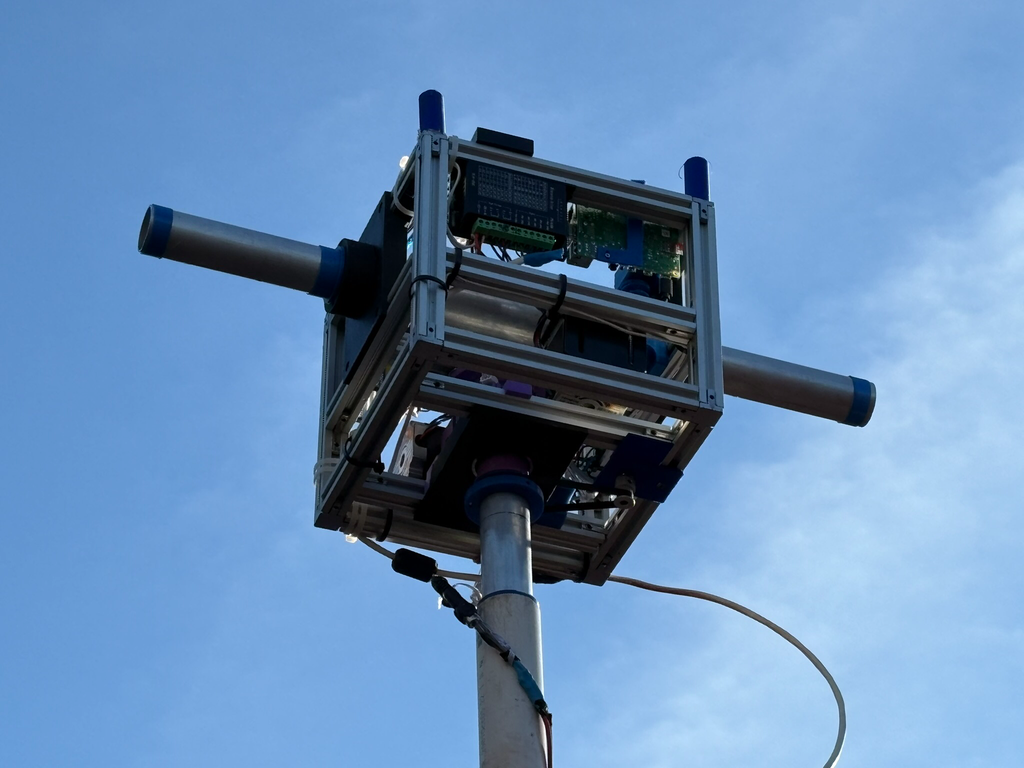
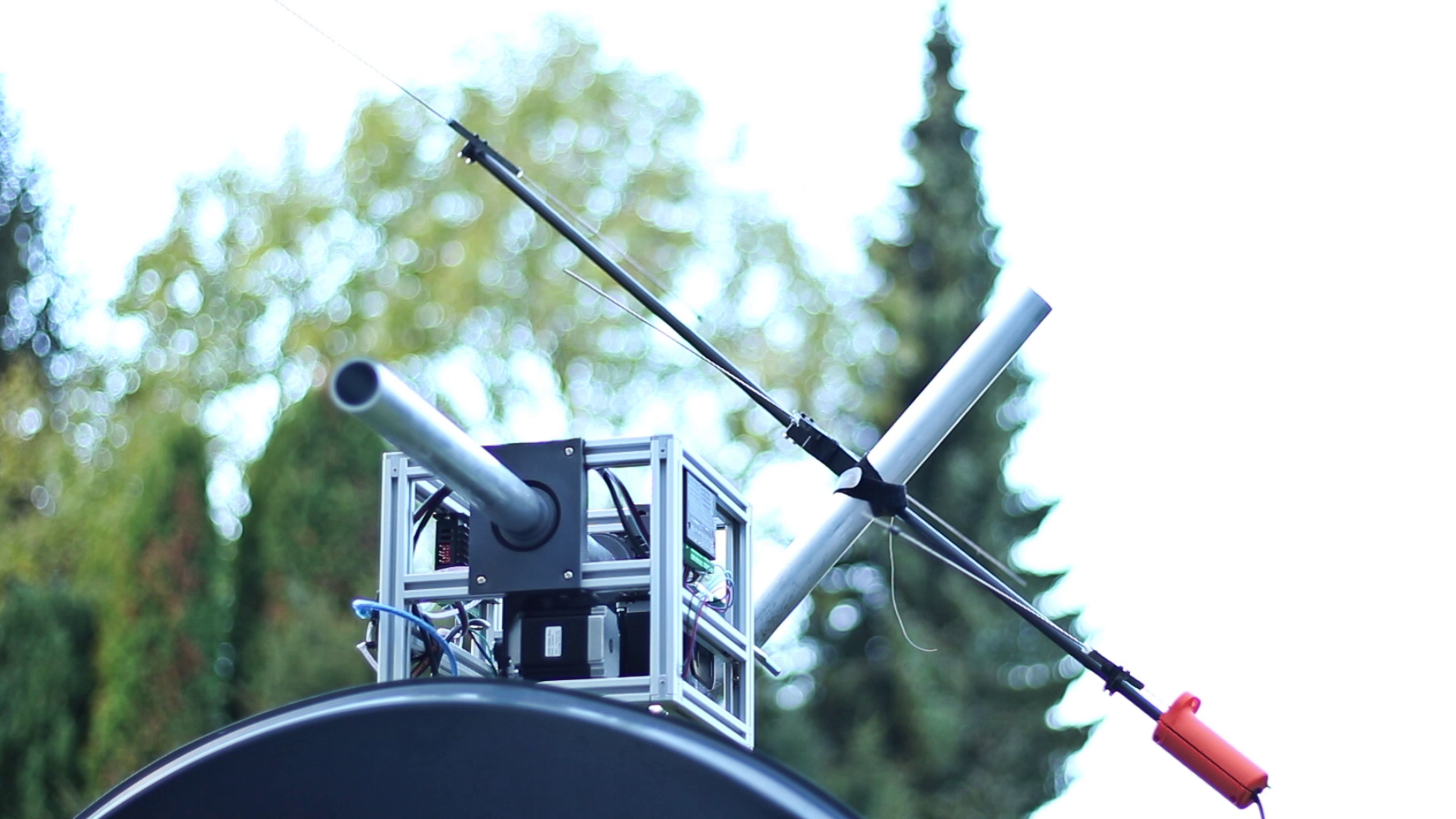
  • AlfaSpid RAS az/el rotor
  • LNA Mini-70 from SHF Elektronik
  • LMR-400 coax
  • RTL-SDR v3
  • SDR-Console v3 with doppler correction of downlink and satellite tracking, rotor control
  • PstRotator for rotor control interface between SDR-Console and RAS controller
  • RX-SSTV v2.1.5
  • VB-Cable: virtual audio cable for piping audio from SDR Console to RX-SSTV. Set to 96 kHz and 16 bit.

Short video from the pass:

Categories
Ham Satellite news

Ten-Koh-2 with linear transponder and 5 GHz beacon

Ten-Koh-2 is a satellite planned to be released from ISS later this year (2025). From several sources (see below) we can read that it will include linaer VHF/UHF transponder and a 5 GHz beacon.

From IARU:

  • Transponder uplink 145.895-145.935 MHz
  • Transponder downlink 435.875-435.915 MHz
  • Experiment downlink on 435.895 MHz
  • CW beacon 5839.000 MHz

More information:

Categories
Oscar-100 Telemetry

Decode QO-100 PSK beacon

This is nothing new, but it is actually the first time I have done it. The PSK Beacon can be found on 10489,745 MHz and you can use the following Windows software:

IZ8BLY P3D Decoder. I have tested this one, and it works fine.

AO-40 Telemetry Decoder. Should work fine, but I have not managed to decode.

What you need to do with both these software is to “pipe” the audio from a receiver to the software. This can be done with VB-Audio or other virtual audio cable software.

Below is a short video during decode:

Categories
Ham Satellite news

JAMSAT to develop multi-mode transponders for CubeSats

From ANS-236:
The Japan Amateur Satellite Association (JAMSAT) has announced the launch of the “Blueberry JAM” initiative, a new project to design and build an open-source multi-mode transponder for CubeSats. A kickoff meeting was held on May 3 with 15 participants, marking the start of what is envisioned as a flagship development effort for the organization.

The Blueberry JAM project centers on creating a versatile linear transponder that can be integrated into 1U CubeSats, while also being scalable to larger 3U and 6U platforms. The design is intended to support both traditional linear operation and potential digital enhancements, such as delay modes and data handling. The first demonstration unit—an engineering model—is targeted for completion by mid-2026 and will be offered to universities and satellite developers for potential flight opportunities.

Jerry Buxton, N0JY, AMSAT VP-Engineering commented, “AMSAT-NA is excited to see the Japan Amateur Satellite Association’s commitment to open-source development and collaboration with amateur satellite organizations around the world with their Blueberry JAM initiative.

“We are pleased to offer our help in this collective effort by providing JAMSAT with any schematics and documentation from AMSAT’s open-source/open-access projects developed to date as well as those being introduced this year.

“This includes our flight-proven LTM-2 Linear Transponder Module that has flown successfully on satellites deployed by two world-class universities and currently still operating on MO-122 and MESAT1. LTM provides telemetry downlink support for the host science missions and satellite health, as well as direct control of the LTM amateur radio usage. A third university is set to carry the latest version of LTM, which will fly on GOLF-TEE and Fox-Plus, on their upcoming mission that is currently under construction.”

A core philosophy of the project is openness. JAMSAT has pledged to make the development process, design documents, and results available to the amateur community. Hardware costs are expected to be covered by JAMSAT, while individual participants will bear their own incidental expenses. By sharing the design broadly, the group hopes to encourage adoption by multiple satellite missions, with a goal of eventually deploying the transponder on as many as 10 spacecraft.

Technical discussions during the kickoff highlighted the demand for new linear transponder capability in amateur satellites, as well as recognition that digital features will be important for future operations. Considerations include dual-channel command and data handling, efficient microcontroller use, and antenna and power system constraints inherent to CubeSats. The team also noted the potential to establish a ground-based test station to exercise the transponder under realistic conditions before flight.

Buxton also said, “We are also very happy to share AMSAT’s work on its upcoming SDR GEN-2, an SDR that provides all-mode functionality and continuous coverage from 144 MHz to 6 GHz providing “Five & Dime” capability in a format to fit 1U or larger CubeSats.

“We look forward to supporting JAMSAT in promoting more international collaborations that continue to Keep Amateur Radio in Space!”

Coordination for the project will be managed initially through mailing lists, with Slack and other online tools supporting more detailed technical exchanges. Meetings will be held on an ad-hoc basis until a regular schedule is established. Participants also suggested supplementary seminars to review background information and prior work for the benefit of newer contributors.

By positioning Blueberry JAM as a fully open-source design, JAMSAT hopes to strengthen international collaboration and demonstrate Japan’s continued leadership in the amateur satellite community. With a development horizon stretching into 2026 and beyond, the project has the potential to become a cornerstone payload for future CubeSat missions and to provide valuable new communication opportunities for amateur operators worldwide.

[ANS thanks JAMSAT and Jerry Buxton, NØJY, AMSAT VP-Engineering for the above information]