A portable satellite station for the QO-100 geostationary satellite (Es’hail-2) was commissioned on the icebreaker FS “Polarstern” at 14:23 UTC on December 27, 2020, with an initial QSO between DP0POL/mm and DK3ZL. A very special experiment, originated from an idea of Felix DL5XL and Charly DK3ZL. AMSAT-DL spontaneously supported this project by providing a complete 6 Watt transverter radio station, as well as a 75 cm dish on a tripod.
Här kommer en sammanfattning över medlemsstatus och AMSAT-SMs internet- och informationsaktivitet från 2020.
Medlemsstatus AMSAT-SM hade vid årets slut 289 medlemmar att jämföra med 268 medlemmar för 2019. Ingen har aktivt gått ur under året. Detta innebär att vi ökar vårt medlemsantal varje år. Sedan 2013 har vi fått 205 nya medlemmar vilket innebär att mer än två tredjedelar har registrerat sig de senaste sju åren.
Hemsidan och sociala medier Via Twitter har vi en fortsatt stor ökning av följare – just nu (jan 2020) 1164 följare jämfört med 668 följare i slutet av 2018. Under året fick vår webbhotell-leverantör nya ägare och hemsidan flyttades därför rent tekniskt. För webbredaktören har det blivit något enklare att redigera och prestandan är även något bättre (snabbare svarstider). I och med den nya webbhotell-leverantören har vi även fått en ny statistikfunktion, vilket gör att det inte går att jämföra värden från föregående år. Så här såg det ut under andra halvan av 2020 (notera ökningen under december):
Kostnaden för hemsidan är fortsatt sponsrad av Lars SM0TGU under flera år framåt. Under december gjordes ett stort arbete med ny design för hemsidan vilket förhoppningsvis gör det enklare att hitta.
This is a guide how to working satellites with the IC-705 or similar rig. When trying to understand the IC-705 I needed to write down how to use it – so this is how this post was born. I will try to explain 3 different user scenarios, each have a case for FM- and linear satellites :
Working stand alone (portable) without computer control
Working with SDR-Console for doppler adjust and a SDR as receiver
Working with PstRotator for doppler adjust
The IC-705 satellite memory examples and file can be found here. Please contact me if you see anything that will not work in the following user cases – I have limited knowledge.
Setting up PstRotator
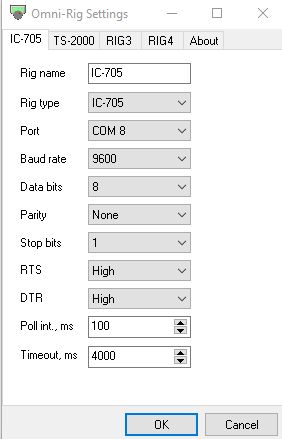
I will not explain how to use and set up PstRotator – the PstRotator manual is very good. The settings for Omnirig is like this:
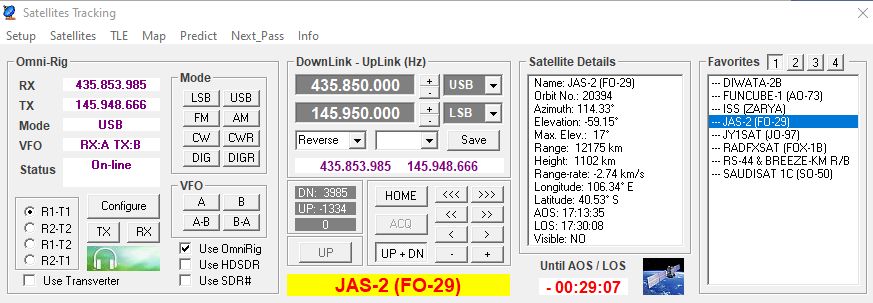
And a typical layout for PstRotator Satellites Tracking is like this (and for reference image for the text below):
Case 1: Using IC-705 stand alone without computer control
FM satellites
Select split memory for the satellite in IC-705.
If needed adjust the RX frequency with the VFO knob (look at the waterfall).
Adjust the TX frequency for doppler when transmitting with VFO knob. Use a printed frequency chart for help.
Linear satelliteswith SSB transponder (I have never tried semi-duplex on linear satellites before so not sure if this works)
Select split memory for the satellite in IC-705.
Adjust the RX frequency with the VFO knob to find a free space on the transponder (look at the waterfall).
Adjust the TX frequency (press PTT and use the VFO knob) to the correct frequency on the uplink. Use a printed frequency chart for help.
Case 2: Using IC-705 with SDR-Console v3
In this case the IC-705 is working as the transmitter with full doppler control and a SDR as receiver, also with doppler control. This is my primary working setup for now!
FM satellites
Select the downlink frequency in SDR-Console for your SDR receiver and enable tracking in the satellite window, this will doppler control your RX.
Select the uplink memory for the satellite in IC-705 to get correct CCTCS tones.
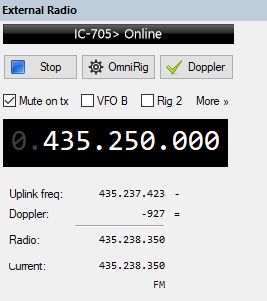
Select the uplink frequency in SDR-Console, it will be transferred to External Radio windows.
Start External Radio in SDR Console for doppler control – no need to do anything on the IC-705 – just transmit.
Linear satelliteswith SSB transponder
Select the downlink frequency in SDR-Console for your SDR receiver and enable tracking in the satellite window, this will doppler control your RX.
Select the uplink frequency in SDR-Console, it will be transferred to External Radio windows.
Adjust the RX frequency at SDR Console to find a free space on the transponder (look at the waterfall).
Start External Radio in SDR Console for doppler control.
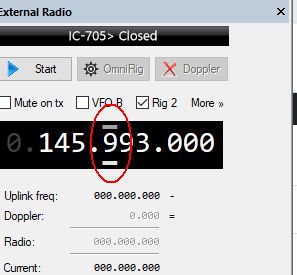
As SDR Console does not link (track) up/downlink VFOs – adjust the TX frequency on the IC-705 with the VFO knob to the correct frequency on the uplink. Doppler is corrected also during TX. Use a printed frequency chart for help. You can also adjust the frequency with the mouse wheel in at the External Radio windows. I find this better then using the VFO knob on the radio.
In this case PstRotator sets the correct frequency and mode on the IC-705 and has doppler control for both RX and TX. You are working IC-705 stand-alone as semi-duplex. Note! I’m not using this setup for now.
FM satellites
Select the satellite from PstRotator Favorites. Correct frequency, mode and subtone are now set in IC-705 VFOs.
Press the “UP+DN” on PstRotator. Doppler is now adjusted on both RX and TX.
No need to do anything on the IC-705 – just transmit and listen.
Linear satelliteswith SSB transponder
Select the satellite from PstRotator Favorites. Correct frequency and mode are now set in IC-705 VFOs.
Press the “UP+DN” on PstRotator and check that VFO linking are set to “Reverse”. Doppler is now adjusted on both RX and TX and the VFOs are linked.
Adjust the RX frequency with the VFO knob to find a free space on the transponder (look at the waterfall). The TX is linked and will have correct frequency.
Change the VFO linking to “Not linked” on PstRotator. This means that both TX and RX are still doppler adjusted but the TX frequency is locked (fixed). If needed you can adjust the RX frequency with the VFO knob on the IC-705.
Finally this is a short video when using the tiny GPD MicroPC with PstRotator and IC-705 as a portable computer controlled doppler adjustment.
Tänkte ta tillfället att önska alla medlemmar i AMSAT-SM ett riktigt gott nytt år.
Från styrgruppens sida känns det lite speciellt att vi nu arbetar vidare med AMSAT-SM i en form där vi har minskat det administrativa och koncentrerar oss i stället på kärnverksamheten. (Vi håller ständigt dörren öppen för fler aktiva som vill deltaga i styrgruppen för AMSAT-SM:s framtid)
Det har varit lite annorlunda i år vad det gäller att kunna träffas och diskutera våran hobby men vi ser framåt och önskar att det återigen skall bli möjligt med lite informationsträffar inte bara via nätet.
Vi befinner oss i AMSAT världen i ett fantastiskt skede där vi nu kan kommunicera via en transponder i det geostationära bältet samt även får se ett otroligt flöde med nya studentsatelliter. Vi kommer även under kommande år, återigen få satelliter på 10&15M vilket kan bli väldigt intressant nu när solfläckarna sakta börjar öka igen.
Ett stort tack till det trogna gänget på HF nätet 3740 söndagar klockan 10.00 (Nätet har varit aktivt över 30 år)
Om man tänker till lite, vad kan vi mer önska oss? Det har från AMSAT världen föreslagits en Måntransponder i samband med ett kommande ESA projekt… Tänk om det skulle bli en verklighet… vilka möjligheter för oss som gillar rymdkommunikation.
Som ett RX test med min nya 2X4ELC antenn testade jag att avkoda SSTV sändningen från ISS på juldagsmorgon. Tid 9:50:31 lokal tid. Man ser att bilden går över i brus på slutet. Vid den tiden tappar jag signalen nere vid horisonten på ett avstånd av 2415KM.