Categories
Ham Satellite news

RadFxSat-2 Signals Detected

Info from ANS-028:
RadFxSat-2 Signals Detected, AMSAT Engineering Continues to Assess
Status

On January 27th, Brad Schumacher, W5SAT, reported copying his CW
signal weakly via the RadFxSat-2 transponder. On the morning of
January 28th, AMSAT Engineering and Operations confirmed these reports and determined that RadFxSat-2 is partially functioning, though
signals are extremely weak. AMSAT thanks W5SAT for his report.

We also appreciate those who joined in determining whether they could
detect their own or other signals in recent passes today.

At this time it is essential and we ask you: Please do not attempt to
transmit through the transponder until further notice. This is very
important to the next steps we are taking now.

The next crucial step in evaluating the condition of RadFxSat-2 is to
determine whether or not the 1200 bps BPSK telemetry beacon is
operating and, if possible, copy telemetry from the beacon. We ask
that everyone with 70cm receive capability listen to the beacon
frequency of 435.750 MHz (+/-) Doppler, upper sideband (USB). Use
FoxTelem with your receiver in order to tune and capture any telemetry
you can. Also make sure FoxTelem is set to “Upload to server” so that
we receive your telemetry data. If you capture a good IQ recording on
SDR, please send a detailed description of your recording to
foxtelem@amsat.us. We may respond with a request for your recording
and details on how to transfer it to the AMSAT Engineering team.
Please understand that keeping the transponder clear is essential to
putting all power and attention to the beacon telemetry.

Two-line elements (TLEs) are available in AMSAT’s nasabare.txt
distribution at https://www.amsat.org/tle/current/nasabare.txt.
Available data suggests that RadFxSat-2 is OBJECT M from the Virgin
Orbit LauncherOne launch, NORAD ID 47320, international designation
21-002M.

We thank the amateur satellite community for their perseverance and
assistance while the AMSAT Engineering and Operations teams work to
understand and resolve the situation with RadFxSat-2.

[ANS thanks the AMSAT Engineering and Operations teams for the above information]

Categories
SDR and software

Satellite Custom Data and Frequency Markers for SDR-Console

Satellite Custom Data XML

In SDR-Console each satellite can have custom frequency data for both up- and downlink. The XML files below are generated from the Amateur Satellite Database project.

This is how to install the XML files for your SDR Console:

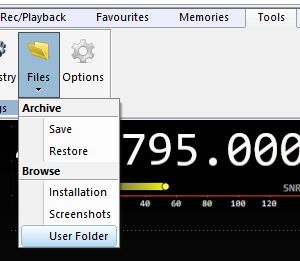
  1. From SDR Console, open your local user folder.

  2. Make a backup of all your local files!
  3. Unzip all the files in the SDR_SAT_Custom_data.zip to your user folder. If you already have XML file for a satellite you can choose not to overwrite it.
  4. Restart SDR-Console.
  5. Now all the XML Custom Satellite data files are available the next time you select a satellite.

Note that many satellites needs correction for mode (default RX mode is FM-W and TX mode is FM), filter etc. but this can be a good start and you do not need to manually enter all the data.

Download the file from SM0TGUs Github:
SDR_SAT_Custom_data.zip

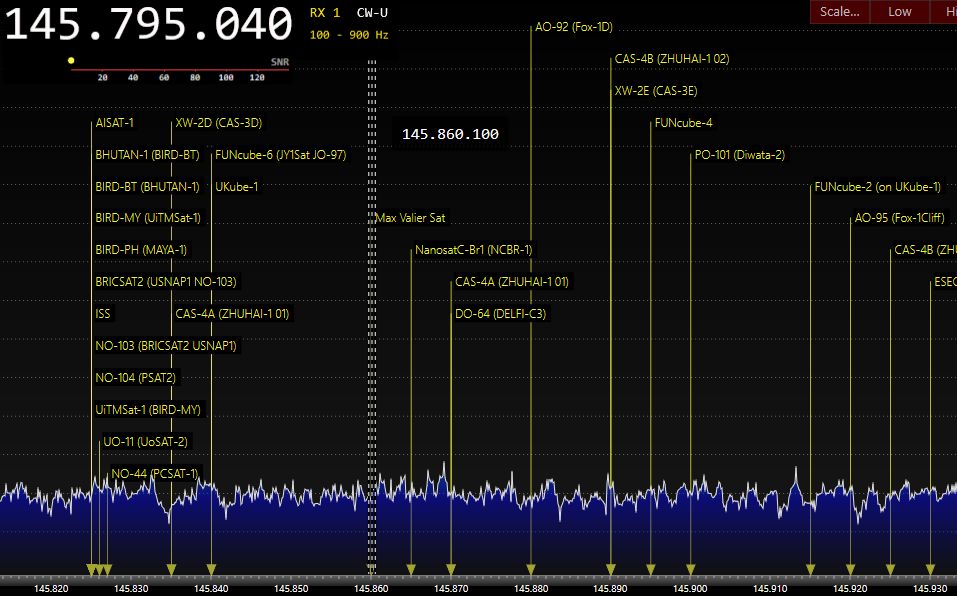
Satellite Frequency Markers

This is a Spectrum Markers (Frequency Markers) file over ham radio satellites beacon and downlinks for SDR-Console v3 software.

Import the csv-file into SDR-Console:

  1. In SDR-Console please go to “View” -> “Markers” -> “Marker Configuration”.
  2. Choose to “CSV: Import”.
  3. Activate the markers of your interest, all or some. There can be errors, I have not double-checked all the frequencies.

Download the file from SM0TGUs Github:
SatelliteFrequencyMarkers.csv

Categories
Telemetry

UVSQ-SAT first decode

Today (2021-01-24) I have been following the launch of UVSQ-SAT from the start from SpaceX, to deploy of the satellites to be one of the lucky to be the first to receive and decode telemetry.

Congratulation to all teams behind this satellite!

The decoded data has been sent to MVP Telemetry server:

And also to SatNOGS network:

I have used the following hardware and software:

  • RX at aprox 437.019 MHz USB BW 3.6 kHz
  • 26 el UHF LFA X-Yagi (2* 13 el) from InnovAntennas.
  • AlfaSpid RAS az/el rotor
  • LNA Mini-70 from SHF Elektronik
  • LMR-400 coax
  • SDRPlay RSP1a
  • SDR-Console v3 with doppler correction of downlink and satellite tracking, rotor control
  • PstRotator for rotor control interface between SDR-Console and RAS controller
  • VB-Cable: virtual audio cable for piping audio from SDR Console to Soundmodem. Set to 96 kHz and 16 bit.
  • Soundmodem G3RUH BPSK v 1.02 at mode BPSK G3RUH 1200bd. Be sure that the BPSK signal is centered “over” the signal in the spectrum.
    For other settings, the picture below. Note the “Input device” – that is you virtual audio cable.
    KISS Server Port is connected to UVSQsat Decoder.
  • UVSQsat Decoder v0.5. Data is beeing sent to both SatNOGS netword database and MVP Telemetry server.
Categories
Ham Satellite news

UVSQ-SAT

UVSQ-SAT Launch Now January 24th

The launch of UVSQ-SAT, which carries an FM transponder for amateur radio use is now planned for January 24, 2021 at 15:00 UTC.
437,020 MHz

The project team is offering a gift to the first 5 people who receive
the satellite’s signal and the first 5 people who receive and decode
the signal and submit it to the AMSAT-F server and/or SatNOGS.

For more information on UVSQ-SAT, see the following links:

http://uvsq-sat.projet.latmos.ipsl.fr/?ong=Ham-Radio

https://site.amsat-f.org/uvsq-sat/https://lasp.colorado.edu/home/inspire/

UVSQ-SAT Decoder

https://code.electrolab.fr/xtof/josast/-/blob/21-ecr-uvsqsat/ApplicationUVSQsatDecoder/src/site/markdown/ManuelUtilisateur.md

[ANS thanks Christophe Mercier, AMSAT-F President, for the above
information]

Categories
Ham Satellite news

Update on the Status of RadFxSat-2 / Fox-1E

From ANS-024:
RadFxSat-2 was launched Sunday, January 17, on Virgin Orbit
LauncherOne launch vehicle. Reports from the launch provider stated
that telemetry confirmed that the deploy commands had been sent and
that all of the doors opened successfully, resulting in payload orbits
that were all within the ICD limits.

Nominally, we expected to see “First (digital) Veronica” from the
RadFxSat-2 telemetry beacon commencing 54 minutes after our deployment
from the launch vehicle. That did not occur as expected.

For each of our launches, we follow a number of steps documented in
the “In Orbit Checklist” (IOC) spreadsheet. Confirmation of launch
and deployment are the first steps and then, confirmation of beacon
reception. All other steps follow that but there are steps in case of
anomaly, beginning with the detection of the beacon.

As always, from the moment we are deployed we look for signs of the
beacon through the ears of amateur radio operators and other means,
SatNOGS and webSDR to name a few. The antenna deployment and full
start of the IHU to bring up the beacon can occur anywhere around the
globe. AMSAT greatly appreciates the ongoing and reliable help we
receive from you and it is by far the best satellite ground network
even beyond that of many commercial players, for LEO orbits.

Command coverage is limited to the United States for various reasons
including regulatory requirements, so the opportunity to exercise the
steps of the IOC occurs a few times per day as the orbit passes over
us.

With no sign of the beacon after a few orbits offering good footprints
for reception, we proceeded with the contingency steps to verify the
presence of or activate the beacon. This past week our Engineering
and Operations Team members have been at work literally 20 hours per
day exercising all of the contingencies outlined in the IOC steps.
These steps have grown and matured with each launch of a Fox-1 program
CubeSat and are tailored to the specific satellite. RadFxSat-2, while
she may seem to be much the same as the others with the exception of
the transponder vs. FM radio, does present a number of variations to
be included in the IOC. As the results of those steps were exhausted
with no beacon detected, we added meetings and increased emails
including all of our engineers to discuss possible causes by any of
the systems and to develop further steps.

From those we drew new steps of command sequences that might overcome
whatever anomaly existed and make the beacon heard. As the week drew
on, we continued brainstorming and steps to activate other functions
that would provide proof of life. We continue to do so today and for
whatever time until we exhaust all possibilities that we are able to
draw from the expertise and satellite experience of our Engineering
Team and Operations Team drawing from the design of RadFxSat-2 and
lessons learned in the Fox-1 program as well as any from missions
prior to AMSAT’s first CubeSats.

AMSAT still needs your help as always, to help detect any sign of
activity from RadFxSat-2. This includes ability to listen for local
oscillators or transponder driver output in the case of a failed PA.

I personally ask that those of you who are and have been interested in
the entire process of bringing a new amateur radio satellite to orbit
and through end of life to continue to contribute your curiosity and
enthusiasm in exploring from your own station, to pursue the
possibilities of a successful RadFxSat-2 mission along with us. I
have received reports and queries from some of you, and I greatly
appreciate your contributions. You are in fact volunteers in the
AMSAT Engineering Team through your contribution.

If you are interested, I ask that you do due diligence in your
procedure if you think you have identified a signal by re-creating (if
possible) and verifying to yourself that what you have is credible, as
we do, before contacting us. That “standard” procedure is what adds
value by making the information actionable rather than placing the
onus of determining if it is even real upon us, because we are of
course quite busy with that already. Please email your findings to
foxtelem@amsat.us and allow us a day or two to acknowledge and/or
reply.

While we tend to talk about our involvement with RadFxSat-2 above all,
a real effect reaches outside our mutual desire for amateur radio
satellite fun. RadFxSat-2 is sponsored by Vanderbilt University as
part of our long partnership going back to Fox-1A. RadFxSat-2’s
mission belongs to Vanderbilt University as part of their RadFX series
of missions seeking to verify and explore radiation effects on COTS
components. Their mission coincides well with AMSAT’s desire to fly
lower cost satellite missions using COTS components, in the unfriendly
radiation environment of Earth orbit and beyond. Vanderbilt also
sponsored the CSLI for RadFxSat (one) in our Fox-1B spacecraft back in

  1. Their proposal was selected by NASA, flown on the ELaNa XIV
    mission in November of 2017.

RadFxSat’s mission was very successful in the information provided
through the combined telemetry-gathering of all of those who pursue
our missions through FoxTelem. Vanderbilt University published their
results giving praise to AMSAT and our Fox-1 CubeSats. The experiments
we host are built by students and Vanderbilt shares the experiences
with the educational community in their area. That is a success for
AMSAT as well in our goal to provide STEM and other educational
contributions.

While the RadFxSat-2 mission is problematic at this time, we will
pursue every possibility to make her work for the amateur community
and for our partner. I certainly hope to continue our partnership
with Vanderbilt, the mutual benefit is a wonderful and fun undertaking
that adds to the value of our satellites.

Categories
För nybörjare

Transceivers for Amateur Radio Satellites

IC-9700

Updated 2026-10-10

This is a list of VHF/UHF transceivers that can be used for Amateur Radio Satellites. Note that the general rule is that you need a full duplex rig (or two single rigs) to be able to hear yourself on the satellite downlink.

This list will never be complete in any way but maybe can help if you looking for old used rigs. Most of the info is from the excellent RigPix Database. If you have any updates or would like to add more rigs please send a mail to info@amsat.se

Also – WD9EWK, Patrick E Stoddard, has an excellent and large Excel spreadsheet with lists of HTs, VHF/UHF mobile transceivers and base-station transceivers. If you would like more information please download Patricks spreadsheet.

The list below shows:

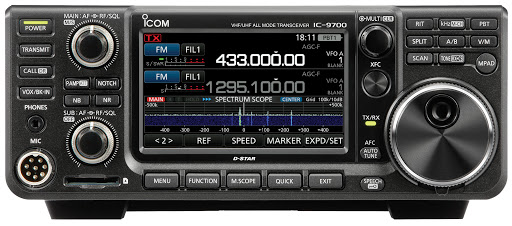
  • Base stations rigs that have both VHF and UHF (HF as bonus) and all mode. Only one – IC-9700 – is in production today.
  • Non Full Duplex smaller rigs with VHF/UHF that can be used mobile or as portable. The classic FT-817 and IC-705 are listed here.
  • Handheld (HT) FM VHF/UHF – only full duplex or that has special satellite functions. There are many VHF/UHF HTs but very few are of interest for satellite use as they are not full duplex.
  • Mobile FM stations VHF/UHF – only full duplex or that has special satellite function.

Full Duplex All Mode Base Station VHF/UHF transceivers

NameWeight (kg)In production?Note
IC-820/8215.0No
IC-910/9114.5No
IC-97015.0No
IC-97004.7YesD-Star, SDR
IC-910011.0NoAlso HF
TS-7909.2No
TS-20007.8NoAlso HF
FT-736R9.0No
FT-8477.0NoAlso HF

Mobile or Portable All Mode VHF/UHF transceivers
(not full duplex, all has HF except IC-905)

NameWeight (kg)In production?Note
HS2<1NoSDR. Also rebranded by others.
IC-706MKIIG2.45No
IC-70002.3No
IC-71002.7 (with front panel)No
IC-7051.1YesD-Star, SDR, Battery
See our posts about IC-705
IC-9050.94 (controller)YesVHF/UHF/SHF 
Interface based on IC-705.
No HF.
FT-817/8181.17YesBattery
FT-100D3.0No
FT-8572.1No
FT-8973.9No
FT-9914.3Yes
FTX-1F1.25YesPortable with battery.

Handheld (HT) FM VHF/UHF
(only full duplex HTs or HTs that has special satellite functions and only in production)

NameIn production?Full duplex?Note
Anytone AT-D890UVYesYesFull duplex, doppler correction and sat tracking
KG-UV8DYesYesProbably same desense as KG-Q332
KG-UV9PYesYesProbably same desense as KG-Q332
KG-Q332YesYesTested: Has some desense on UHF with TX with 5W on VHF
VGC N76
BTech UV-Pro
YesNoDoppler correction via APP. Note: not full duplex
AnyTone
AT-D878UVII
YesNoDoppler correction and sat tracking. Note: not full duplex
Kenwood TH-D72NoYesClassic Full Duplex HT. Yes I know it is not production but it is still one of the most used for sats.

Mobile FM VHF/UHF
(only full duplex or that has special satellite functions and only in production)

NameIn production?Full duplex?Note
VGC N7600YesNoDoppler correction via APP. Note: not full duplex
Wouxun KG-UV980PYesYes
Retevis MA1YesYes
Yaesu FTM-300DEYesYes
Yaesu FTM-310YesYes
Yaesu FTM-150RYesYesReported RX problem see this demo
Yaesu FTM-510RYesYesReported RX problem see this demo
Icom IC-2730YesYes
Icom ID-5100YesYes
Icom ID-5200SoonYesWifi, Bluetooth