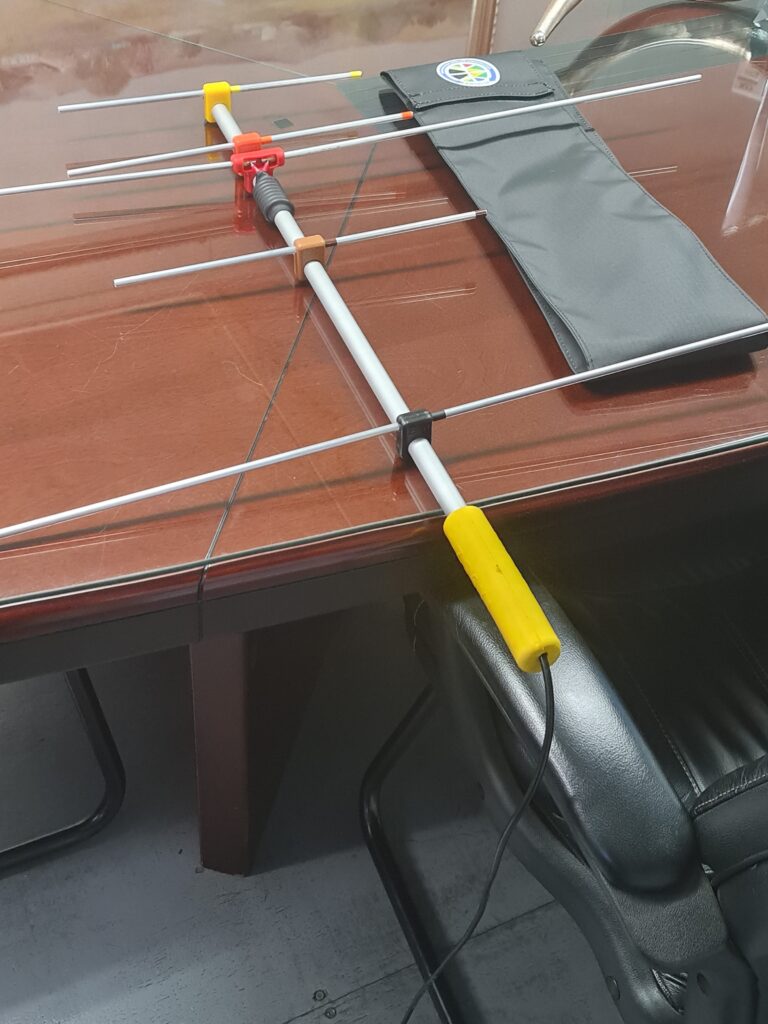
AMSAT SA has launched Mark II of its dual band 70 cm/2 m handheld beam antenna with a new, easier to hold handle and improved coaxial terminations. The Yagi has been retuned for maximum performance in the amateur radio 2 m and 70 cm satellite bands. The coax cable is terminated crimped brass lugs instead of being soldered making it environmentally more robust. The driven element has been adjusted to accommodate the change in the connection. More about the Yagi. The antenna has a 50-ohm designed driver. The Yagi has a unique element called an ‘Open Sleeve’ which is a director very close to the driven element. The driven element is sized for 2 m. When operating on 70 cm the ‘Open Sleeve’ acts as part of the driven element on 70 cm (the third harmonic of 2 m).
The original concept was developed in 1946 by Dr J T Bolljahn of the Stanford Research institute but was not introduced into amateur radio until the 1950s. The AMSAT SA version is based on a design by DK7ZB with modifications by WB5CXC. The first South African version was a collaboration between Guy Eales, ZS6GUY and Gary Immelman, ZS6YI. It was developed for YOTA 2018 where young people successfully used the antenna operating satellites using hand-held transceivers.
The mechanical structure was redesigned by Gary Immelmann ZS6YI. A choke around the boom was added to isolate the antenna from the coax and reduce the effect human contact has on the antenna. A handle was added on the boom end which makes it more comfortable to hold and further isolates the antenna from the handler. The AMSAT SA Yagi is manufactured in one of Gary Immelmann’s factories in Vereeniging. It has two elements on 145 MHz and 3 elements on 435 MHz.
For its size, the antenna has excellent gain: 145 MHZ: 4.12 dBd or 6.3 dBi and 435 MHz: 6.23 dBd or 8.4 dBi. The Yagi is broadband with measured SWR being almost flat over the entire bands. The antenna is plug and play, no tools are needed except for soldering on a connector to suit the application. It comes complete in a carry bag with full instructions. This antenna can be assembled and dissembled in minutes. The price of the MKII Yagi is R400 for AMSAT SA and SARL members. Non-members pay R500 (approximately $36.75 US). The courier charge is R120 (approximately $9 US, Postnet to Postnet). Ask for a quote for other courier options. Find more details and order forms on http://www.amsatsa.org.za/
Daniel Ekman SA2KNG @knglaser has been working with integration of gr-satellites in SatNOGS client. The installation process is described at Daniels GitHub: https://github.com/kng/satnogs_gr-satellites
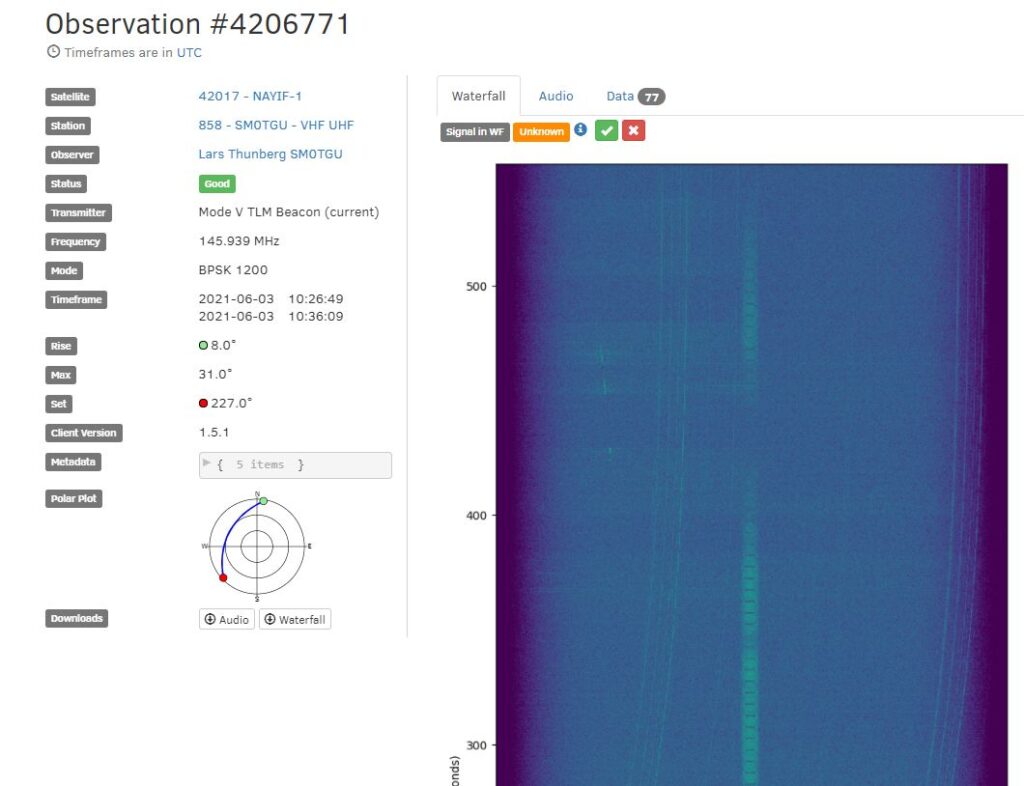
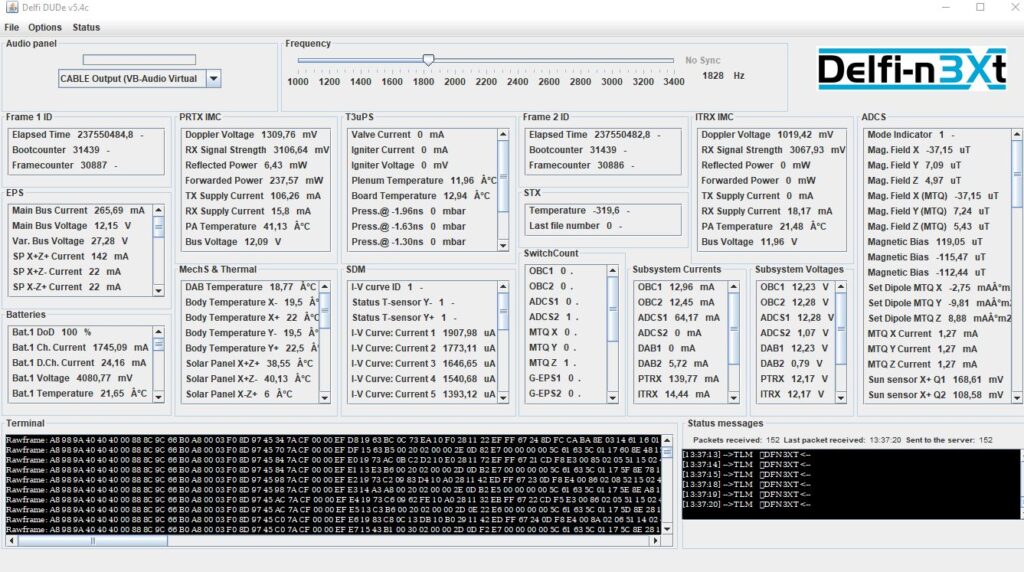
I have followed the manual installation instructions and it worked with any problem (a minimal knowledge of Linux is recommended). Below you can see a SatNOGS decode from my station that has been processed by the gr-satellites integration.
This is a great add-on for the SatNOGS station/network! Nice work Daniel!