Categories
Ham Satellite news

AMSAT-NA Announces GOLF CubeSat Program

Nytt spännande projekt från AMSAT-NA med målet att skicka upp Cubesats i högre bana än LEO:

AMSAT News Service Special Bulletin 301.01
From AMSAT SYMPOSIUM, RENO, NV
DATE October 28, 2017
To All RADIO AMATEURS
BID: $ANS-301.01

At the AMSAT-NA Annual General Meeting in Reno, NV, AMSAT-NA President
Joe Spier, K6WAO, announced the next phase of AMSAT’s CubeSat program:
GOLF. GOLF, an acronym for “Greater Orbit, Larger Footprint,” is a
crucial step towards fulfilling AMSAT’s strategic goals involving high
altitude, wide access satellite missions.

As an initial step in the GOLF program, the AMSAT-NA Board of
Directors approved the submission of a NASA CubeSat Launch Initiative
proposal for the GOLF-T satellite project. The GOLF-T project will
serve as a rapidly deployable Low Earth Orbit (LEO) testbed for
technologies necessary for a successful CubeSat mission to a wide
variety of orbits, including LEO, Medium Earth Orbit (MEO),
Geosynchronous Orbit (GEO), Highly Elliptical Orbit (HEO), or beyond.

AMSAT-NA Vice-President Engineering Jerry Buxton, N0JY, said “The
GOLF-T project tees off the next phase of our CubeSat program. GOLF-T
provides AMSAT hardware and knowledge for Attitude Determination and
Control (ADAC) capability and the opportunity to develop a 3U
spaceframe with deployable solar panels that can be used in LEO or HEO
missions, two of the major systems required in future GOLF and HEO
missions.”

In addition, GOLF-T provides the opportunity for rapid deployment and
on orbit testing of the AMSAT’s Advanced Satellite Communications and
Exploration of New Technology (ASCENT )program’s technology, including
radiation tolerant transponder and Integrated Housekeeping Unit (IHU)
technologies that will lead the way for low cost commercial
off-the-shelf (COTS) systems that can function in the MEO and HEO
radiation environments. GOLF-T will also provide for the development
of “Five and Dime” Field-Programmable Gate Array Software Defined
Radio (FPGA SDR) transponders for use on a variety of missions and
orbits.

[ANS thanks the AMSAT-NA Board of Directors and our Engineering Team
for the above information]

Categories
Ham Satellite news

ESA Academy

Via SM5SRR/Eskil kommer denna information:

Dreaming of flying a satellite into space but not sure how? Wonder no more! The ESA Education Office and ESA’s Systems and Concurrent Engineering Section have the perfect workshop for you. We are currently looking for university students who would like to participate in ESA Academy’s  first  Concurrent Engineering Workshop dedicated to CubeSats. The 4-day workshop will be organised between 16 and 19 January 2018 at the Training and Learning Centre in ESEC, Belgium.

Läs mer på ESA hemsida

Categories
Ham Satellite news

AMSAT-UK Colloquium presentationer 2017

Har du några minuter (timmar?) över så kan du se videopresentationer från AMSAT-UK årsmöte:

AMSAT-UK YouTube Channel Updated with 2017 Colloquium Recordings

AMSAT-UK has begun uploading recordings of all talks from the 2017
Colloquium, October 14-15 to the AMSAT-UK YouTube Channel:
https://www.youtube.com/user/AMSATUK

Some of the videos have already been uploaded; refresh your screen
occasionally to to catch additional 2017 Colloquium uploads.

2017: An introduction to Amateur satellites – David Johnson, G4DPZ and
Carlos Eavis G3VHF
https://www.youtube.com/watch?v=1Tj2rUsNpPs&t=1039s

2017: Es’hail-2 Geostationary Amateur Satellite – Peter Guelzow DB2OS
(AMSAT-DL)
https://www.youtube.com/watch?v=L67pza0hCZw

2017: The Goonhilly project (aka playing with big boys toys) – Noel Matthews
G8GTZ
https://www.youtube.com/watch?v=xzrcLFFEq74

Categories
Ham Satellite news

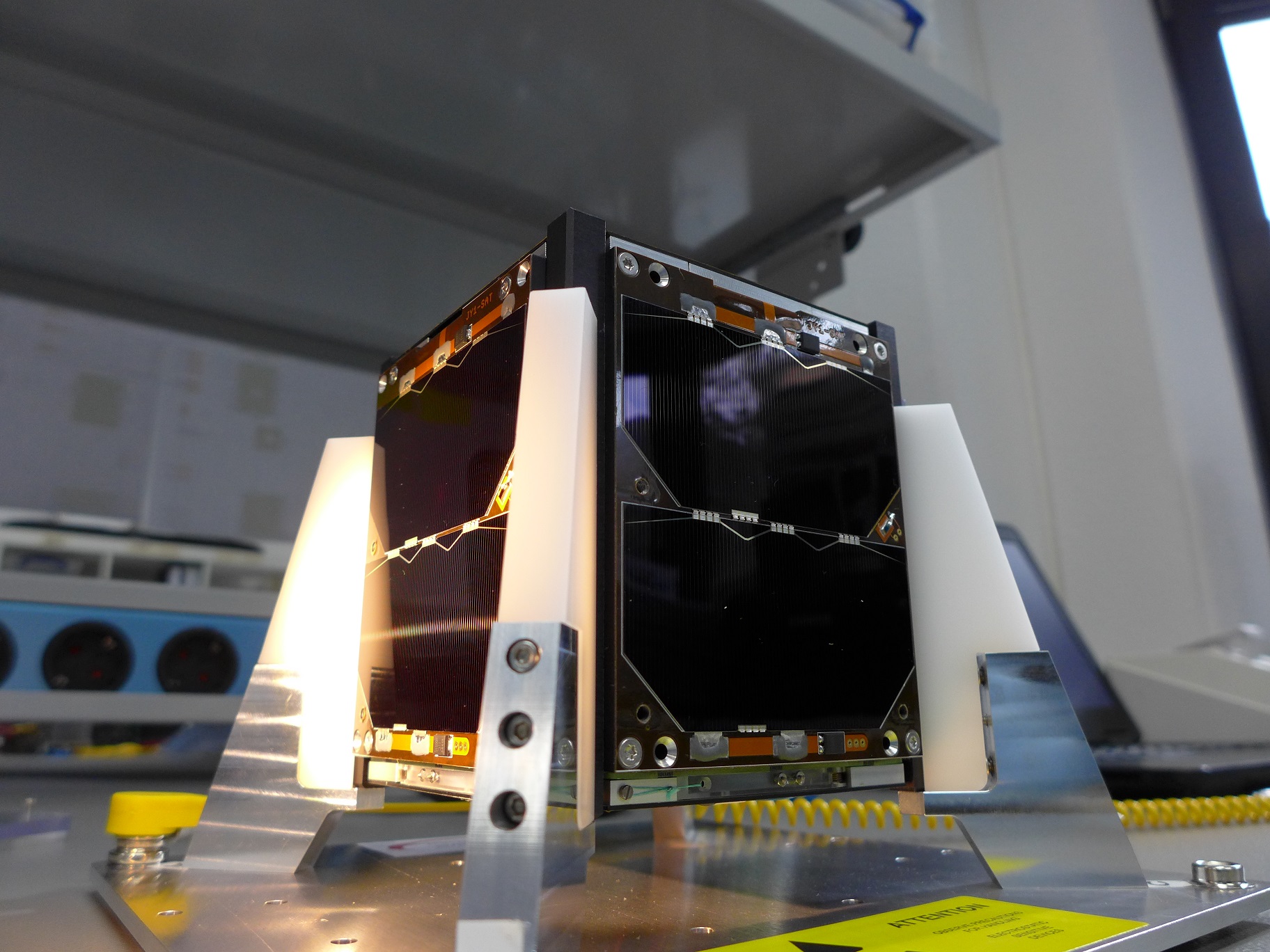
Information om JY1-SAT

Nu finns mer information om JY1-SAT som är Jordaniens första satellit. Intressant för oss radioamatörer är att det finns en FUNCube ombord dvs. samma system som tex. AO-73. Det är ett samarbete med AMSAT-UK och AMSAT Nederländerna.

Glädjande är att det blir en linjär transponder nerlänk mellan 145.855 & 145.875 MHz och uplänk mellan 435.100 & 435.120 MHz. Telemetry downlink på 145.840MHz.
Info nedan från FUNCubes hemsida.


During the final satellite integration training for Jordan’s first satellite, JY1-SAT, the team was supported for the final stages of integration by His Royal Highness Crown Prince Al Hussein bin Abdullah II. The spacecraft has been given to students of the Masar Initiative at the Jordan University of Science and Technology as part of the JY1-SAT mission support and training program under the Crown Prince Foundation given by ISIS – Innovative Solutions In Space and AMSAT UK and AMSAT Netherlands,.

The JY1-SAT mission was proposed by Jordanian students who participated in the first batch of the cooperation program with NASA, after which the interns had suggested the design and launch of the first Jordanian satellite CubeSat.

To build up the capability to design and develop such a first mission, the Crown Prince Foundation signed a support agreement with ISIS – Innovative Solutions In Space and the AMSAT Radio Amateur Societies of the UK and the Netherlands, for hardware and training support, building on ISIS’ and AMSAT’s experience with FUNcube radio amateur transponder missions.

As a special development for the JY1-SAT mission, AMSAT has expanded the capabilities of the FUNcube transponder to be able to transmit stored images reflecting the Jordanian culture and its historical heritage, along with a voice message recorded by the Crown Prince to be transmitted in space to receivers around the world.

The launch of the JY1-SAT, scheduled during the first half of next year, is in memory of His Majesty the late King Hussein, the first founder of the HAM Radio in Jordan and holder of call sign JY1.

JY1-SAT will have a linear, inverting, transponder downlinking between 145.855 & 145.875 MHz with the uplink between 435.100 & 435.120 MHz. The telemetry downlink will be on 145.840MHz and be FUNcube compatible. A new Dashboard will be made available before the launch of JY1-SAT

Categories
Ham Satellite news

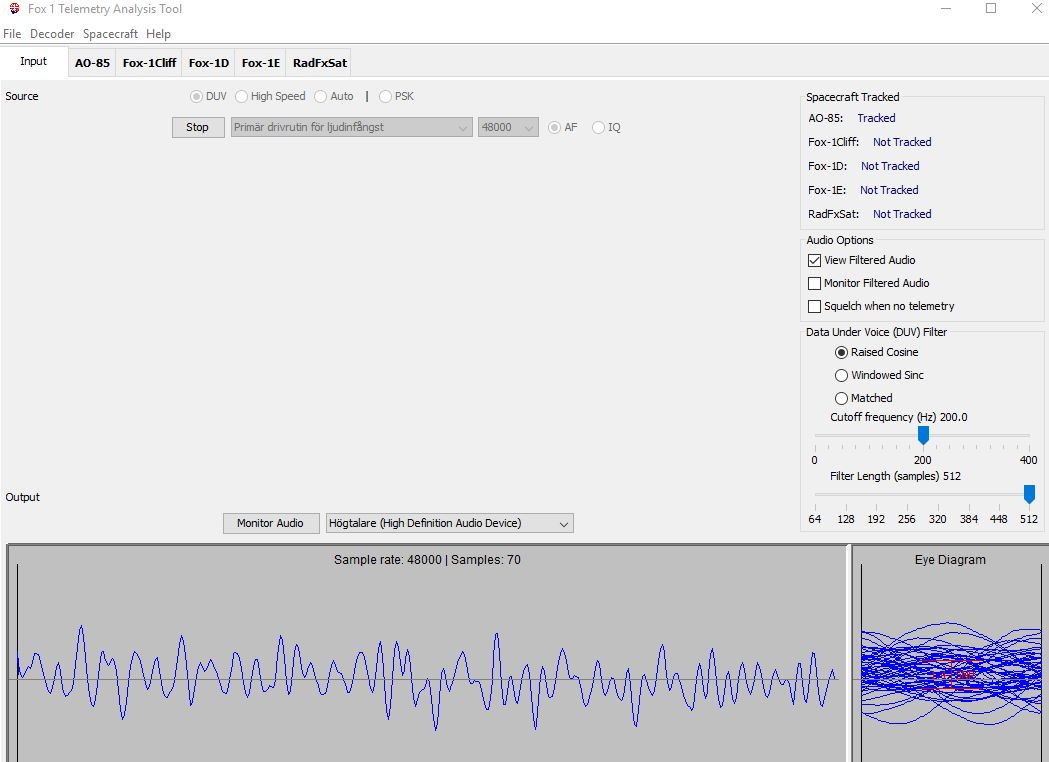
FoxTelem v1.05 Released

Senaste programvaran för telemetrimottagning av Fox-satelliterna finns nu tillgänglig:

FoxTelem v1.05 Released

Categories
Ham Satellite news

RadFxSat/Fox-1B info inför uppskjutning

Viktig information runt uppskjutningen av RadFxSat/Fox-1B den 10:e november 2017:

AMSAT Vice-President Engineering, Jerry Buxton, NØJY wrote what to
initially expect when the AMSAT RadFxSat/Fox-1B cubesat is launched
as a passenger on NASA’s ELaNa XIV mission on Friday, Nov. 10, from
Vandenberg Air Force Base, California.

Liftoff will be aboard a United Launch Alliance Delta II rocket from
Space Launch Complex 2 and is targeted for 1:47 a.m. PT (4:47 a.m. ET,
9:47 am UTC) at the opening of a 65-second launch window. Launch cov-
erage will begin on NASA Television and the agency’s website at
1:15 a.m. PT.

RadFxSat/Fox-1B will automatically come up in Beacon Mode, transmitting
a beacon and voice ID (Veronica saying “RadFxSat Safe Mode”) every two
minutes, starting about 50 minutes after deployment. The AMSAT command
stations will want to see voltage and current data to determine that
it’s healthy and conduct various tests before opening it up for general
use.

Telemetry makes the engineering and operations teams very happy,
starting ASAP after startup (~55 minutes after deployment) and for
the next 72-96 hours at least as we look for successful startup, watch
the general health and function as the satellite begins to acclimate
to space, and perform the on orbit checkout. Ground stations are also
invited to continue uploading received telemetry for the life of the
satellite.

If you are capturing telemetry with FoxTelem please be sure that “Upload
to Server” is checked in your settings, and your Ground Station Params
are filled in as well. You can help AMSAT and everyone waiting to get
on the air with RadFxSat tremendously, by capturing RadFxSat telemetry.

In the initial Beacon Mode, the transmitter is limited to 10 seconds on
time then does the two minutes off cycle as Paul pointed out. For those
of you capturing telemetry, that means that you will only see Current
frames and no High or Low frames because the High and Low are truncated
as it takes just over 10 seconds to send two frames. Veronica may also
be cut off before she gets to say her whole ID string. If Veronica is
speaking, “RadFxSat Fox-1B Safe Mode” which is the full ID, if it’s cut
off then we’re still in Beacon Mode. If we are seeing good data from
user telemetry data, it is likely when it comes over the U.S. for the
first good pass we will command it from Beacon Mode to normal Safe Mode,
which then puts RadFxSat in full (still Safe Mode though) operation and
transmits a full two frames of telemetry which is one Current frame
followed by, and alternating each ID cycle, a High or a Low frame.
Veronica now has time to make the whole ID announcement, in Safe Mode.

YOUR HELP IS NEEDED!
——————–
Jerry, NØJY commented further …

Help your friends and all of our satellite ham friends get on the air
and have fun sooner by being polite and patient!

The on orbit checkout procedure is similar to Fox-1A/AO-85 and could
be completed in as little as a few days if we have the cooperation of
the users. It is very important, not to mention just plain good Amateur
Operating Practice, to refrain from using the transponder uplink so we
can do the on orbit tests, including when we turn on transponder mode
for testing. I can’t stress enough, the importance of this cooperation
not just for us but for all users, simply having a little patience so
we can conduct the tests as quickly and accurately as possible.

AMSAT will make it broadly known when the tests are complete and the
transponder is available for all to use. If you hear someone on the
transponder, please don’t assume that it is open for general use –
check the AMSAT website, Facebook, Twitter, to be sure you’re not
accidentally jumping in with and unwittingly interfering with the
commissioning process.

Lots of hams put thousands of volunteer hours of their time into making
RadFxSat happen. Just like any ham radio project you might undertake,
we build satellites. We do it because we like to, and when we’re done
we freely share our project with hams everywhere as is the spirit of
amateur radio.

I am asking all satellite hams to contribute just a little bit of your
time to the fun now, by being patient and just gathering telemetry,
not using the transponder uplink, and helping us complete the last few
days of getting RadFxSat in orbit and operating for all of you.

Thank you very much, see you on the bird!