Rapporteras att transpondrarna har aktiverats. Stark nedlänk.
Frekvenser
se även:
se även:
Med vänlig hälsning Håkan
 AMSAT-SM - Official Website of AMSAT-SM Sweden
Här finner du nyheter om amatörradiosatelliter från hela världen.
Varios ham radio satellites news.
På PE1ITR hemsida finns en presentation från AMSAT-DL årsmöte med en del intressanta bilder och information om Es’Hailsat. Använd Google translate om du inte kan holländska 🙂
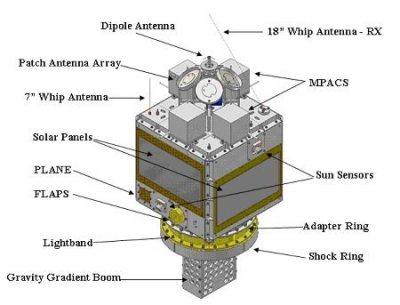
Falconsat-3 som sköts upp 2007 har nu gått över till amatörradiobruk. Tyvärr kan vi inte höra den i Sverige pga. dess bana men stor aktivitet rapporteras på Twitter.
Falconsat-3 is Now Open for Amateur Radio Use

The Air Force Academy satellite Falconsat-3 is now open for amateur
radio use as a digital store-and-forward system. FalconSAT-3 was
built in 2005 and 2006 by cadets and faculty in the Space Systems
Research Center at the US Air Force Academy in Colorado Springs, CO,
and launched in 2007 on an Atlas V.

After serving in scientific and training roles, the Academy has
now made the satellite available for Amateur radio use.

The satellite is in a 35.4 degree inclination orbit, with an
approximate altitude of 465 to 476 km. The Packet Bulletin Board
System is operating at 9600 baud with a 145.840 uplink, and
435.103 downlink. Output power is 1 watt, and the downlink is con-
tinuously on. Digipeating is enabled for live QSOs, but unattended
digipeating operations is not authorized at this time. Current
Keplerian elements can be found in the AMSAT distributed Keplerian
elements.

More information can be found at https://www.amsat.org/falconsat-3/
and further operational inquiries should be directed to AMSAT Vice
President Operations, Drew Glasbrenner, KO4MA (ko4ma@amsat.org).

[ANS thanks AMSAT Vice President Operations, Drew Glasbrenner, KO4MA for the
above information]
English summary below!
Wisnu YB0AZ skickade lite information och en video till AMSAT-SM om deras contest via satelliten IO-86:
The LAPAN A2, also known as LAPAN-ORARI, was launched on September 28th 2015.
It carries a payload of amateur radio FM voice repeater and an APRS digipeater for radio amateur communications.
After launch, it received the designation IO 86 or Indonesia-OSCAR 86.
This satellite also carries an AIS (Automatic Identification System) to identify the ships and a video camera with a range three times wider than the previous Lapan satellite (Lapan Tubsat).
The IO86 satellite orbit the Earth along the equator with an altitude of 650 kilometers, and travel at 7.5 kilometers per second – enabling it to circle the Earth 14 times a day.
To celebrating its 2 years anniversary, the Indonesian National Institute for Aeronautics and Space (LAPAN) and the Indonesian Amateur Radio Organization (ORARI) make some events.
One of the event is the radio amateur communications contest via the IO86 satellite during 22 September 2017 08:00 UTC until 24 September 2017 17:00 UTC.
The exchanges are RS + Grid Locator.
The calculation of points is based on how many QSOs you can made and how long the distance that you can reach through the IO86 satellite.
We called it the World’s First Equatorial Amsat Contest because as we knew it’s the first contest in the world via the Equatorial amateur satellite.
That’s my explanation Felix and please don’t hesitate to email me if you have more questions.
73 de Wisnu YBØAZ
 . Jag delade själv ut DXCC nummer 41 via FO-29 till UX0FF i helgen, efter att han jagat en månad på satelliterna. Det är ett flertal jänkare på USA:s östkust som vill köra CW/SSB på AO-7 på längre avstånd. (Även FO-29 går bra.)
Members of the Russian Robinson Club (RRC) continue planning for
their next Arctic operation. Look for RI1F to be active from
Victoriya Island (EU-190). They plan to leave Murmansk around
September, 27. They are expected to operate between October 1-7.
This island group has never been activated before. These islands
also count for DXCC purposes as Franz Josef Land.
Activity will be on 160-10 meters, including the WARC bands,
VHF and UHF. Operations will be on CW, SSB, the Digital modes,
EME (dates are October 3-7) and the satellites.
They plan to operate from two different sites (one HF and EME;
one VHF/UHF). The complete break down can be see on QRZ.com.
Currently, 12 operators have been named: Igor/UA9KDF (Team leader),
Yury/ UA9OBA (RRC President), Andrey/UA9LDD (CW op), Valery/UA0ZC
(CW/SSB op), Vladimir/R9LR (SSB/CW op), Sergey/UA9KB (CW op),
Artemy/UA9KAM (Photo, video, SSB op), Andrey/RT9K (Mechanic,
cook, SSB op), Victor/RW0BG (CW/SSB op), Mikhail/UA1QV (CW/SSB op),
Valery/RA9J (CW/SSB op) and Vladimir, son of UA9LDD; CW/SSB op).
The Pilot station is Igor, RA3CQ. QSL via ClubLog’s OQRS or by
the Bureau. QSL Manager is Alexandr, RX9KM. Watch QRZ.com for updates.
Their Web page is still under construction at: http://legendsarctic.com
John Papay, K8YSE, sent advice to amateur satellite operators in
the northeastern section of North America that Nikolay, UX0FF,
is looking skeds via AO-7. John wrote, “He is an accomplished
operator and worked satellites years ago. He is an active EME
operator and has WAS on 2M. His grid square is KN45kj.”
Skeds can be arranged via e-mail using the address listed on
Nicolay’s QRZ.com page.
On September 17 KB1RVT and UX0FF completed a QSO on AO-7. This
was Nikolay’s first satellite contact with the USA. Nikolay is
still looking for others to work in North America.
Paul, N8HM offers additional pointers in regard to operating via
AO-7 that the satellite has been observed to have been reliably
in Mode B for the past several days.
For the past several months, AO-7 has had a tendency to flip from
Mode B to Mode A even in the presence of only modest uplink sig-
nals, likely due to poor illumination on the solar panels. As
the seasons have progressed, it appears that the illumination
situation has improved. Get on and make some QSOs! This would
be a particularly good time to set up skeds for extreme range
QSOs.
According to DK3WN’s illum software, from October 15th through
November 21st, AO-7 will be in constant sunlight. During this
period, the 24 hour timer will function and the satellite will
spend 24 hours in Mode B then 24 hours in Mode A. Get those 10
meter antennas ready!
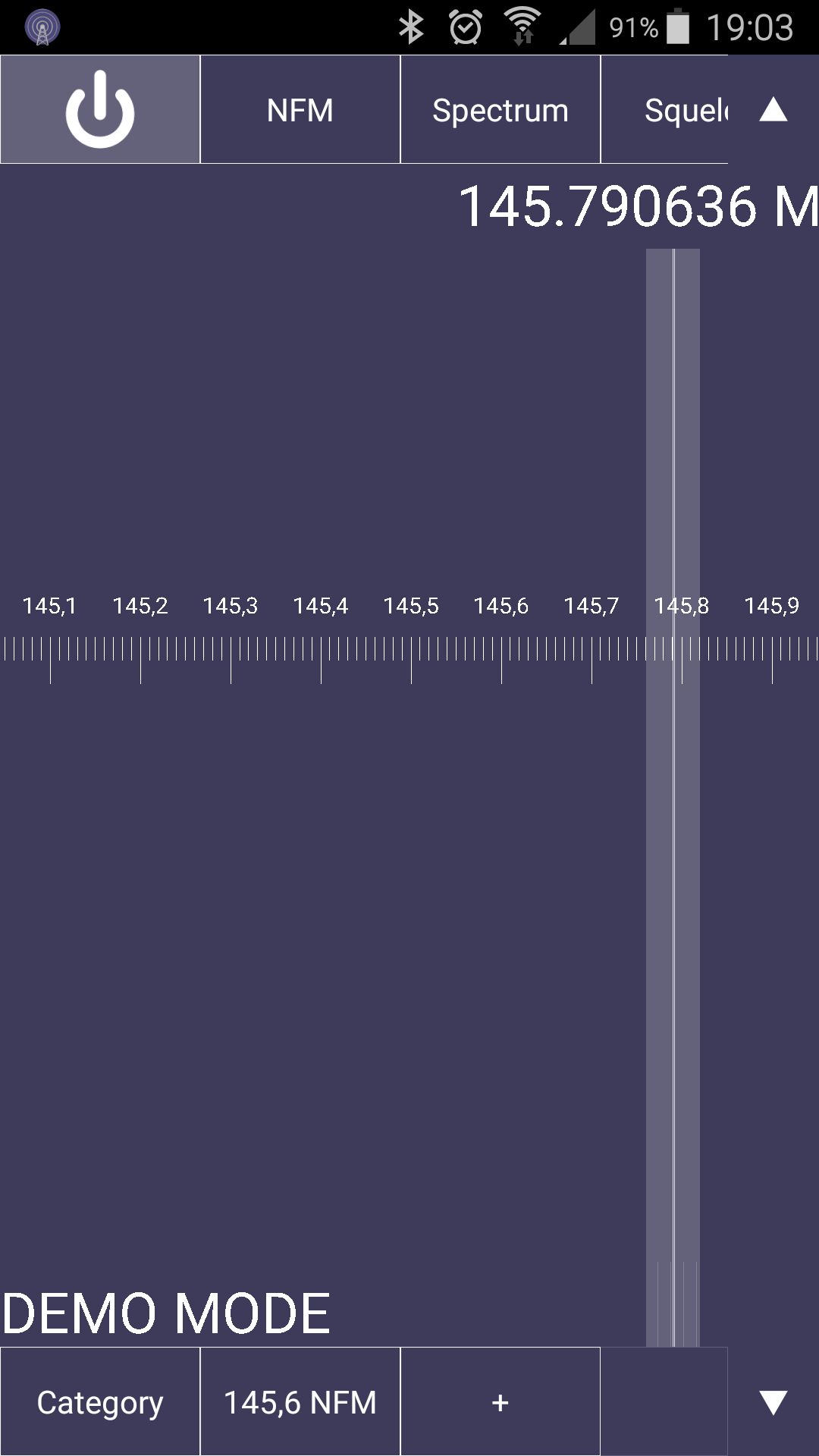
In order to have a full duplex portable satellite station you must have two transceivers or one transmitting rig, like the FT817ND, and one receiver. But how about using your mobile Android phone and a RTL-SDR dongle? I have tested SDRTouch with my Samsung Galaxy 5 and a RTL-SDR.com V3.
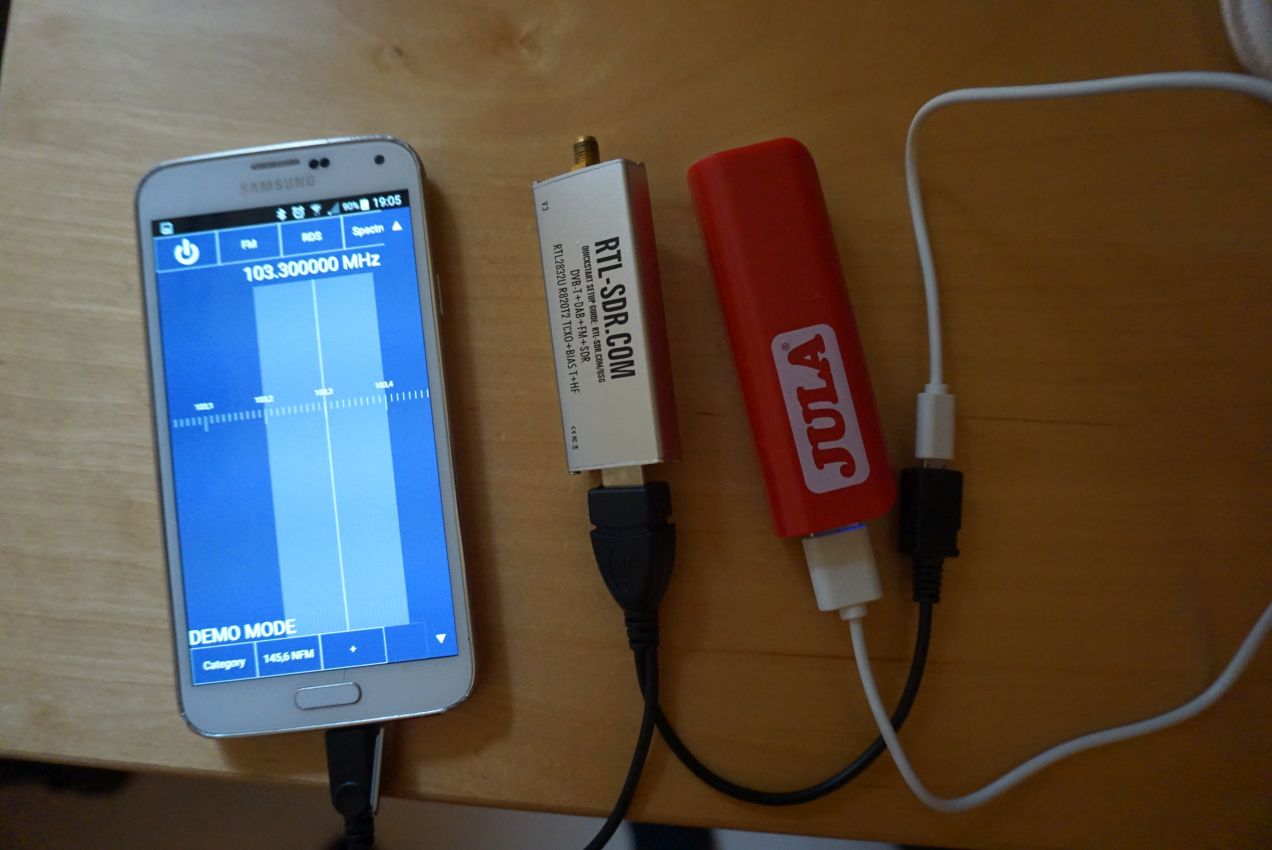
I also needed an OTG-cable with extra power jack (1 US$ on eBay) as my phone could drive the RTL by itself. The red little box is a USB Power Bank that powers the SDR.
And yes, it works… kind of. Installation of SDRTouch is very simple and after downloading drivers for the RTL-SDR everything works without any configuration.
But this is not a solution for me. Too much cables hanging around and the navigation in SDRTouch is not so easy. So I will try some other solution, probably a Windows 10 Tablet. Stay tuned for updates…