Categories
Ham Satellite news

Satellite config files moved to Github

Different configuration files for SDR Console and IC-705 has now moved to SM0TGUs Lars Thunberg Github at: https://github.com/LarsThunberg/SatelliteConfigurationFiles

The link in the following posts about how to use the files are now direct links to Github:

Categories
Antennas Ham Satellite news

AMSAT SA Dual Band 70cm/2M Yagi Mark II

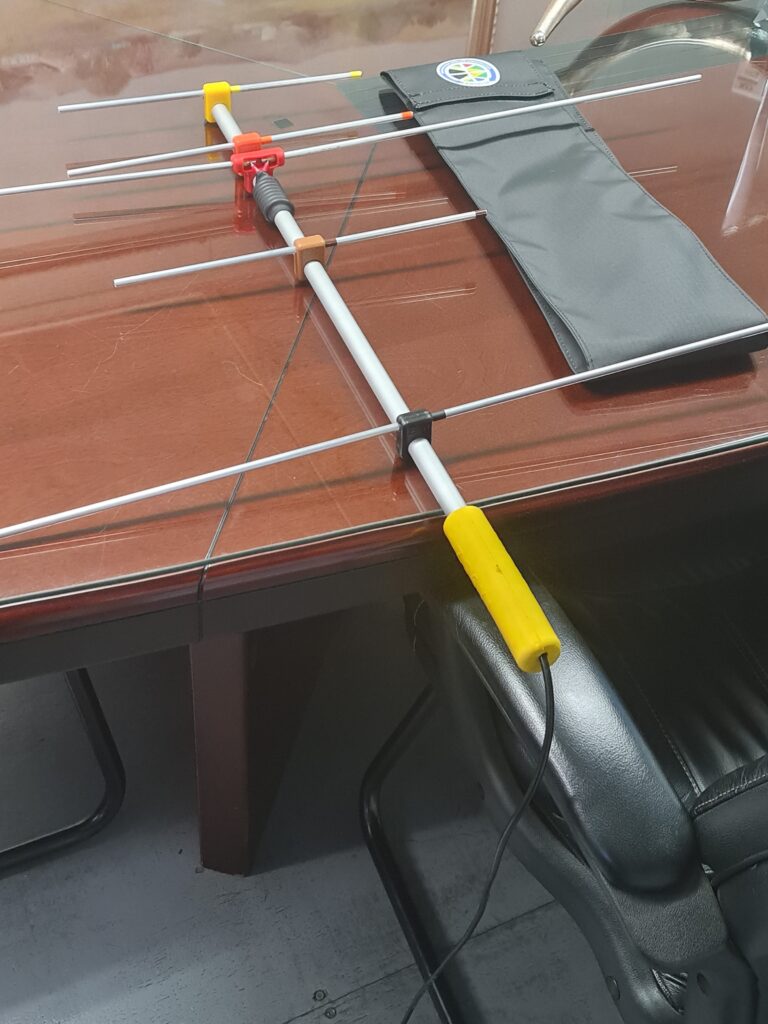
AMSAT SA has launched Mark II of its dual band 70 cm/2 m handheld beam antenna with a new, easier to hold handle and improved coaxial terminations. The Yagi has been retuned for maximum performance in the amateur radio 2 m and 70 cm satellite bands. The coax cable is terminated crimped brass lugs instead of being soldered making it environmentally more robust. The driven element has been adjusted to accommodate the change in the connection. More about the Yagi. The antenna has a 50-ohm designed driver. The Yagi has a unique element called an ‘Open Sleeve’ which is a director very close to the driven element. The driven element is sized for 2 m. When operating on 70 cm the ‘Open Sleeve’ acts as part of the driven element on 70 cm (the third harmonic of 2 m).

The original concept was developed in 1946 by Dr J T Bolljahn of the Stanford Research institute but was not introduced into amateur radio until the 1950s. The AMSAT SA version is based on a design by DK7ZB with modifications by WB5CXC. The first South African version was a collaboration between Guy Eales, ZS6GUY and Gary Immelman, ZS6YI. It was developed for YOTA 2018 where young people successfully used the antenna operating satellites using hand-held transceivers.

The mechanical structure was redesigned by Gary Immelmann ZS6YI. A choke around the boom was added to isolate the antenna from the coax and reduce the effect human contact has on the antenna. A handle was added on the boom end which makes it more comfortable to hold and further isolates the antenna from the handler. The AMSAT SA Yagi is manufactured in one of Gary Immelmann’s factories in Vereeniging. It has two elements on 145 MHz and 3 elements on 435 MHz.

For its size, the antenna has excellent gain: 145 MHZ: 4.12 dBd or 6.3 dBi and 435 MHz: 6.23 dBd or 8.4 dBi. The Yagi is broadband with measured SWR being almost flat over the entire bands. The antenna is plug and play, no tools are needed except for soldering on a connector to suit the application. It comes complete in a carry bag with full instructions. This antenna can be assembled and dissembled in minutes. The price of the MKII Yagi is R400 for AMSAT SA and SARL members. Non-members pay R500 (approximately $36.75 US). The courier charge is R120 (approximately $9 US, Postnet to Postnet). Ask for a quote for other courier options. Find more details and order forms on http://www.amsatsa.org.za/

[ANS thanks AMSAT SA for the above information]

Categories
Ham Satellite news

SatNOGS gr-satellites integration

Daniel Ekman SA2KNG @knglaser has been working with integration of gr-satellites in SatNOGS client. The installation process is described at Daniels GitHub:
https://github.com/kng/satnogs_gr-satellites

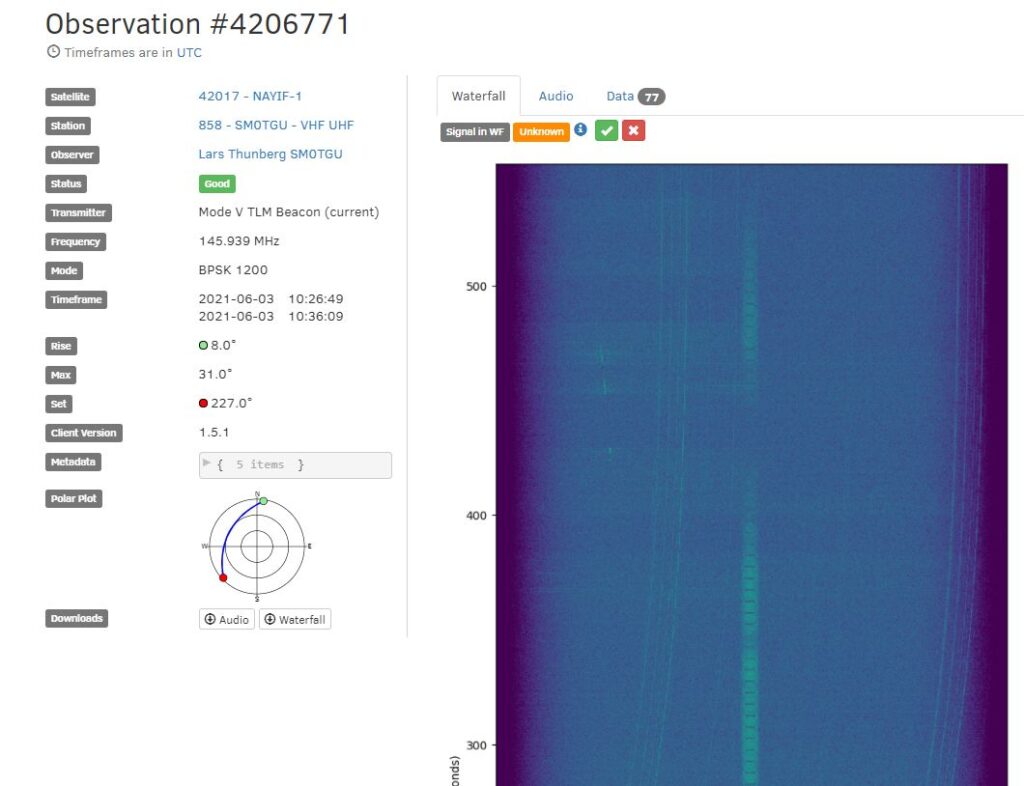
I have followed the manual installation instructions and it worked with any problem (a minimal knowledge of Linux is recommended). Below you can see a SatNOGS decode from my station that has been processed by the gr-satellites integration.

This is a great add-on for the SatNOGS station/network! Nice work Daniel!

Categories
Ham Satellite news

New DTMF mode on PSAT2

From ANS-122: PSAT2 (NO-104) VHF is alive and new DTMF mode:

Bob Bruninga writes: PSAT2 VHF awoke from an 8 month slumber on 26 Apr 2021. We have no idea why. Its telemetry looks fine. Volts between 6.2 and 7.0 volts (5 NiCds). Exterior temps between -18 and +22 C. See
http://aprs.org/psat2.html

PSAT2 will NOT be in APRS mode but a brand new experimental mode for DTMF uplink and VOICE downlink. So you preload your grid and callsign into a 16 digit DTMF memory in your radio and when the satellite hears this it will assign a QSO number and QSL the grid by voice and then also generate an APRS packet for collection by APRS operators. There is even a way to send back a DTMF QSL so you can make it a 2-way DTMF. contact. Successful DTMF grids and messages will appear on a special URL on the PSAT2 page (above). To QSL, you key in that stations 2 digit QSL number and then dump your pre-loaded QSL DTMF message.
Since this is the first time this transponder is on the air and because a
DTMF uplink takes maybe 4 seconds, we don’t want the uplink saturated by a bunch of newbees initially until we see if it actually works. So read the
docs and be sure you know what you are doing. There is a user operating manual available on the PSAT2 web page:
http://aprs.org/psat2.html

[ANS thanks Bob Bruninga, WB4APR for the above information]

Categories
Ham Satellite news

Inactive satellites removed from TLE distribution

The following satellites, marked as inactive, have been removed from this AMSAT-NA TLE Distribution as of April 8 2021. The source is from ANS-101.
A note regarding GRIFEX: according to PE0SAT it is still active.

TISAT – NORAD Cat ID 36799
JUGNU – NORAD Cat ID 37839
AO-71 – NORAD Cat ID 37854
HORYU-2 – NORAD Cat ID 38340
BEESAT-3 – NORAD Cat ID 39135
BEESAT-2 – NORAD Cat ID 39136
TRITON-1 – NORAD Cat ID 39427
DUCHIFAT-1 – NORAD Cat ID 40021
NANOSATCBR1 – NORAD Cat ID 40024
ANTELSAT – NORAD Cat ID 40034
VELOX-1 – NORAD Cat ID 40057
DAURIA DX 1 – NORAD Cat ID 40071
CHUBUSAT-1 – NORAD Cat ID 40300
QSAT-EOS – NORAD Cat ID 40301
GRIFEX – NORAD Cat ID 40379
DEORBITSAIL – NORAD Cat ID 40719
NUDT-PHONESAT – NORAD Cat ID 40900
LQSat – NORAD Cat ID 40958
OUFTI-1 – NORAD Cat ID 41458
Swayam – NORAD Cat ID 41607
AlSat 1N – NORAD Cat ID 41789
ScatSat – NORAD Cat ID 41790
Pegasus-1 – NORAD Cat ID 41846
UCLSat – NORAD Cat ID 42765
LituanicaSAT 2- NORAD Cat ID 42768

Categories
Ham Satellite news

RadFxSat-2 Signals Detected

Info from ANS-028:
RadFxSat-2 Signals Detected, AMSAT Engineering Continues to Assess
Status

On January 27th, Brad Schumacher, W5SAT, reported copying his CW
signal weakly via the RadFxSat-2 transponder. On the morning of
January 28th, AMSAT Engineering and Operations confirmed these reports and determined that RadFxSat-2 is partially functioning, though
signals are extremely weak. AMSAT thanks W5SAT for his report.

We also appreciate those who joined in determining whether they could
detect their own or other signals in recent passes today.

At this time it is essential and we ask you: Please do not attempt to
transmit through the transponder until further notice. This is very
important to the next steps we are taking now.

The next crucial step in evaluating the condition of RadFxSat-2 is to
determine whether or not the 1200 bps BPSK telemetry beacon is
operating and, if possible, copy telemetry from the beacon. We ask
that everyone with 70cm receive capability listen to the beacon
frequency of 435.750 MHz (+/-) Doppler, upper sideband (USB). Use
FoxTelem with your receiver in order to tune and capture any telemetry
you can. Also make sure FoxTelem is set to “Upload to server” so that
we receive your telemetry data. If you capture a good IQ recording on
SDR, please send a detailed description of your recording to
foxtelem@amsat.us. We may respond with a request for your recording
and details on how to transfer it to the AMSAT Engineering team.
Please understand that keeping the transponder clear is essential to
putting all power and attention to the beacon telemetry.

Two-line elements (TLEs) are available in AMSAT’s nasabare.txt
distribution at https://www.amsat.org/tle/current/nasabare.txt.
Available data suggests that RadFxSat-2 is OBJECT M from the Virgin
Orbit LauncherOne launch, NORAD ID 47320, international designation
21-002M.

We thank the amateur satellite community for their perseverance and
assistance while the AMSAT Engineering and Operations teams work to
understand and resolve the situation with RadFxSat-2.

[ANS thanks the AMSAT Engineering and Operations teams for the above information]