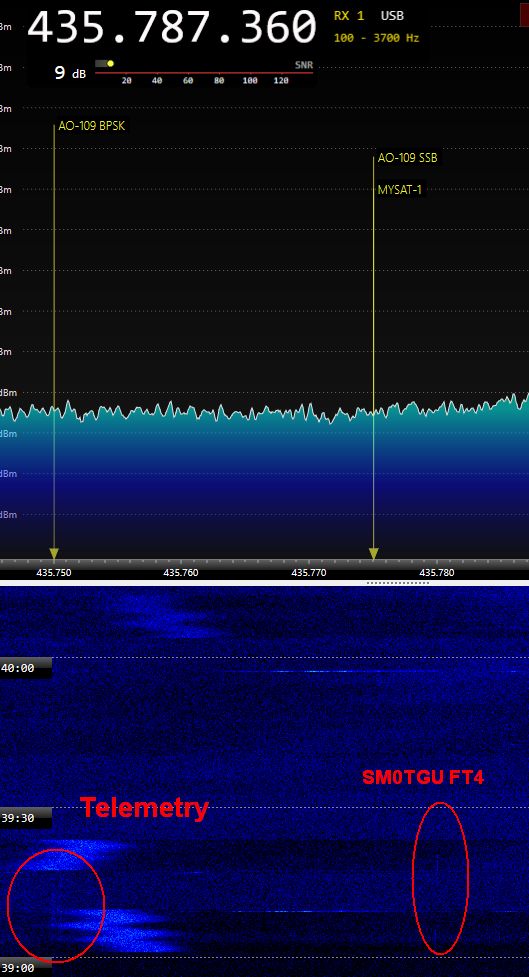
During a high elevation passage over Stockholm area I managed to copy a very weak fraction of the AO-109 telemetry and two weak spots of my own FT4 signals. The FT4-signal was too weak to be able to decode.
I was using a Airspy Mini with SDR-Console V3 with 2*6 el Vårgårda Yagi in RHCP or LHCP on the downlink.
On the uplink I was using a IC-705 with 10 watts output to a 13 el LFA UHF X-Yagi.
The AMSAT Engineering and Operations Teams are pleased to announce that AO-109 (RadFxSat-2/AMSAT Fox-1E) is now open for amateur use. Users are advised to use efficient modes such as CW or FT4 for making contacts, since issues with the satellite make SSB voice contacts challenging at best.
Please see the May/June 2021 issue (Vol. 44, No. 3) of The AMSAT Journal for an article by Burns Fisher, WB1FJ, and Mark Hammond, N8MH, detailing the various attempts to characterize AO-109 and its apparent problems.
On behalf of the Engineering and Operations Teams–
[ANS thanks AMSAT Vice President – Engineering Jerry Buxton, N0JY, and AMSAT Vice President – Operations Drew Glasbrenner, KO4MA, for the above information]
I am releasing version 1.11 of FoxTelem. This primarily supports new features needed for GOLF-TEE development and the CubeSatSim. If you are using FoxTelem in the lab or classroom then this release should be installed. It also fixes several bugs that will help with live decoding of AO-95. It is not a mandatory upgrade but it is recommended.
Specifically it addresses the following:
Fixes a bug where Costas decoding can stop if audio is being monitored
Supports all the latest features needed for the CubeSatSim
Better warnings for tracking and Find Signal errors
Supports all the latest GOLF-TEE layouts
Fixes a bug where strong signals may not be tracked correctly
Supports math expressions in telemetry conversions
Better handles USB device errors
You can download FoxTelem here: http://amsat.us/FoxTelem/windows/FoxTelem_1.11g_windows.zip http://amsat.us/FoxTelem/linux/FoxTelem_1.11g_linux.tar.gz http://amsat.us/FoxTelem/mac/FoxTelem_1.11g_mac.tar.gz
Feel free to reach out to me with questions or comments.
[ANS thanks Chris Thompson, G0KLA/AC2CZ, AMSAT FoxTelem Developer, for the above information]
Information from ANS-185: On June 22, 2021, MIR-SAT1 was deployed from the International Space Station by JAXA. MIR-SAT1 is a project of the Mauritius Research and Innovation Council and carries a digipeater and camera experiment. Further information is available at https://spacemauritius.com.
At the request of the Mauritius Research and Innovation Council, AMSAT hereby designates MIR-SAT1 as MIRSAT-OSCAR 112 (MO-112). We congratulate the owners and operators, thank them for their contribution to the amateur satellite community, and wish them a long mission and continued success on this and future projects.
ANS thanks Drew Glasbrenner, KO4MA, AMSAT VP Operations / OSCAR Number Administrator, for the above information.
And…
MIR-SAT1 has been identified as NORAD Cat ID 48868 as per Pierros Papadeas, SV1QVE and Nico Janssen, PA0DLO.
(Swedish only!) ny uppdatering av vår satellitstatus: Det är svårt att hänga med vilken status satelliterna har, och många av dem fungerar ibland och ibland inte…
Jag har testat följande satelliter själv, dvs. hört mig själv på nerlänken, och då använt max 10 watt på upplänken: