Categories
Ham Satellite news

Amateur Radio Contest for Receiving PW-Sat2 Telemetry

PW-Sat2, the second Polish student satellite, also launched on the
SpaceX Falcon 9 SSO-A flight with AMSAT Fox-1Cliff, is a student pro-
ject with the goal to test a new deorbit sail. A team formed of over
30 students from many different faculties of Warsaw University of
Technology started working on a new satellite in 2013. For more
information visit:

https://github.com/PW-Sat2/HAMRadio/wiki

Amateur radio operators are invited to take part in a multi-faceted
contest. How to take part in the contests? It’s easy! Register on the
website: https://radio.pw-sat.pl/ – then – use the application for
HAM radio, to receive, decode and upload PW-Sat2 frames to our cloud
based service. Just after completing of the PW-Sat2 satellite mission,
the team will announce the winners and send prizes!

On the ham radio contest web page https://pw-sat.pl/en/ham-contest/
you’ll find several categories to participate:

+ QSL cards – for a correctly received and decoded frame
+ The first received and uploaded frame – First come, first served!
+ The last received and uploaded frame – During the deorbit sail
deployment sequence!
+ The largest number of uploaded frames

PW-Sat2 will transmit on 435.275 MHz using 1k2-9k6 BPSK AX25.

[ANS thanks the PW-Sat2 team for the above information]

Categories
Ham Satellite news

Y1SAT Dashboard

Från FUNcube websida kommer information om kommande JY1Sat och ESOE. Bla så finns nu data warehouse, dvs. den server som samlar in telemetri från alla stationer som lyssnar på FUNCubes, på en helt ny adress: http://data.amsat-uk.org/ 


From:M0XTD

With some luck, Sunday December 2nd will see two more satellites carrying FUNcube payloads launched into orbit.With that launch, JY1Sat and ESEO will join FUNcube-1 (A0-73) and Nayif-1 (EO-88). The FUNcube team have been busy, not only designing and implementing the payloads, but also working on the Telemetry Dashboards and the Data Warehouse. Each satellite has a dedicated dashboard and we have created a one page summary (FUNcube Dashboard Summary v1) of those dashboards, their current version number and a dedicated download link.

Telemetry Dashboard

We have included the recommended warehouse settings for each satellite as well as the “FCD Centre Frequency”. Note that the frequency we quote is 20kHz offset from the published telemetry downlink to allow for the zero hertz spike and close in phase noise that is inherent on SDRs.

Currently, to view the telemetry for a particular satellite, it is necessary to run the dashboard for that satellite. Any telemetry for one of the other FUNcube satellites can be captured and forwarded to the central data warehouse. For this reason, some users tend to run all dashboards simultaneously using the same FUNcube Dongle. Users should remember the that dashboard that was started last, is the one that will control the frequency settings applied to the FUNcube Dongle.

These dashboards are under continual development and the next planned development is to create a single dashboard that will service all FUNcube Telemetry payloads simultaneously. Keep a look out for further news on this unified dashboard in 2019.

Telemetry Data Warehouse

All telemety received via the dashboards is forwarded to the central data warehouse, providing you have registered for an account. This has been a very successful part of the FUNcube project as it has allowed for worldwide data collection by amateurs and for all the data to be available to download and used for educational purposes.

With the pending launch of two additional satellites, some changes where required to allow this data capture to continue in an efficient manner. The data warehouse has a new user interface and all satellite data can be assessed with one URL – http://data.amsat-uk.org . Once at the new user interface, simply select the satellite you are interested in, and all the usual telemetry will be available along with the list of current data providers to the database for that satellite.

Both the dashboards and the data warehouse are under continual development, so be sure to check back for updates.

The FUNcube team is very grateful to all radio amateurs worldwide for their continued support and we encourage you all to join in with the reception of JY1Sat and ESEO telemetry upon a successful launch this Sunday.

73s

Categories
Telemetry

CubeBel-1 high power telemetry 2018-11-13

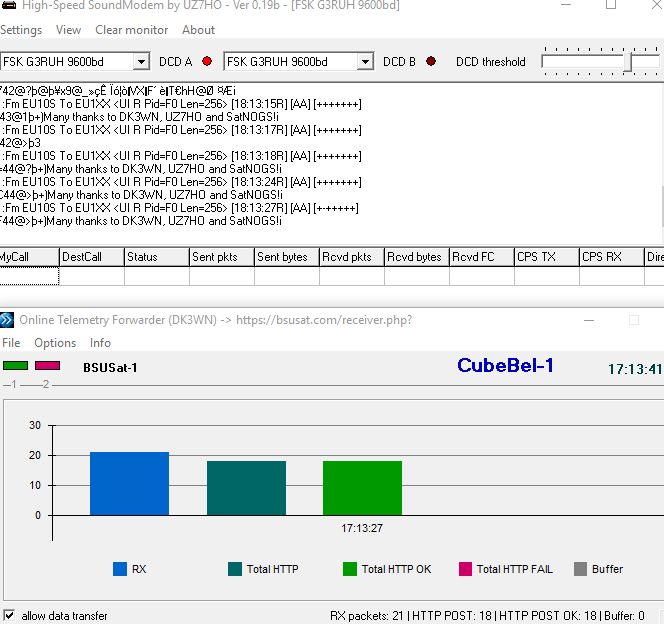
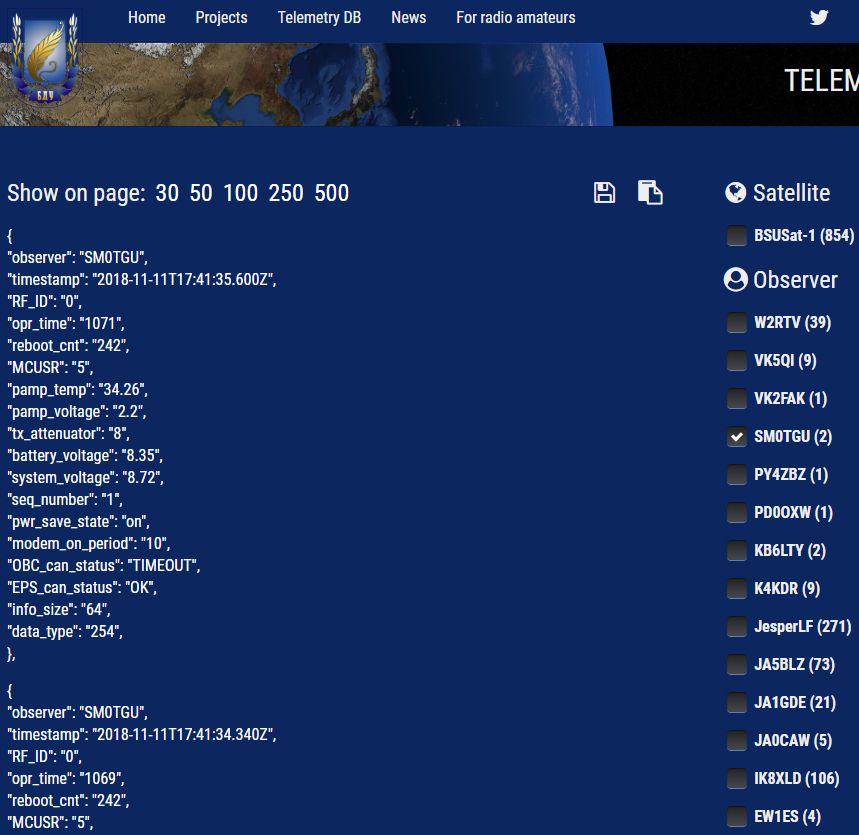
@EU1SAT @BsuSat 21 packets uploaded to Bsusat server during high pass over Stockholm.

Categories
Telemetry

First CubeBel-1 telemetry 2018-11-11

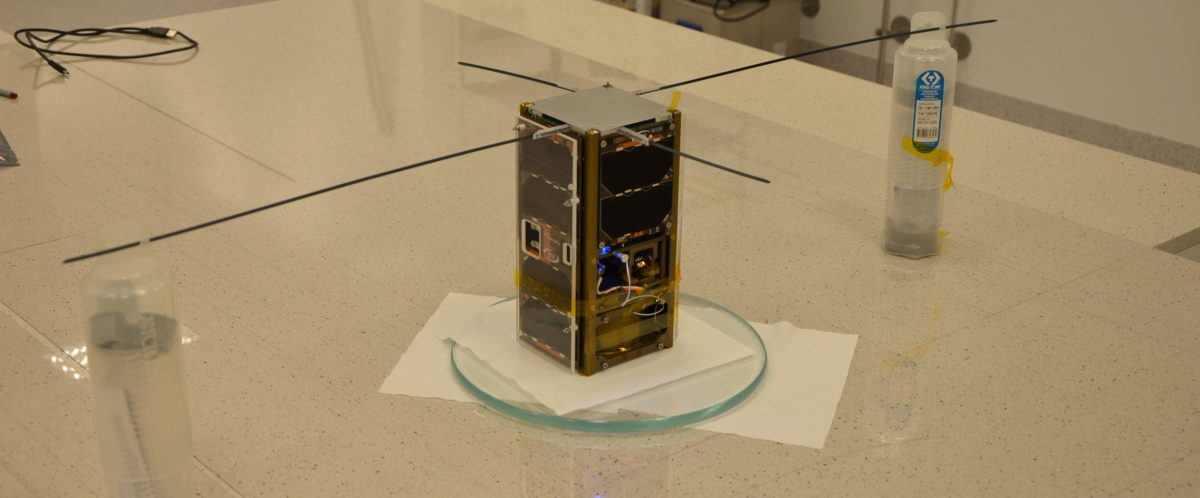
@EU1SAT @BsuSat My first CubeBel-1 decode and uploaded to Bsusat web. The following equipment was used:

  • Antenna 13 el Vårgårda UHF Yagi, vertical
  • LNA Mini-70 from SHF-Elektronik
  • Rotor el/azi RAS  from SPID Elektronik
  • 16m RFC 400 low loss coax
  • Airspy Mini
  • SDR-Console V3
  • High-Speed Soundmodem by UZ7HO
  • Online Telemetry Forwarder by DK3WN. Server set to bsusat.com
  • PstRotator for controlling rotor
  • And maybe some more software…

Frq for RX was 436.990 MHz Wide FM, data stream sent as FSK G3RUH 9600bd. Everything was received and decoded fully automatic while I was doing dinner for my kids 🙂

Categories
Ham Satellite news

PW-Sat2 under november 2018

Intressant satellit från Polen – PW-Sat2. Notera att de har mycket bra information för radioamatörer:

Polish satellite – PW-Sat2 is scheduled as soon as early as 19th
November 2018 launch of 4. . It’s primary mission is a technological
tests of sail-based deorbit system. The PW-Sat2 is one of the
payloads in
SpaceFlight SSO-A The SmallSat Express mission aboard SpaceX’s Falcon
9 rocket. Please be advised that planned launch date may change since
it’s quite common for orbital rockets launches – be prepared and
follow our socials!

Radio link

The satellite is equipped with full duplex communication module
TRxVU Rev. B from Innovative Solutions in Space BV. It operates in
amateur bands UHF (downlink) and VHF (uplink). Antenna module
consists of two dipole antenna (for uplink/downlink) with linear
polarisation. Downlink power equals to 27 dBm (0.5 W). Downlink
signal utilizes BPSK modulation, data scrambling according to G3RUH
and AX.25 protocol. By default, the satellite transmits its downlink
signal at 1200 bps, however it might be changed on request by the
OPERation team (via uplink telecommand) up to 9600 bps. Currently set
bitrate will be published on PW-Sat2’s Twitter profile, however
determination of actual bitrate should be fairly easy by looking at
signal spectrum.

What data will be transmitted?

Every 60 seconds the satellite transmits a beacon frame full of
telemetric data. 229-bytes long payload of the beacon frame contains
the most important information about satellite’s state – among others
– temperatures of main subsystems, battery voltage, solar power, on-
board computer mission time and experiments state. Other data, such
as historical telemetry, experiments data, photos from cameras will
be send on request from PW-Sat2’s OPERation team. There is one
exception from this rule – deorbit sail experiment will transmit its
results on-line (since after sail deployment random tumbling is
expected to occur resulting in signal loses and solar energy
decrease). Downlink signal of PW-Sat2 will be opened for everyone to
receive, decode and interpret data!

HAM radio tools to receive PW-Sat2

HAM radio community plays important role in almost every cubesat
mission – receiving and sharing acquired signal with satellites’
owners. Our team has prepared set of tools helping in receiving and
demodulation of PW-Sat2 radio signal and upload to cloud-based
service afterwards. We believe that data shared to us by community
will have big impact on our mission.

Prepared desktop application is available on Linux and Windows
platforms (however Ubuntu Linux is the main supported OS). It allows
for signal reception utilizing software defined radio receivers
(SDR): RTL-SDR, FUNcube Dongle Pro+, ADALM-Pluto SDR as well as
“traditional” analogue radio receivers with single sideband
demodulator (SSB) via computer’s line-in. Acquired signal from radio
receiver is demodulated and deframed. Correctly received frames are
classified by means of their type and uploaded to cloud-based
application (radio.pw-sat.pl) prepared thanks to co-operation with
SoftwareMill company. The cloud-based application allows for frames
collection, sharing and telemetry decoding (for beacon frames,
labeled as “telemetry frame”). There are available additional
features like charts presenting the most important telemetry data.

How to start receiving?

Detailed information are available in our Wiki –
https://github.com/PW-Sat2/HAMRadio/wiki. A good starting point is to
take a look at “Quick start guide”. The wiki pages will be updated as
new information (e.g. about orbit, TLE data) will be available.

We encourage to try the software (desktop and cloud parts) right
now! In case of any problems – don’t hesitate to mail us (by an e-
mail, Messenger, in comment etc.), create an issue on GitHub
(https://github.com/PW-Sat2/HAMRadio/issues) or simply ask in this
thread!

Mission status information

Up to date information about mission status will be published on our
Twitter profile – don’t miss anything, follow us now!

Contests

To encourage you to listen to PW-Sat2 and honour your contribution
we would like to issue QSL cards for every HAM radio who will send us
(to radio.pw-sat.pl) at least one correct PW-Sat2 frame.

Additionally we’ve prepared contest in three categories:
* the first received and uploaded frame,
* the last received and uploaded frame,
* the most received and uploaded frames.

Shortly after mission we will reveal the winners and honour with
packs of PW-Sat2-related gadgets!
For more about contests see (https://pw-sat.pl/en/ham-contest/).

[ANS thanks MGUMIELA via QRZ.com for the above information]

Categories
Operations

Att köra PSK31 via PSAT NO-84

Scott, K4KDR har gjort några bra noteringar om hur man kör PSK31 via PSAT:


Hi everyone.

If you would like to make some satellite contacts using a digital mode that
doesn't require linux, it turns out that the PSK31 transponder on PSAT
(NO-84) works very well.

A few days ago I posted that I had successfully used PSAT's PSK31
transponder:

http://www.amsat.org/pipermail/amsat-bb/2018-November/070178.html

I had always seen in the documentation that the 435.350 FM downlink from
PSAT transmitted PSK31 and I had even decoded its telemetry beacons using
FLDigi.  However, until a new How-To came out last week, I had never
figured out how to use the 10m USB PSK31 uplink to add my own signal to
PSAT's 70cm downlink stream.

Here is that excellent How-To from 2M0SQL:

https://www.2m0sql.com/2018/10/29/using-the-no-84-psat-psk-transponder/

... and I am making this post to share a couple of additional notes.
Please forgive if this is old news, but it was new to me.

I have uploaded some screen shots to illustrate.  First, please note the
bottom waterfall in this image showing -2- PSK31 streams in PSAT's downlink:

https://www.qsl.net/k/k4kdr//how-to/psat-psk31/fldigi-decoding.png

... the stream at the 310 Hz. mark is PSAT's telemetry beacon, but the mark
at 2369 is a repeat of what I am transmitting on 28.120!

Since the key to this is FLDigi's ability to decode multiple streams at the
same time, it's extremely helpful to SEE each of those streams separately.
In the following image, please note how to enable the left-hand "channels"
browser window in FLDigi:

https://www.qsl.net/k/k4kdr//how-to/psat-psk31/fldigi-view-channels.png

... and this is a matter of personal preference, but I find that the most
helpful display setting in that left-hand window is to label each stream
with the audio frequency it's on:

https://www.qsl.net/k/k4kdr//how-to/psat-psk31/fldigi-freq-view-settings.png

... when you click on any of those decode streams, that selects which
stream appears in the main upper decode window in FLDigi.

So that's the decode side of this.  If you combine that with the
information provided in the How-To by 2M0SQL on how to transmit, we ought
to be able to get some 2-station or even multi-station QSO's logged.

Finally, if you don't have 10m transmit capability -or- even if you only
own an FM radio, this is a digital mode that you can absolutely decode to
enjoy another aspect of one of our long-orbiting satellites.

If you would like to practice using FLDigi to decode the PSK31 signals from
PSAT, here is the audio file that produces the two streams you see in the
screen shots I have mentioned above:

https://www.qsl.net/k/k4kdr//how-to/psat-psk31/psat-psk31-sample-audio.wav

-Scott,  K4KDR