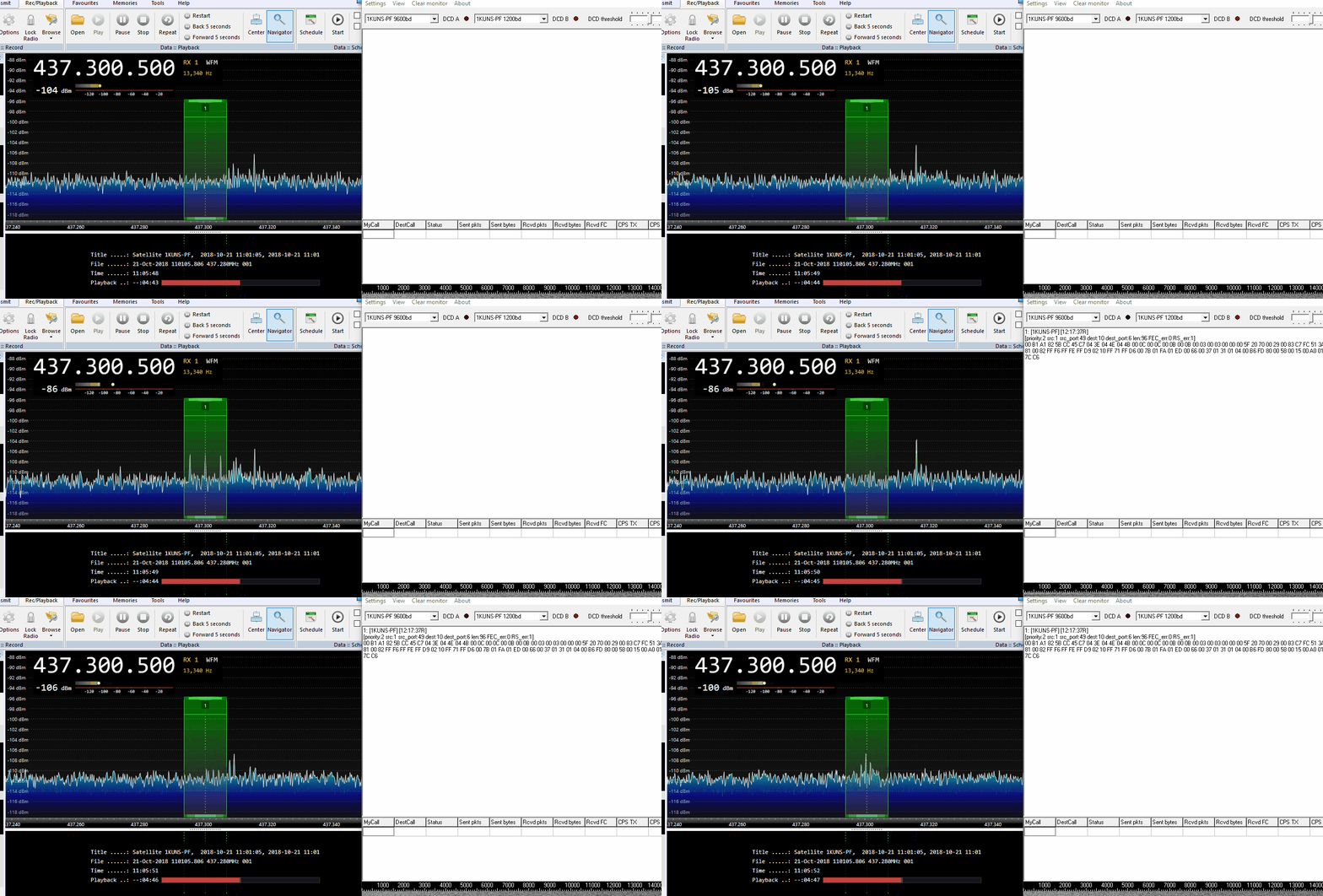
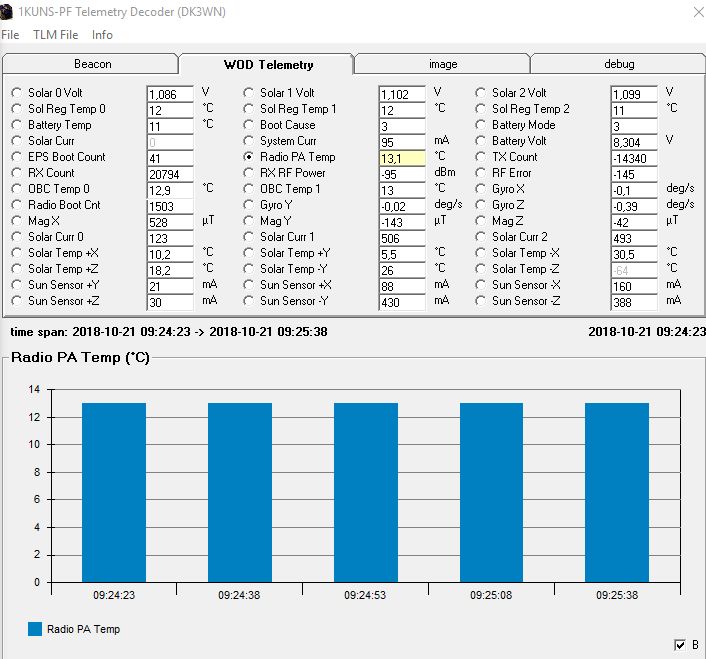
My first 1KUNS-PF RX. 13 el yagi and a lot of software 🙂
 AMSAT-SM - Official Website of AMSAT-SM Sweden
Webmaster and member of the AMSAT-SM steering group.
My first 1KUNS-PF RX. 13 el yagi and a lot of software 🙂
Complete FUNcube status (aktuell FUNcube status över samtliga satelliter):
Graham Shirville, G3VZV has posted the current status of the AMSAT-UK
FUNcube series of satellites.
FUNcube-1 (AO-73)
—————–
As you will know, AO73/FUNcube-1 has been in full sunlight for over
one month and has been transmitting continuously high power telemetry
for most of that time. This has now been changed to full time amateur
mode so the transponder is once again available. With the more stable
on board temperatures being experienced, this means that the transpon-
der frequencies are also now more stable. We expect to leave it in this
mode for some weeks so that the team can determine whether or not the
currents flowing from the solar panels are having any noticeable effect
on the spin period.
Uplink: 435.150 – 435.130 MHz CW, LSB
Downlink: 145.950 – 145.970 MHz CW, USB
Beacon: 145.935 MHz 1k2 BPSK
FUNcube-2 (UKube-1)
——————-
The FUNcube-2 transponder on UKube-1 continues to be in full time
transponder mode. There are occasional breaks in service for a few
seconds when the OBC reboots and the other onboard transmitter sends
its CW beacon.
Uplink: 435.080 – 435.060 MHz CW, LSB
Downlink: 145.930 – 145.950 MHz CW, USB
Beacon: 145.915 MHz 1k2 BPSK
FUNcube-3 (EO-88 Nayif-1)
————————-
EO88/Nayif-1 continues to perform nominally with high power telemetry
when in sunlight and amateur mode when in eclipse.
Uplink: 435.045 – 435.015 MHz CW, LSB
Downlink: 145.960 – 145.990 MHz CW, USB
Beacon: 145.940 MHz 1l2 BPSK
With their slightly different orbital characteristics it is useful that
AO73 is now the early bird, EO88 comes over in the mid morning and UKube
provides coverage in the afternoon.
We have been suffering from some network issues in relation to upload-
ing the telemetry from the Dashboards to the Data Warehouse over the
past couple of weeks. Apologies for this, but hopefully everything is
now stable again. ie fingers are still crossed. Thank you for all the
telemetry that you upload.
Like many other teams, we are presently waiting for the next Space-X
launch from Vandenberg which is expected to be carrying a number of new
amateur payloads, These will provide additional transponder and STEM
capabilities for the amateur satellite service. Exciting times ahead.
[ANS thanks Graham Shirville, G3VZV and AMSAT-UK for the above information]
Hörbara i Sverige:
Quick list of scheduled contacts and events:
Integrierte Gesamtschule Osterholz-Scharmbeck, Osterholz – Scharmbeck, Germany and Gymnasium Soltau, Soltau, Germany, direct via DN3HB and DN5ABG
Martin-Andersen-Nexö-Gymnasium Dresden/DLR_School_Lab TU Dresden, Dresden, Germany, and Liborius-Gymnasium Dessau, Dessau-Roßlau, Germany, direct via DLØTSD and DKØLG
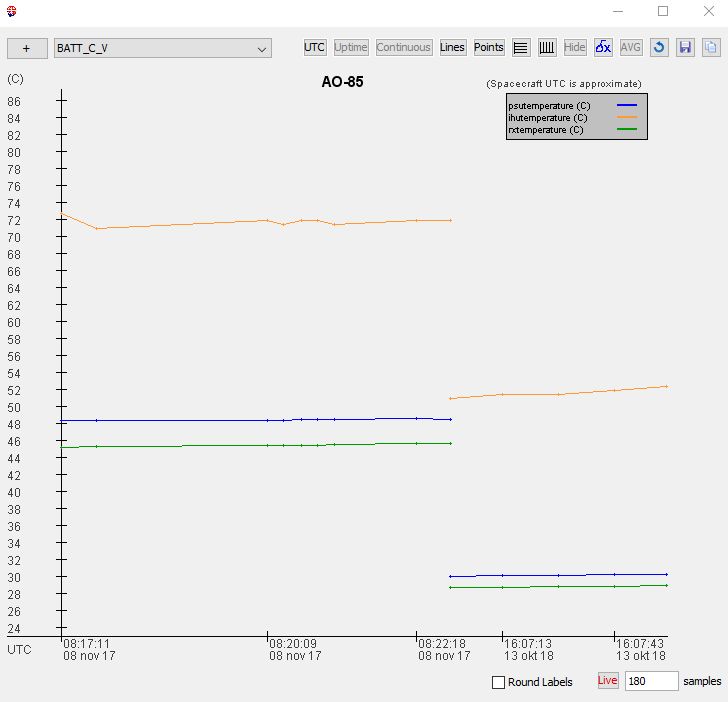
RX over Stockholm with crossed dipole. Some temps compared with values from november last year.
Den 10:e oktober 2018 är det en ARISS-kontakt som kan vara hörbar i SM. Läs mer:
An International Space Station school contact has been planned for Alexander Gerst KF5ONO with Robert-Mayer-Gymnasium, Heilbronn, Germany and Realschule & Gymnasium Weingarten, Weingarten, Germany. The event is scheduled Wednesday 10 October 2018 at approximately 14.03 UTC (16:03 CEST). The conversation will be conducted in German.
The contact will be a direct operated by DN1RMG and DN2RV. The downlink signals will be audible in parts of Europe on 145.800 MHz FM.
From ANS-273:
Japan’s seventh HTV mission, Kounotori 7, arrived at the ISS this
week and delivered cubesats planned for deployment on October 6:
+ STARS-Me
+ Rymansat Project RSP-00
+ SPATIUM-I
STARS-Me
——–
This mission consists of two 1U CubeSats connected by a tether which
includes a mini space elevator experiment, the climber, by Shizuoka
University. The climber has a Bluetooth connection that will transmit
its data to a ground station via a STARS-Me downlink. Radio amateurs
can monitor the behavior of the climber in the telemetry data.
Additional experiments include radio wave propagation studies, and
flight dynamics including tethered spacecraft position and rotation.
UHF downlinks will transmit CW, 1k2 AFSK and 9k6 GMSK telemetry.
Mother satellite – 437.245 MHz CW Beacon; 437.405 MHz telemetry
Daughter satellite – 437.255 MHz CW Beacon; 437.425 MHz telemetry
Rymansat Project RSP-00
———————–
The mission of RSP-00, a 1U cubesat, includes:
+ Send messages collected from the public back to Earth via a
digitalker and CW for reception by radio amateurs and school
children.
+ Image capture with on-board camera and transmit image data
with high-speed telemetry on 38k4 π/4QPSK downlink on UHF.
The downlink frequency for the digitalker, CW beacon and AFSK 1k2
packet is 145.890 MHz. The UHF downlink frequency has not been
published.
SPATIUM-I
———
SPATIUM 1 is scientific (non-amateur radio) cubesat to demonstrate
a new technique for ionosphere mapping using a constellation of
CubeSats equipped with Chip Scale Atomic Clock (CSAC) to provide
real-time three-dimensional mapping of ionosphere plasma density
at the altitudes of electron density peak (200 to 400 km above the
Earth).
[ANS thanks the satellite teams for the above information]