Categories
Telemetry

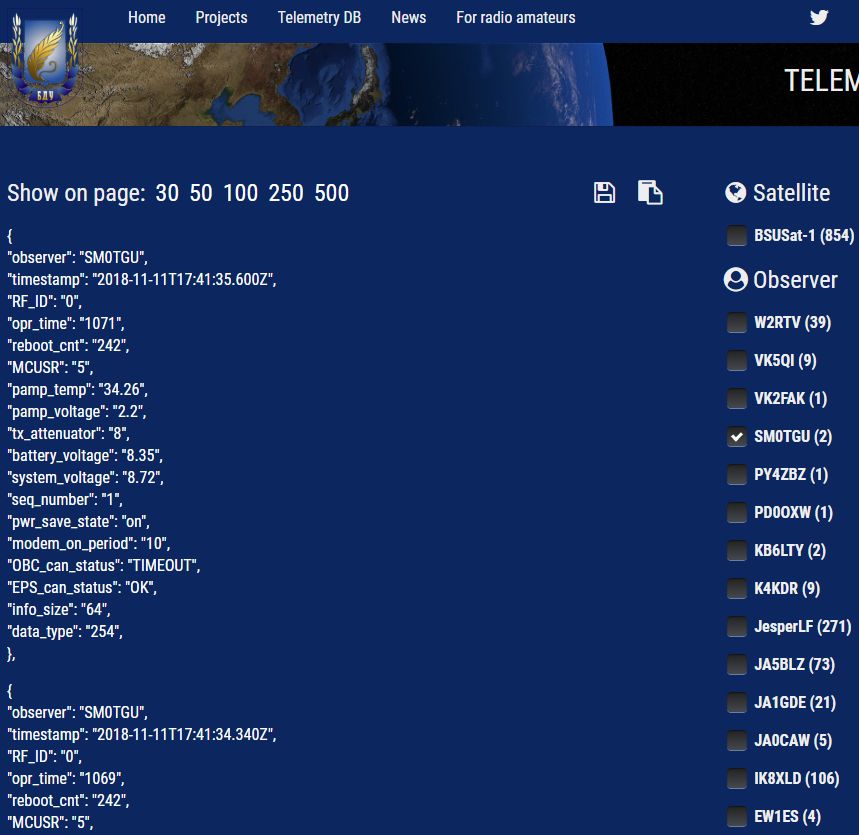
First CubeBel-1 telemetry 2018-11-11

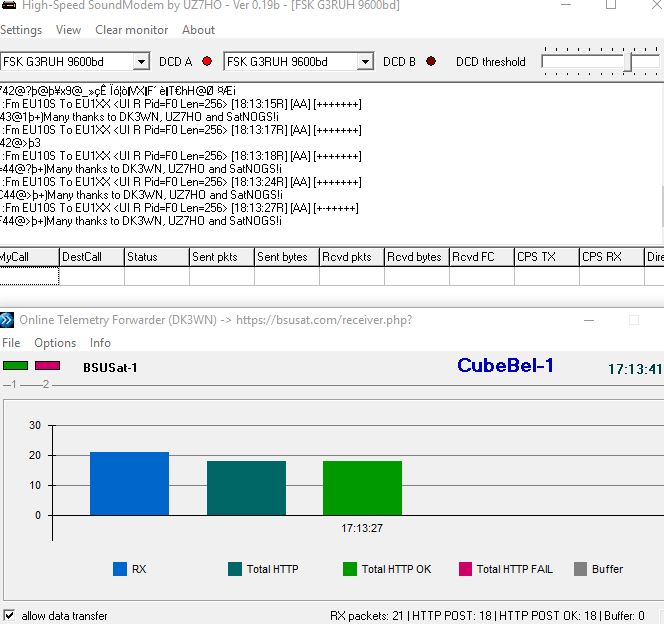
@EU1SAT @BsuSat My first CubeBel-1 decode and uploaded to Bsusat web. The following equipment was used:

  • Antenna 13 el Vårgårda UHF Yagi, vertical
  • LNA Mini-70 from SHF-Elektronik
  • Rotor el/azi RAS  from SPID Elektronik
  • 16m RFC 400 low loss coax
  • Airspy Mini
  • SDR-Console V3
  • High-Speed Soundmodem by UZ7HO
  • Online Telemetry Forwarder by DK3WN. Server set to bsusat.com
  • PstRotator for controlling rotor
  • And maybe some more software…

Frq for RX was 436.990 MHz Wide FM, data stream sent as FSK G3RUH 9600bd. Everything was received and decoded fully automatic while I was doing dinner for my kids 🙂

Categories
Ham Satellite news

PW-Sat2 under november 2018

Intressant satellit från Polen – PW-Sat2. Notera att de har mycket bra information för radioamatörer:

Polish satellite – PW-Sat2 is scheduled as soon as early as 19th
November 2018 launch of 4. . It’s primary mission is a technological
tests of sail-based deorbit system. The PW-Sat2 is one of the
payloads in
SpaceFlight SSO-A The SmallSat Express mission aboard SpaceX’s Falcon
9 rocket. Please be advised that planned launch date may change since
it’s quite common for orbital rockets launches – be prepared and
follow our socials!

Radio link

The satellite is equipped with full duplex communication module
TRxVU Rev. B from Innovative Solutions in Space BV. It operates in
amateur bands UHF (downlink) and VHF (uplink). Antenna module
consists of two dipole antenna (for uplink/downlink) with linear
polarisation. Downlink power equals to 27 dBm (0.5 W). Downlink
signal utilizes BPSK modulation, data scrambling according to G3RUH
and AX.25 protocol. By default, the satellite transmits its downlink
signal at 1200 bps, however it might be changed on request by the
OPERation team (via uplink telecommand) up to 9600 bps. Currently set
bitrate will be published on PW-Sat2’s Twitter profile, however
determination of actual bitrate should be fairly easy by looking at
signal spectrum.

What data will be transmitted?

Every 60 seconds the satellite transmits a beacon frame full of
telemetric data. 229-bytes long payload of the beacon frame contains
the most important information about satellite’s state – among others
– temperatures of main subsystems, battery voltage, solar power, on-
board computer mission time and experiments state. Other data, such
as historical telemetry, experiments data, photos from cameras will
be send on request from PW-Sat2’s OPERation team. There is one
exception from this rule – deorbit sail experiment will transmit its
results on-line (since after sail deployment random tumbling is
expected to occur resulting in signal loses and solar energy
decrease). Downlink signal of PW-Sat2 will be opened for everyone to
receive, decode and interpret data!

HAM radio tools to receive PW-Sat2

HAM radio community plays important role in almost every cubesat
mission – receiving and sharing acquired signal with satellites’
owners. Our team has prepared set of tools helping in receiving and
demodulation of PW-Sat2 radio signal and upload to cloud-based
service afterwards. We believe that data shared to us by community
will have big impact on our mission.

Prepared desktop application is available on Linux and Windows
platforms (however Ubuntu Linux is the main supported OS). It allows
for signal reception utilizing software defined radio receivers
(SDR): RTL-SDR, FUNcube Dongle Pro+, ADALM-Pluto SDR as well as
“traditional” analogue radio receivers with single sideband
demodulator (SSB) via computer’s line-in. Acquired signal from radio
receiver is demodulated and deframed. Correctly received frames are
classified by means of their type and uploaded to cloud-based
application (radio.pw-sat.pl) prepared thanks to co-operation with
SoftwareMill company. The cloud-based application allows for frames
collection, sharing and telemetry decoding (for beacon frames,
labeled as “telemetry frame”). There are available additional
features like charts presenting the most important telemetry data.

How to start receiving?

Detailed information are available in our Wiki –
https://github.com/PW-Sat2/HAMRadio/wiki. A good starting point is to
take a look at “Quick start guide”. The wiki pages will be updated as
new information (e.g. about orbit, TLE data) will be available.

We encourage to try the software (desktop and cloud parts) right
now! In case of any problems – don’t hesitate to mail us (by an e-
mail, Messenger, in comment etc.), create an issue on GitHub
(https://github.com/PW-Sat2/HAMRadio/issues) or simply ask in this
thread!

Mission status information

Up to date information about mission status will be published on our
Twitter profile – don’t miss anything, follow us now!

Contests

To encourage you to listen to PW-Sat2 and honour your contribution
we would like to issue QSL cards for every HAM radio who will send us
(to radio.pw-sat.pl) at least one correct PW-Sat2 frame.

Additionally we’ve prepared contest in three categories:
* the first received and uploaded frame,
* the last received and uploaded frame,
* the most received and uploaded frames.

Shortly after mission we will reveal the winners and honour with
packs of PW-Sat2-related gadgets!
For more about contests see (https://pw-sat.pl/en/ham-contest/).

[ANS thanks MGUMIELA via QRZ.com for the above information]

Categories
Operations

Att köra PSK31 via PSAT NO-84

Scott, K4KDR har gjort några bra noteringar om hur man kör PSK31 via PSAT:


Hi everyone.

If you would like to make some satellite contacts using a digital mode that
doesn't require linux, it turns out that the PSK31 transponder on PSAT
(NO-84) works very well.

A few days ago I posted that I had successfully used PSAT's PSK31
transponder:

http://www.amsat.org/pipermail/amsat-bb/2018-November/070178.html

I had always seen in the documentation that the 435.350 FM downlink from
PSAT transmitted PSK31 and I had even decoded its telemetry beacons using
FLDigi.  However, until a new How-To came out last week, I had never
figured out how to use the 10m USB PSK31 uplink to add my own signal to
PSAT's 70cm downlink stream.

Here is that excellent How-To from 2M0SQL:

https://www.2m0sql.com/2018/10/29/using-the-no-84-psat-psk-transponder/

... and I am making this post to share a couple of additional notes.
Please forgive if this is old news, but it was new to me.

I have uploaded some screen shots to illustrate.  First, please note the
bottom waterfall in this image showing -2- PSK31 streams in PSAT's downlink:

https://www.qsl.net/k/k4kdr//how-to/psat-psk31/fldigi-decoding.png

... the stream at the 310 Hz. mark is PSAT's telemetry beacon, but the mark
at 2369 is a repeat of what I am transmitting on 28.120!

Since the key to this is FLDigi's ability to decode multiple streams at the
same time, it's extremely helpful to SEE each of those streams separately.
In the following image, please note how to enable the left-hand "channels"
browser window in FLDigi:

https://www.qsl.net/k/k4kdr//how-to/psat-psk31/fldigi-view-channels.png

... and this is a matter of personal preference, but I find that the most
helpful display setting in that left-hand window is to label each stream
with the audio frequency it's on:

https://www.qsl.net/k/k4kdr//how-to/psat-psk31/fldigi-freq-view-settings.png

... when you click on any of those decode streams, that selects which
stream appears in the main upper decode window in FLDigi.

So that's the decode side of this.  If you combine that with the
information provided in the How-To by 2M0SQL on how to transmit, we ought
to be able to get some 2-station or even multi-station QSO's logged.

Finally, if you don't have 10m transmit capability -or- even if you only
own an FM radio, this is a digital mode that you can absolutely decode to
enjoy another aspect of one of our long-orbiting satellites.

If you would like to practice using FLDigi to decode the PSK31 signals from
PSAT, here is the audio file that produces the two streams you see in the
screen shots I have mentioned above:

https://www.qsl.net/k/k4kdr//how-to/psat-psk31/psat-psk31-sample-audio.wav

-Scott,  K4KDR
Categories
Members news Oscar-100

Utlottning av LNB för Es’hail-2

Inför uppskjutningen av Es’hail-2 lottar AMSAT-SM ut en (1) LNB av typ Octagon Optima Twin Slim Oslo. Detta är enligt många en utmärkt LNB att använda för Es’hail-2 vilket går att läsa på detta forum. Reglerna för utlottningen är följande:

  • Du måste vara medlem i AMSAT-SM (vilket är kostnadsfritt och kan göras här)
  • Sista dag för att deltaga är 24 november 2018
  • Om du vinner kommer du få LNB levererad direkt hem så det är viktigt att dina uppgifter är korrekta
  • Observera att det inte är en komplett mottagare, du måste själv bygga ihop en lösning. AMSAT-SM kan inte hjälpa till med detta men det finns många artiklar ute och vi kommer kontinuerligt att publicera länkar till byggbeskrivningar när det finns tillgängligt

Tävlingen avslutad. Grattis SM5EPC Anders Jonsson som är vinnaren!


Categories
Telemetry

Bugsat-1 telemetry 2018-10-27

A lot of local QRM on 437 MHz…

Categories
Oscar-100

Oscar-100 QO-100 Es’hail-2

For english information please visit AMSAT-DL.

Uppdaterad: november 2025

Lyssna med WebSDR

Goonhilly Earth Station i Cornwall har en WebSDR som funnits med sedan start. Även IS0GRB har en WebSDR.
Lyssna på QO-100 utan egen utrustning!

Länkar

Numera finns hur mycket information som helst genom att söka på Google. Nedanstående är bara ett axplock av artiklar:

Utrustning

Här finns länkar till lämplig utrustning att bygga och företag som säljer tillbehör (finns dock många fler – sök på Google):

Föredrag av SM3BYA

Vi har fått tillåtelse att publicera Gudmund Wannberg SM3BYA fina föredrag från oktober 2020. Ladda ner den här (PDF).

Avkoda PSK beacon

Det går att ta emot PSK Beacon på 10489,745 MHz med hjälp av följande program:

Se en kort video från mottagning här:

Bandplan och frekvenser

Gällande publicerad Narrowband (NB) bandplan från april 2021 är följande (all information kommer från AMSAT-DL):

Viktiga “kom ihåg”:

  • NO FM mode is allowed on the transponder.
  • No transmission below the lower beacon and no transmission above the upper beacon.
  • The NB transponder is a bent-pipe transponder and non-inverting.
  • Uplink polarization is RHCP (right-hand circular polarization).
  • Downlink polarization for the NB transponder is V (vertical linear polarization).
  • Monitor the beacons and keep your own signal level below, otherwise you might trigger LEILA warnings.
  • Please use minimum uplink power (ERP).
  • The beacons are modulated in 400 bit / s BPSK (similar to the P3 satellites) or in CW.
  • The beacons are generated in the ground station and will Provide selected telemetry from the main satellite related to our amateur radio transponder.

Täckningskarta

Täckningskartorna nedan är imponerande, bara att njuta och använda! Klicka för större bild.