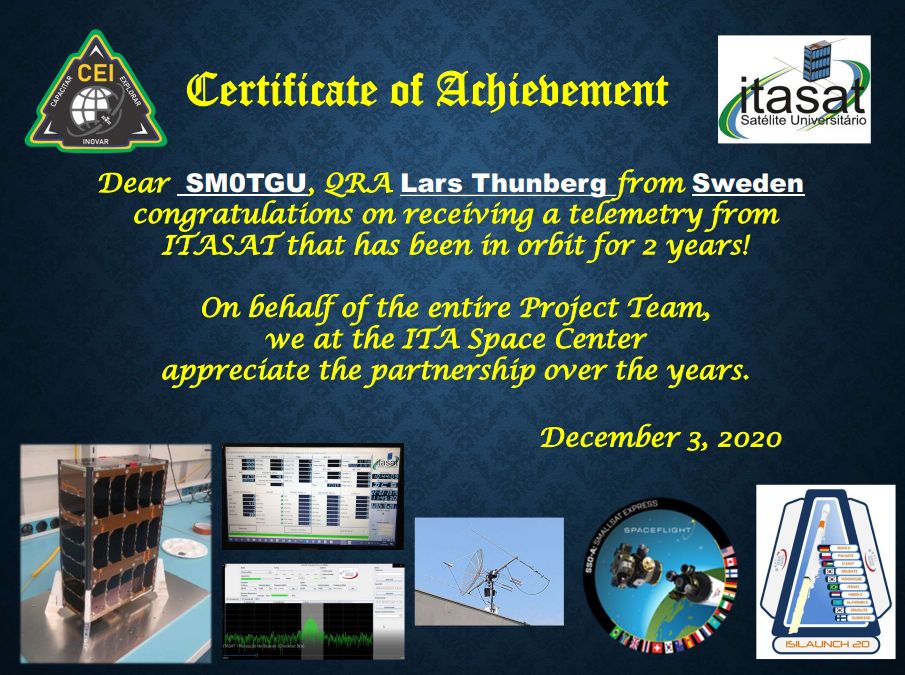
Thank you ITA SPace Center for certificate!
 AMSAT-SM - Official Website of AMSAT-SM Sweden
Webmaster and member of the AMSAT-SM steering group.
Thank you ITA SPace Center for certificate!
Only night passes for Europe:
The Japan Amateur Radio League has released the FO-29 operation
schedule for December 2020 and January 2021. Times are in UTC. The
operation runs until the UVC (lower limit voltage control) activates.
December 2020
5 01:52, 03:35
6 02:45, 04:30
12 02:25, 04:15
13 03:20, 05:05
14 02:25, 04:10
19 01:20, 03:05
20 02:10, 03:55
26 01:55, 03:40
27 02:45
30 01:45
31 02:35
January 2021
1 01:40, 03:25
3 01:35, 03:20
9 01:20, 03:05
10 02:10, 03:55
11 01:15, 03:00
[ANS thanks Hideo Kambayashi, JH3XCU for the above information.]

Strong telemetry at 145.858 MHz easy to decode. Used the following:

Den sista satelliten i AMSAT-NAs FOX-serie, RadFxSat-2 / Fox-1E, har fått ett uppskjutningsfönster som börjar den 19 december (2020). Till skillnad mot de andra FOX-satelliterna, som har haft FM-transponder, har Fox-1E en linjär inverterande transponder för SSB och CW-trafik.
Dessutom har telemetrilänken flyttat till 70cm på 435.750 MHz och kan tas emot med den senaste versionen av FoxTelem.
Läs hela nyheten här:
Launch Window for AMSAT’s RadFxSat-2 / Fox-1E Opens December 19th
Virgin Orbit has announced that the launch window for their
LauncherOne Launch Demo 2 mission opens on December 19th. This launch
will carry AMSAT’s RadFxSat-2 / Fox-1E to orbit.
RadFxSat-2, like RadFxSat / Fox-1B, now AMSAT-OSCAR 91, is a
partnership opportunity between Vanderbilt University and AMSAT and
will carry a similar radiation effects experiment, studying new FinFET
technology.
RadFxSat-2 is the fifth and final Fox-1 satellite built by AMSAT. The
RadFxSat-2 spacecraft bus is built on the Fox-1 series but features a
linear transponder “upgrade” to replace the standard FM transponder in
Fox-1A through D. In addition, the uplink and downlink bands are
reversed from the previous Fox satellites in a Mode V/u (J)
configuration using a 2 meter uplink and 70 cm downlink. The downlink
features a 1200 bps BPSK telemetry channel to carry the Vanderbilt
science data in addition to a 30 kHz wide transponder for amateur
radio use. Telemetry and experiment data can be decoded using FoxTelem
version 1.09 or later. FoxTelem is available at
https://www.amsat.org/foxtelem-software-for-windows-mac-linux/.
Participation in telemetry collection by as many stations in as many
parts of the world as possible is essential as AMSAT Engineering looks
for successful startup and indications of the general health and
function of the satellite as it begins to acclimate to space. AMSAT
will send a commemorative 3D printed QSL card to the first station
capturing telemetry from RadFxSat-2.
RadFxSat-2 / Fox-1E Frequencies:
Telemetry Downlink – 435.750 MHz
Inverting Linear Transponder Uplink – 145.860 MHz – 145.890 MHz
Inverting Linear Transponder Downlink – 435.760 MHz – 435.790 MHz
[ANS thanks AMSAT for the above information]
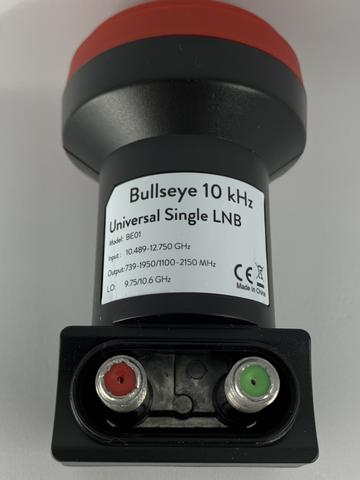
Dags för en ny “give-away” från AMSAT-SM! Nu lottar vi ut en Othernet Bullseye LNB, en extra frekvensstabil LNB för Oscar 100. Årets julklapp 2020 för oss i AMSAT. Läs mer om den här:
https://www.passion-radio.com/lnb-pll/lnb-othernet-978.html
Det är mycket hög chans att vinna så det finns ingen anledning att inte deltaga. Detta är reglerna

This is a memory group file over satellite frequencies for Icom IC-705 and CS-705 software. It is not complete and will be updated. Feel free to use it, change and add, make your own groups etc.
The memories are used like this:
Import the memory file into CS-705:
Note! Be sure that you not overwrite anything in your IC-705 when cloning. Make a backup of your current settings!
As CS-705 seems to handle character set different between regions I have now created two files. If one does not work, try the other one. Comma separated is working for North America.
Download the latest files from SM0TGUs Github:
IC-705_SatFrqMemGroup.csv
IC-705_SatFrqMemGroup_commaseparated.csv
The files has to be downloaded as a zip file from GitHub, then use your file of interest: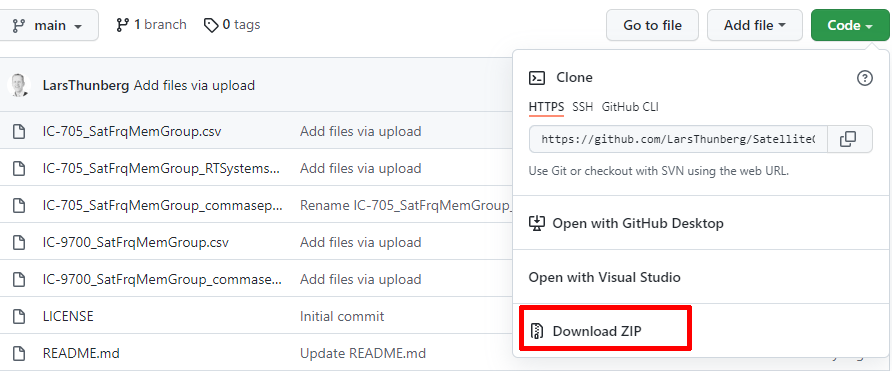
If you have problems downloading the files from GitHub please contact us and the files can be sent via mail.
RT Systems Memories example
The following explanation is from Jack Spitznagel – KD4IZ, for the RT Systems software.This brief explanation assumes that the RT Systems IC-705 Programmer user knows how to import memories into the software:
Users may want to edit the arrangement once the data is imported into the RT Systems IC-705 Programmer.
Download the latest file from SM0TGUs Github (updated Feb 2021):
IC-705_SatFrqMemGroup_RTSystemsFormat.csv