Den sista satelliten i AMSAT-NAs FOX-serie, RadFxSat-2 / Fox-1E, har fått ett uppskjutningsfönster som börjar den 19 december (2020). Till skillnad mot de andra FOX-satelliterna, som har haft FM-transponder, har Fox-1E en linjär inverterande transponder för SSB och CW-trafik.
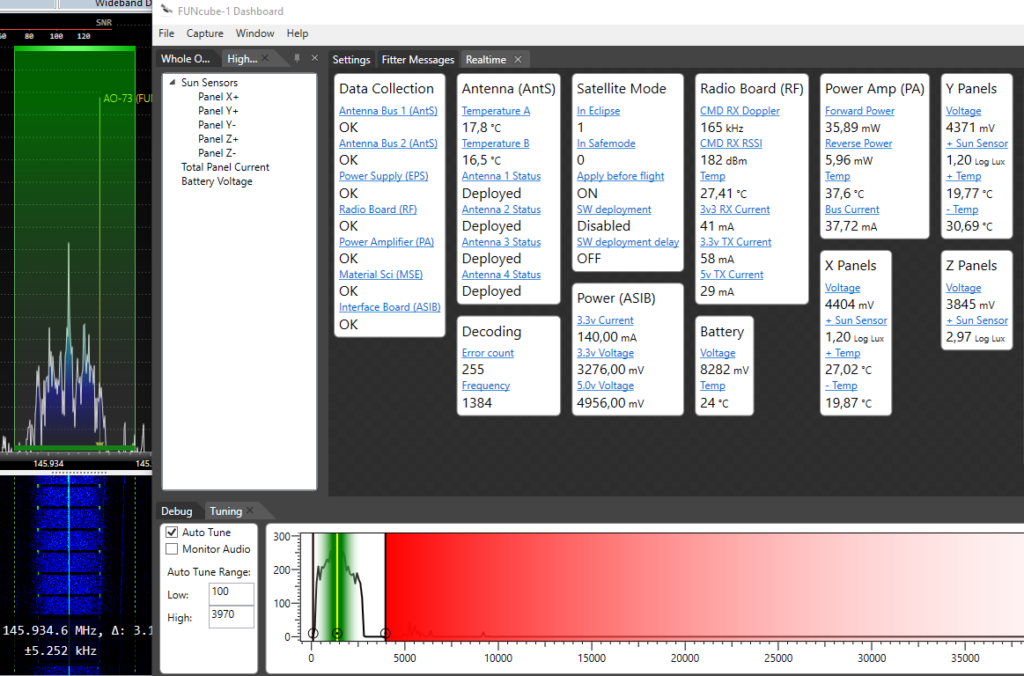
Dessutom har telemetrilänken flyttat till 70cm på 435.750 MHz och kan tas emot med den senaste versionen av FoxTelem.
Läs hela nyheten här:
Launch Window for AMSAT’s RadFxSat-2 / Fox-1E Opens December 19th
Virgin Orbit has announced that the launch window for their LauncherOne Launch Demo 2 mission opens on December 19th. This launch will carry AMSAT’s RadFxSat-2 / Fox-1E to orbit.
RadFxSat-2, like RadFxSat / Fox-1B, now AMSAT-OSCAR 91, is a partnership opportunity between Vanderbilt University and AMSAT and will carry a similar radiation effects experiment, studying new FinFET technology.
RadFxSat-2 is the fifth and final Fox-1 satellite built by AMSAT. The RadFxSat-2 spacecraft bus is built on the Fox-1 series but features a linear transponder “upgrade” to replace the standard FM transponder in Fox-1A through D. In addition, the uplink and downlink bands are reversed from the previous Fox satellites in a Mode V/u (J) configuration using a 2 meter uplink and 70 cm downlink. The downlink features a 1200 bps BPSK telemetry channel to carry the Vanderbilt science data in addition to a 30 kHz wide transponder for amateur radio use. Telemetry and experiment data can be decoded using FoxTelem version 1.09 or later. FoxTelem is available at https://www.amsat.org/foxtelem-software-for-windows-mac-linux/.
Participation in telemetry collection by as many stations in as many parts of the world as possible is essential as AMSAT Engineering looks for successful startup and indications of the general health and function of the satellite as it begins to acclimate to space. AMSAT will send a commemorative 3D printed QSL card to the first station capturing telemetry from RadFxSat-2.
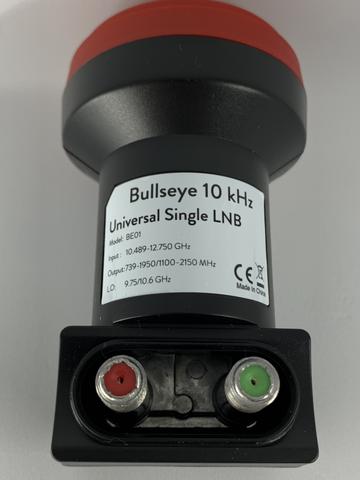
Dags för en ny “give-away” från AMSAT-SM! Nu lottar vi ut en Othernet Bullseye LNB, en extra frekvensstabil LNB för Oscar 100. Årets julklapp 2020 för oss i AMSAT. Läs mer om den här: https://www.passion-radio.com/lnb-pll/lnb-othernet-978.html
Det är mycket hög chans att vinna så det finns ingen anledning att inte deltaga. Detta är reglerna
Du måste vara medlem i AMSAT-SM (vilket är kostnadsfritt och kan göras här)
Sista dag för att deltaga är söndag 13 december 2020
Om du vinner kommer du få LNB levererad direkt hem så det är viktigt att dina adressuppgifter är korrekta
Observera att det inte är en komplett mottagare, du måste själv bygga ihop en lösning.
This is a memory group file over satellite frequencies for Icom IC-705 and CS-705 software. It is not complete and will be updated. Feel free to use it, change and add, make your own groups etc.
The memories are used like this:
Channels named with satellite name, for exemple “PO-101 Split”, are used in split mode. This channel can be used when using the IC-705 for portable operation or without an extra receiver .
The FM-satellites also has five split memories each with AOS-LOS frequencies – for portable operation without computer doppler tuning.
Channels named with satellite name and Uplink, for exemple “PO-101 Uplink”, are used only for uplink (not split). This can be used with software like SDR-Console v3 (external radio) or if you have an extra receiver.
Channels named with satellite name and Downlink, for exemple “RS-44 Downlink”, are used only for downlink (not split).
Import the memory file into CS-705: Note! Be sure that you not overwrite anything in your IC-705 when cloning. Make a backup of your current settings!
Create a new memory group
Mark this new group
Choose File->Import->Group and choose the .csv file
The memories will now be imported to CS-705
Clone to your IC-705
As CS-705 seems to handle character set different between regions I have now created two files. If one does not work, try the other one. Comma separated is working for North America.
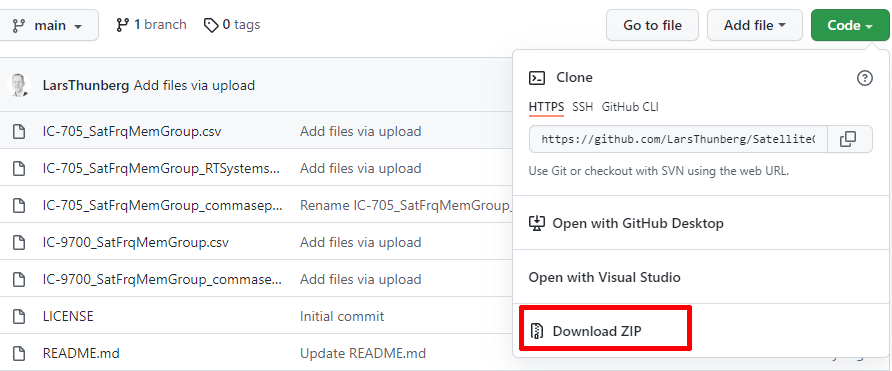
The files has to be downloaded as a zip file from GitHub, then use your file of interest:
If you have problems downloading the files from GitHub please contact us and the files can be sent via mail.
RT Systems Memories example
The following explanation is from Jack Spitznagel – KD4IZ, for the RT Systems software.This brief explanation assumes that the RT Systems IC-705 Programmer user knows how to import memories into the software:
Before you merge these into an existing RT Systems memory set, it is first necessary to open the .CSV file in a spreadsheet (Excel or Libre Office) and edit the Channel Number and Bank names. Save the edited file as a .CSV file.
Channel numbers should be set to start numbering at the first open memory row (this example: if row 77 is your first open memory row, start numbering at 77, go up to 99).
Bank numbers should be changed to the first open memory Bank # in the form “##:Bank Name”. In the example, “04:Satellite” was used because Bank 0, 1, 2, and 3 already have assigned names in the memopry file that was used. Interestingly, the “Satellite” Bank Name was not recorded which requires some easy editing of the new file.
Save your RT Systems memory file to a NEW FILENAME so you don’t lose your settings. Users may want to edit the arrangement once the data is imported into the RT Systems IC-705 Programmer.
Users may want to edit the arrangement once the data is imported into the RT Systems IC-705 Programmer.
During the month of October the IARU coordinated frequencies for six upcoming Amateur Radio satellites:
OreSat0 (Portland State Aerospace Society at Portland State University is a 1U CubeSat. The mission is to provide flight heritage to the “OreSat bus”, an open source card-cage based system that is ideally suited for education CubeSat projects involving interdisciplinary teams of students. Downlinks on UHF using CW beacon, 9k6 G3RUH AX25/APRS packet beacon and a 96k GMSK engineering downlink. Also downlink on S Band using amateur 802.11b DPSK with 11M chip/sec spread and 1 Mbps data rate for bulk mission data. Downlinks on 436.500 MHz and 2425.00 MHz have been coordinated. Planning a launch with Momentus Space from Cape Canaveral in February 2021 into a 450 km polar orbit. More info at: http://oresat.org/ and https://github.com/oresat.
TartanArtibeus-1 (Carnegie Mellon University) is a 1P PocketQube. The Amateur Radio community globally will be provided with a delay ping-back service, allowing Amateurs to send messages, with replies from the satellite transmitted later. A UHF downlink using 3kbps FSK compatible with RadioHead library. A downlink on 437.170 MHz has been coordinated. Planning a SpaceX launch from KSC in December 2020 into a 550km SSO.
SATLLA-2 (Ariel University) is a 2P picosat that will take low-resolution photos and will broadcast the photos over the Amateur Radio with its position in orbit and data from its sensors. UHF and S Band downlinks using LORA from 476bps to 9k6 bps. Downlinks on 437.250 MHz and 2401.000 MHz have been coordinated.Planning a SpaceX launch into a 410 km 52 degree orbit in December 2020.
CSIROSat-1 (University of South Australia & CSIRO) is a 3U CubeSat mission that will perform hyperspectral infrared imaging of the earth for scientific research purposes. An experimental two-way link for Amateur Radio operators to exchange short messages through a ‘ping-pong’ arrangement of data exchange is among the several communications experiments. Proposing a 9k6 FSK downlink. A downlink on 437.315 MHz has been coordinated. Planning a launch from Cape Canaveral in March 2021 into an ISS orbit.
PyCubed-1 (Carnegie Mellon University) is a 1P PocketQube that will test a novel 3-axis attitude control system based on magnetic torque coils. In addition, it will test new low- power LoRa radios in low-Earth orbit which will be of interest to many other Amateur Radio small satellite operators. Proposing a 3kbps UHF downlink. A downlink on 437.290 MHz has been coordinated. Packets are standard LoRa format and are compatible with the RadioHead library. Planning a SpaceX launch from KSC into a 550 km SSO in December 2020.
Grizu-263A (Zonguldak Bülent Ecevit University) is a pocketcube satellite with a digipeater mode that will allow forwarding of received messages back to earth to support communication between Amateur Radio operators. Proposing a UHF downlink using 4k8 FSK. A downlink on 437.190 MHz has been coordinated. Planning a SpaceX launch from Vandenberg into a 500 600 km SSO in December 2020.
Information on these and other upcoming satellites can be found at: http://www.amsat.org.uk/iaru/.