
Categories
Ham Satellite news

145.825 MHz APRS Cubesats från ISS

Under augusti 2018 finns det möjlighet att tre satelliter med APRS släpps ut från ISS. De kommer att sända på 145.815 MHz och bör bli lätta att höra:

The June 29, 2018 SpaceX Falcon 9 launch of the Dragon cargo
capsule included cubesats of the BIRDS-2 satellite constellation.
All cubesats in the BIRDS-2 constellation MAYA-1, BHUTAN-1 and
UiTMSAT-1 have identical designs and utilize the same radio
frequencies. While independently made, the operation and control
of the three cubesats will be shared by the three teams after
they are released from the ISS early in August. They will be
operational for six months.

“The three will form a constellation, orbiting the earth from
different places. This will provide the countries more opportun-
ities to make measurements and run experiments, than just with
using one cubesat,” explained Joel Joseph Marciano Jr., manager
of the PHL-Microsat program in the Philippines.

The primary mission of BIRDS-2 CubeSat constellation is to
provide digital message relay service to the amateur radio
community by means of an APRS digipeater onboard. The APRS
digipeater onboard BIRDS-2 CubeSats will use 145.825 MHz for
both receive and transmit which isa standard configurations
used by other satellites such as ARISS and LAPAN-A2.

Another mission of the BIRDS-2 CubeSat constellation is to
demonstrate a store-and-forward (S&F) system. In this mission,
their goal is to investigate technical challenges through ex-
periments on appropriate data format, multiple access scheme,
file-handling protocol while complying with limited operational
time and power constraints.

The BIRDS-2 CubeSat S&F system will collect data from remote
ground sensors, store them onboard and download them to the
different BIRDS-2 ground stations network.

Additional experiments will use the BIRDS-2 CubeSat constellation
to enhance research and experiment in the fields of single latch-up
event detection, magnetic field measurements using a COTS aniso-
tropic magnetometer, and flight testing of a COTS GPS chip which
can be used for future CubeSat missions if proven effective. Stu-
dents will also explore a passive attitude stabilization mechanism
consisting of magnets and hysteresis dampers for proper orientation
of camera on a CubeSat. All measurements and image data will be
shared with the public on BIRDS-2 project website.

Moveover, BIRDS-2 CubeSat constellation will expand amateur radio
communication experiment on the operation of CubeSat constellation
via a network of UHF/VHF amateur radio ground stations (started
in the BIRDS-1 CubeSat constellation project). BIRDS-2 hopes to
promote awareness of amateur radio communication and amateur
satellites among the general public and students, especially in
the participating nations of BIRDS-2 Project: Bhutan, Malaysia,
Philippines, and Japan.

The IARU has coordinated 437.375 MHz CW beacon for a downlink and
145.825 MHz for the APRS experiment.

Philippine news coverage of MAYA-1 can be accessed at:
https://tinyurl.com/ANS189-MAYA-1
http://tinyurl.com/ANS-BIRDS2-cubesats
Visit the BIRDS-2 website at: http://birds2.birds-project.com/

[ANS thanks the BIRDS-2 Project, Kyushu Institute of Technology and
the IARU for the above information]
Categories
Ham Satellite news

CAMSAT planerade satelliter med HF-transponder

Nu kan det åter igen bli aktuellt med HF-transpondrar på amatörradiosatelliter. Det är CAMSAT (China’s Amateur Radio Satellite organization) som planerar två nya satelliter varav en med HF. Det är en mycket intressant kombination av frekvenser. Läs mera nedan:

CAMSAT, China’s Amateur Radio Satellite organization, has offered
additional details about the three Amateur Radio satellites it
plans to launch later this year. Two of the satellites, designated
CAS-5A and CAS-6, will carry transponders, and one of them will
offer HF capability. CAMSAT’s Alan Kung, BA1DU, told ARRL that
the 6U CAS-5A will carry two HF transponders and two V/UHF trans-
ponders. The plentiful equipment package includes an H/T (21/29 MHz)
mode linear transponder, an H/U (21/435 MHz) mode linear transponder,
an HF CW telemetry beacon, a V/U linear transponder, a V/U FM trans-
ponder, a UHF CW telemetry beacon, and UHF AX.25 4.8k/9.6k baud GMSK
telemetry.

+ The H/T mode linear transponder will have a 30 kHz wide uplink centered
on 21.400 MHz, and a downlink centered on 29.490 MHz. RF output is 0.5 W.

+ An HF CW telemetry beacon will transmit on 29.465 MHz with 0.1 W.

+ The H/U mode linear transponder will have a 15 kHz wide uplink centered
on 21.435 MHz, and a downlink centered on 435.505 MHz. The RF output is
0.5 W.

+ The V/U mode linear transponder will have a 30 kHz wide uplink at
145.820 MHz, and a downlink at 435.540 MHz. The RF output is 0.5 W.

+ The V/U mode FM transponder will uplink at 145.925 MHz, and downlink
at 435.600 MHz. The transponder passband is 15 kHz, and the RF output
is 0.5 W.

+ The UHF CW telemetry beacon will transmit on 435.570 MHz, with an RF
output of 0.1 W.

+ UHF AX.25 4.8k/9.6k baud GMSK telemetry will transmit on 435.650 MHz
at 0.5 W.

Kung told ARRL that the HF, VHF, and UHF antennas are quarter-wave
monopoles.

A satellite within a satellite, the tiny CAS-5B, weighing 0.5 kilogram,
will be deployed from CAS-5A in orbit. It will carry a UHF CW beacon on
an Amateur Radio frequency. Both CAS-5A and CAS-5B will be placed into
539 × 533 kilometer, 97.5° orbits. They will launch from the Jiuquan
Satellite Launch Center in late September.

The 50-kilogram CAS-6 microsat will include a VHF CW telemetry beacon,
a U/V mode 20 kHz linear Amateur Radio transponder, and AX.25 4.8k baud
GMSK telemetry. It will also carry an atmospheric wind detector and
other systems that will operate on non-amateur frequencies.

A launch at sea on an as-yet undetermined date is planned for CAS-6
from the China Academy of Launch Vehicle Technology. The microsat will
be placed into a 579 × 579 kilometer, 45° orbit.

[ANS thanks ARRL for the above information]

Categories
Ham Satellite news

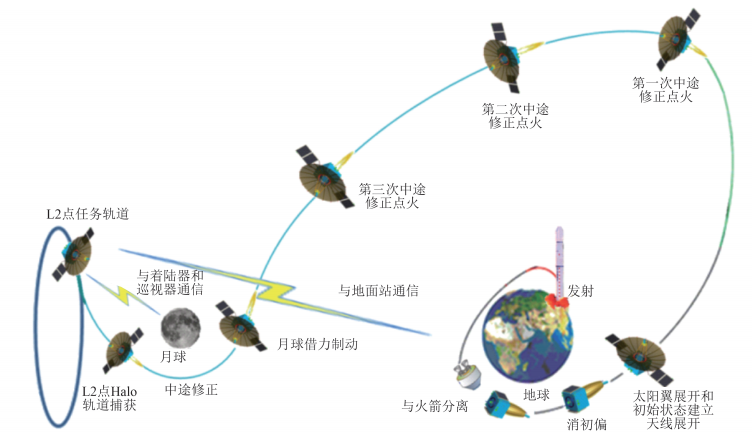
DSLWP – amatörradio i bana runt månen

DSLWP-A och DSLWP-B är två microsatelliter från Kina som under maj/juni skickats upp i bana runt månen. Det är, vad jag förstår, de första satelliterna med amatörradio ombord som är i bana runt månen! Ett par radioamatörer har lyckats ta emot telemetri på 435 och 436 MHz. Det är dock inte enkelt, det kräver en del gain i antennerna och en ganska komplicerad uppsättning programvara för att avkoda telemetri.

Det finns mycket bra information på DK3WNs sida om DSLWP. Jag hänvisar det istället för att översätta allt till svenska.
Frekvensen som gäller för DSLWP-B är 435.400/436.400 MHz, modulation är 250/500 bps GMSK/JT4G.


First Amateur Radio Transmissions from Lunar Orbit and Subsequent
Test Plan

On 2 Jun and 3 Jun we had 2 successfully tests on the UHF downlink
of DSLWP-B after lunar orbit insertion. BY2HIT and PI9CAM team
successfully decoded 39 GMSK packets from the satellite. SP5ULN and
M0IEB also detected signals from the satellite with much smaller
antenna, but the decode was not fully successful.

Two weeks ago, when the satellites were launched on 20 May, UHF
signals from both satellites was received by PY2SDR, CD3NDC, PY4ZBZ
and N6RFM.

The subsequent tests are planned from 4 Jun 22:00 UTC to 5 Jun 00:00
UTC, and from 5 Jun 08:00 UTC to 5 Jun 10:00 UTC. The mode is 250 bps
GMSK for both 435.4 MHz and 436.4 MHz.

Tracking file updates can be found on:
https://github.com/bg2bhc/dslwp_dev or
http://lilacsat.hit.edu.cn/tle/program_tracking_dslwp-b.txt

[ANS thanks Wei BG2BHC for the above information]


Categories
Ham Satellite news

Nya Cubesats från ISS 2018-05-11

Den 11 maj 2018 släpptes tre nya Cubesats ut från ISS med amatörradio ombord. Alla dessa tre har rapporterats bla. via DK3WN. Frekvenser enligt följande:

1KUNS-PF (Kenya)- NORAD CAT ID 43466 (a 3U cubesat with a 1200 bps or 9600
bps telemetry beacon at 437.300 MHz)

UBAKUSAT (Turkey)- NORAD CAT ID 43467 (a 3U cubesat with a CW beacon at
437.225 MHz, a telemetry beacon at 435.325 MHZ, and a linear transponder
with a 435.200 – 435.250 MHz downlink / 145.940 – 145.990 MHz uplink)

Irazu (Costa Rica) – NORAD CAT ID 43468 (a 1U cubesat with a 9600 bps
telemetry beacon at 436.500 MHz)

Källa: ANS-147

Categories
Ham Satellite news

Äldre keplerelement

Behöver du äldre keplerelement? AMSAT-NA har ett arkiv för detta. Se nedan:

25 Year Archive of Keplerian Elements Now on AMSAT Web Site

AMSAT Orbital Elements Manager Ray Hoad, WA5QGD    has made his archive
of orbital elements for active amateur satellites back to October 1993.
Joe Fitzgerald, KM1P has posted this on the AMSAT web site at:
http://www.amsat.org/tle/historical/   Joe commented, “Thanks for all
those bulletins, Ray. That represents a lot of work over 25 years!”

[ANS thanks Ray Hoad, WA5QGD and Joe Fitzgerald, KM1P for the above
information]

Categories
Ham Satellite news Members news

AMSAT-SM på ESA Radiomässa / SSA årsmöte 2018

AMSAT-SM besökte årets Radiomässa i Eskilstuna tillika SSA årsmöte. Runt 1000 besökare kom denna dag. Tack till alla som stannade vid vår monter och kollade på SSTV-mottagning från ISS, SDR-programvara, en modell av Funcube (AO-73) i skala 1:1 mm. Hoppas att någon blev intresserad att prova på amatörradio via satellit.

73 Lars SM0TGU