Categories
Ham Satellite news

FUNcube Operational Status Update

Complete FUNcube status (aktuell FUNcube status över samtliga satelliter):

Graham Shirville, G3VZV has posted the current status of the AMSAT-UK
FUNcube series of satellites.

FUNcube-1 (AO-73)
—————–
As you will know, AO73/FUNcube-1 has been in full sunlight for over
one month and has been transmitting continuously high power telemetry
for most of that time. This has now been changed to full time amateur
mode so the transponder is once again available. With the more stable
on board temperatures being experienced, this means that the transpon-
der frequencies are also now more stable. We expect to leave it in this
mode for some weeks so that the team can determine whether or not the
currents flowing from the solar panels are having any noticeable effect
on the spin period.

Uplink: 435.150 – 435.130 MHz CW, LSB
Downlink: 145.950 – 145.970 MHz CW, USB
Beacon: 145.935 MHz 1k2 BPSK

FUNcube-2 (UKube-1)
——————-
The FUNcube-2 transponder on UKube-1 continues to be in full time
transponder mode. There are occasional breaks in service for a few
seconds when the OBC reboots and the other onboard transmitter sends
its CW beacon.

Uplink: 435.080 – 435.060 MHz CW, LSB
Downlink: 145.930 – 145.950 MHz CW, USB
Beacon: 145.915 MHz 1k2 BPSK

FUNcube-3 (EO-88 Nayif-1)
————————-
EO88/Nayif-1 continues to perform nominally with high power telemetry
when in sunlight and amateur mode when in eclipse.

Uplink: 435.045 – 435.015 MHz CW, LSB
Downlink: 145.960 – 145.990 MHz CW, USB
Beacon: 145.940 MHz 1l2 BPSK

With their slightly different orbital characteristics it is useful that
AO73 is now the early bird, EO88 comes over in the mid morning and UKube
provides coverage in the afternoon.

We have been suffering from some network issues in relation to upload-
ing the telemetry from the Dashboards to the Data Warehouse over the
past couple of weeks. Apologies for this, but hopefully everything is
now stable again. ie fingers are still crossed. Thank you for all the
telemetry that you upload.

Like many other teams, we are presently waiting for the next Space-X
launch from Vandenberg which is expected to be carrying a number of new
amateur payloads, These will provide additional transponder and STEM
capabilities for the amateur satellite service. Exciting times ahead.

[ANS thanks Graham Shirville, G3VZV and AMSAT-UK for the above information]

Categories
Ham Satellite news

Mini Space Elevator and Digitalker Deployment From ISS

From ANS-273:

Japan’s seventh HTV mission, Kounotori 7, arrived at the ISS this
week and delivered cubesats planned for deployment on October 6:

+ STARS-Me
+ Rymansat Project RSP-00
+ SPATIUM-I

STARS-Me
——–
This mission consists of two 1U CubeSats connected by a tether which
includes a mini space elevator experiment, the climber, by Shizuoka
University. The climber has a Bluetooth connection that will transmit
its data to a ground station via a STARS-Me downlink. Radio amateurs
can monitor the behavior of the climber in the telemetry data.

Additional experiments include radio wave propagation studies, and
flight dynamics including tethered spacecraft position and rotation.

UHF downlinks will transmit CW, 1k2 AFSK and 9k6 GMSK telemetry.
Mother satellite – 437.245 MHz CW Beacon; 437.405 MHz telemetry
Daughter satellite – 437.255 MHz CW Beacon; 437.425 MHz telemetry

Rymansat Project RSP-00
———————–
The mission of RSP-00, a 1U cubesat, includes:
+ Send messages collected from the public back to Earth via a
digitalker and CW for reception by radio amateurs and school
children.

+ Image capture with on-board camera and transmit image data
with high-speed telemetry on 38k4 π/4QPSK downlink on UHF.

The downlink frequency for the digitalker, CW beacon and AFSK 1k2
packet is 145.890 MHz. The UHF downlink frequency has not been
published.

SPATIUM-I
———
SPATIUM 1 is scientific (non-amateur radio) cubesat to demonstrate
a new technique for ionosphere mapping using a constellation of
CubeSats equipped with Chip Scale Atomic Clock (CSAC) to provide
real-time three-dimensional mapping of ionosphere plasma density
at the altitudes of electron density peak (200 to 400 km above the
Earth).

[ANS thanks the satellite teams for the above information]

Categories
Ham Satellite news

Fox-1Cliff Cubesat Ready for Launch

From ANS-273:

Jerry Buxton, NØJY, AMSAT Vice-President Engineering, delivered
and performed the integration of AMSAT’s Fox-1Cliff CubeSat in
preparation for launch.

Unlike AO-85 and AO-91, AMSAT purchased a commercial launch for
Fox-1Cliff. Please consider a donation to help replenish the coffers
for GOLF and other future AMSAT projects!
https://www.amsat.org/product-category/amsat-general-donations/
https://www.amsat.org/product-category/amsat-membership/
https://www.amsat.org/product-category/amsat-presidents-club-donations/

Uplink: 435.300 MHz FM voice (67.0 Hz CTCSS tone)
1267.300 MHz FM voice (67.0 Hz CTCSS tone)
Downlink: 145.920 MHz FM voice; AFSK digital data up to 9600 bps
Transmit power: 600 mW nominal

Because only one uplink frequency can be active at a time, the use
of the Mode-L uplink will be limited to experimental periods announ-
ced in advance.

Fox-1Cliff carries the flight spare of the AO-85 Vanderbilt University
Low Energy Proton (LEP) radiation experiment, and the standard Fox-1
Penn State University–Erie gyroscope experiment. Virginia Tech pro-
vided a VGA camera which is the same as AO-92 but will provide images
at a higher 640 x 480 resolution. These non-SSTV images will be decoded
in the FoxTelem software.

Fox-1Cliff, unlike the other three Fox-1 FM spacecraft, does not have
an active AFC on the uplinks.

Fox-1Cliff’s Subaudible Telemetry (low-speed telemetry) will be the
same as for AO-85, AO-91, and AO-92. It will be supported by the same
FoxTelem software already released.

As with AO-92, a high-speed mode will be used to support the Virginia
Tech VGA camera experiment. This mode will be active for 40 minutes
by ground command, reverting to standard U/v transponder voice operation.

Fox-1Cliff is named in honor of long-time AMSAT member, contributor,
and benefactor Cliff Buttschardt, K7RR (SK), who passed away in 2016.
Cliff’s contributions to AMSAT and other amateur satellite programs,
including serving as an adviser during the initial development of the
CubeSat specification at California Polytechnic State University,
earned him the Lifetime Achievement Award from Project OSCAR in 2006.

[ANS thanks Jerry Buxton, NØJY, AMSAT Vice-President Engineering for
the above information]

Categories
Ham Satellite news

AO73/FUNcube-1 is entering a further period of full sunlight

Nu är det åter igen dags för AO-73 att vara solbelyst under en lång period. Detta gör det extra viktigt att ta emot telemetri och skicka upp till Funcube “warehouse”. Läs mer på Funcubes hemsida.

AO73/FUNcube-1 is entering a further period of full sunlight


Categories
Ham Satellite news

P4A

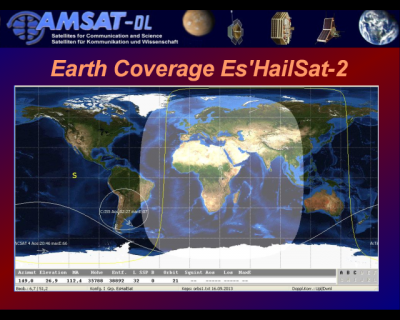
Det börjar  bli dags att förbereda mottagning av P4A  vilket blir vår första transponder i geostationär omloppsbana.
Satelliten kommer att befinna sig runt 26 grader öst.  ( Värnamo, Sweden: 165.85° & 24.08°).
Lämpligt är att använda någon gammal TV parabol men införskaffa sig en modern LNB vilka har blivit mycket stabila i och med dom digitala sändningarnas krav på stabilitet
Man matar in 12v via ett biastee  i sin LNB och får då vertikal polarisation som satelliten kommer att sända med på smalbandssegmentet.  Sedan är det lämpligt med en SDR sticka samt ett program för att kunna lyssna runt 618 MHz. (SDR sharp?)
Har man turen att bo i närheten av en 10GHz amatörradio beacon så kan man använda den för att testa sin mottagning. Tänk då på att den sänder med horisontell polarisation och vid 12v matning av LNB så ligger polarisationen i linje med F kontakterna där man ansluter koax.
Man kan med andra ord lägga parabolen på sidan samt ställa ner elevationspunkten på parabolen så nära noll som möjligt.   För att få en aning om var man riktar då det hela ser lite märkligt ut använder man solen som bruskälla för att få en känsla på rätt riktning för att därefter rikta in radiofyren.
Man får en väldigt tydlig solbrushöjning när man låter parabolen titta in i solen, och man slås direkt av tanken på hur smal loben är även på en sådan här liten vanlig TV parabol.
Är man med så här långt så kan man vara med vid dom första testsändningarna i vinter.  Vad det gäller att sända mot satelliten så får det bli en senare fråga då vi endast har tillstånd för 100mW inmatat i antennsystemet på 2,4GHz.
Vi samarbetar med SSA VUSHF sektion i den här frågan.

Categories
Ham Satellite news

CAMSAT CAS-6 Satellite Receives IARU Frequency Coordination

Nästa CAMSAT är på väg och som vanligt möjligheter till amatörradio!

Alan Kung, BA1DU reported that CAMSAT plans to launch CAS-6, a 50 kg
micro-satellite approx. 490 x 499 x 430 mm. A sea launch is planned
for September, 2018 from the China Academy of Launch Vehicle Technology
into a 579 x 579 km 45 degree orbit.

The mission will include:
+ VHF CW Telemetry Beacon
+ U/V Mode 20 kHz Linear Transponder
+ AX.25 4.8k baud GMSK telemetry downlink
+ Deployable Antennas
+ Solar Panels, Lithium ion battery and power controller
+ Integrated Housekeeping Unit
+ Three-axis stabilization system
+ Atmospheric Wind detector
+ S-band TT&C system (non-amateur radio band)
+ X-band Data link system (non-amateur radio band)

The following frequencies have been coordinated by the IARU:

+ VHF/UHF linear transponder
Uplink: 435.280 MHz
Downlink: 145.925 MHz
+ CW telemetry beacon: 145.910 MHz,
+ Telemetry: 145.890 MHz