Categories
Antennas

Ny portabel VHF/UHF yagi

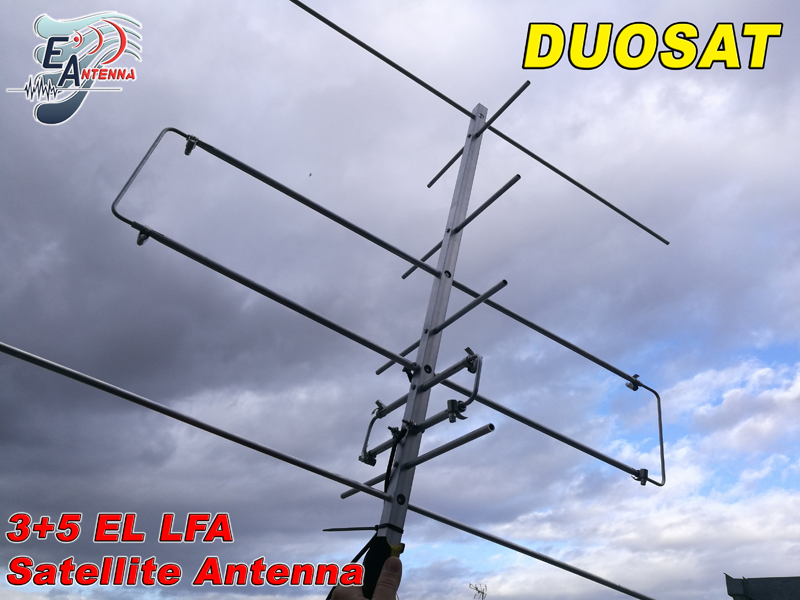
Från antenntillverkaren EAntenna har det kommit en ny portabel VHF/UHF yagi, lämplig för satellittrafik. Modellen heter EAntenna DUOSAT och verkar få ett pris strax under 100 EUR. Eftersom den är tillverkad i Spanien kan priset bli konkurrenskraftigt jämfört med de två andra modeller som finns på marknaden – Arrow och Elk – båda från USA Det verkar även följa med en diplexer vilket gör priset ännu mer attraktivt.

Modellen skiljer sig något från Arrow då det är en LFA-antenn dvs. drivelementen är en loop. Några data enligt tillverkaren:

Gain dBi VHF: 8,87 dB
Gain dBi UHF: 11,38 dB
Längd: 0,89m
Vikt: 0,8 kg

Mer info och bilder finns hos EAntenna.

Jag återkommer med mera information när det finns recensioner ute från användare.

Categories
Members news

AMSAT-SM donerar 100 EUR till Mike DK3WN

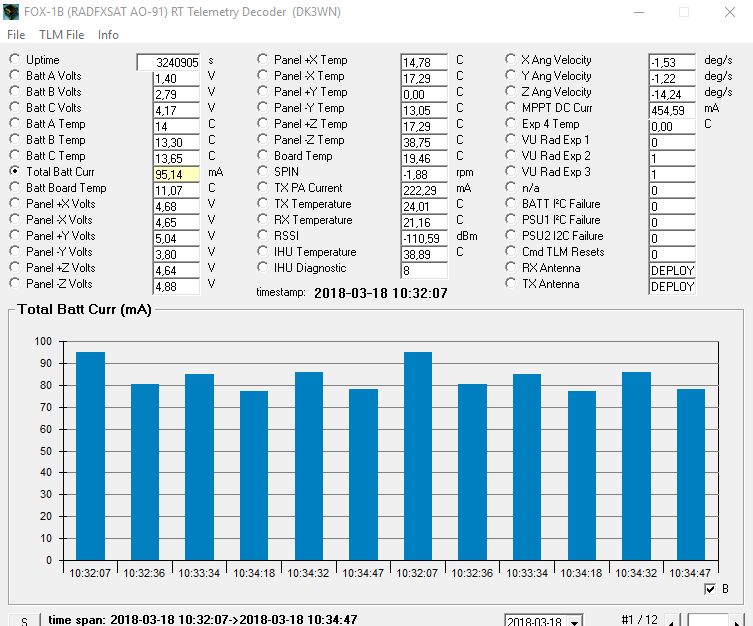
AMSAT-SM styrelse har beslutat att donera 100 EUR till Mike Rupprecht, DK3WN, för hans utmärkta arbete under åren med avkodningsprogram för telemetri från amatörradiosatelliter. Har har bidragit till ökad förståelse för telemetrimottagning och hjälp både studenter och radioamatörer. Dessutom innehåller hans hemsida senaste nytt runt telemetri och en alltid aktuell frekvenslista.

AMSAT-SM stadgar punkt 2 kan anses gälla som bakgrund för besultet:
“…vars ändamål är att främja tekniskt framåtskridande, främst inom satellitkommunikation och rymdteknologi genom att bland radioamatörer stimulera intresset för forskning och vetenskap, speciellt inom området avancerad radiokommunikation.”

DK3WN hemsida finner du här.

Styrelsen
2018-02-09

Categories
Telemetry

PicSat telemetry 2018-01-28

New PicSat @lampicsat decoder from @dk3wn  Thank you!

Categories
Ham Satellite news

AO-92 är nu öppen för amatörradiobruk

Nu är AO-92 öppen för amatörradiobruk, eller som det kallas på satellitspråk “Commissioned”. Nedan kan du läsa det officiella meddelandet inkl. en bra frekvensguide:

On the 03:25 UTC pass on January 26, 2018, AMSAT Vice President –
Engineering Jerry Buxton, N0JY, announced that AO-92 had been
commissioned and formally turned the satellite over to AMSAT
Operations. AMSAT Vice President – Operations Drew Glasbrenner, KO4MA,
then declared that AO-92 was now open for amateur use.

Initially, the U/v FM transponder will be open continuously for a
period of one week. After the first week, operations will be scheduled
between the U/v FM transponder, L-Band Downshifter, Virginia Tech
Camera, and the University of Iowa’s High Energy Radiation CubeSat
Instrument (HERCI).

Schedule updates will appear in the AMSAT News Service Weekly
Bulletins and will also be posted to the AMSAT-BB, AMSAT’s Twitter
account (@AMSAT), the AMSAT North America Facebook group, and the
AMSAT website at https://www.amsat.org/satellite-schedules/

AO-92 was launched on the PSLV-C40 mission from Satish Dhawan Space
Centre in Sriharikota, India on January 12, 2018. For the past two
weeks, the AMSAT Engineering and Operations teams have been testing
the various modes and experiments on board. Testing has shown that
both the U/v FM transponder and L-Band Downshifter work very well. The
Virginia Tech camera has returned stunning photos and data from HERCI
has been successfully downlinked.

AMSAT thanks the 178 stations worldwide that have used FoxTelem to
collect telemetry and experiment data from AO-92 during the
commissioning process. The collection of this data is crucial to the
missions of AMSAT’s Fox-1 satellites. Please continue to collect data
from AO-85, AO-91, and AO-92.

RADIO PROGRAMMING CHART
Fox-1D Doppler Shift Correction

Memory 1 (AOS) – TX 435.340 MHz (67.0 Hz Tone), RX 145.880 MHz
Memory 2 (Rise) – TX 435.345 MHz (67.0 Hz Tone), RX 145.880 MHz
Memory 3 (TCA) – TX 435.350 MHz (67.0 Hz Tone), RX 145.880 MHz
Memory 4 (Descend) – TX 435.355 MHz (67.0 Hz Tone), RX 145.880 MHz
Memory 5 (LOS) – TX 435.360 MHz (67.0 Hz Tone), RX 145.880 MHz

The L-band experiment will use 1267.350 MHz uplink with 145.880 MHz
downlink. UHF and L-band uplink operation are set by the command
stations; the operating schedule will be posted.

[ANS thanks AMSAT Vice-President Engineering, Jerry Buxton, NØJY,
AMSAT Vice President Operatings Drew Glasbrenner, KO4MA, and AMSAT
Executive Vice President Paul Stoetzer, N8HM for the above information]


Categories
Telemetry

Decode telemetry from PicSat

PicSat (was launched on the same PSLV-C40 flight from India that delivered AO-92 to orbit) has a telemetry downlink on aprox. 435.525 MHz USB +/- doppler. The format is 1k2 BPSK AX25 and can be decoded using different software.

The downlink is strong if using some kind of Yagi. I’m using 2 * 13 el Yagi with fixed RHCP polarization and have good signal during most of the pass.

I will try to give a short guide how to use the software needed for decoding. First your have to feed the audio into your computer, if using SDR sw use an audio pipe software (like VB Audio), if using external radio use your computer soundcard.

First your need to decode the 1k2 BPSK audio, this can be done with Soundmodem. Be sure to use the version that can be found in “other-versions.zip”.

Then you need to decode the KISS data with AGWOnlineKISS from DK3WN. AGWOnlineKISS connects to Soundmodem be default:

AGWOnlineKISS creates kss (KISS) files that can be imported with DK3WN software KISSDump+:

From this software export as HEX (Write -> Complete frame). Now you have a txt-file with telemetry data as HEX values.

All DK3WN software above can be downloaded here.

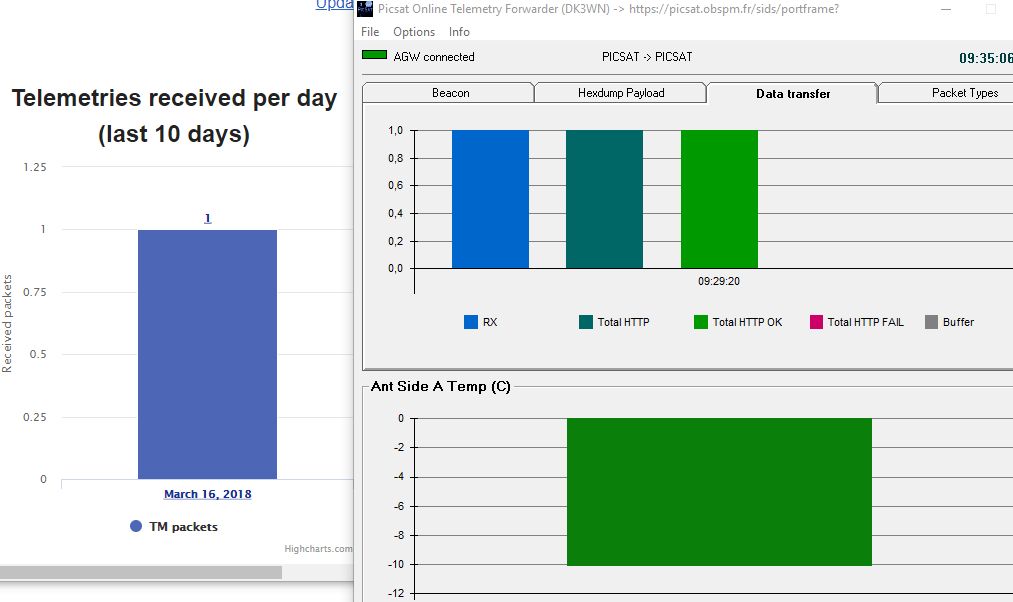
Now you need to go to the PicSat webpage and create an account. Here you can manually upload one frame at a time or upload the HEX-file you created. The HEX-file will be handled by the server at 01.00 UTC. If all is OK, you can see that you have uploaded telemetry OK:

Categories
Ham Satellite news

AO-92 L-band testad

Det finns en del ny information om arbetet med AO-92 och L-bandstesterna (se även videon nedan).

“The AMSAT Engineering and Operations teams have been hard at work testing the various modes and experiments aboard AO-92 since its launch on January 12th. Since the last update, testing has concentrated on the University of Iowa’s High Energy CubeSat Radiation Instrument (HERCI) experiment and the AMSAT L-Band Downshifter.”

Läs mer på:

AO-92 Commissioning Update: HERCI Experiment and L-Band Downshifter Tested