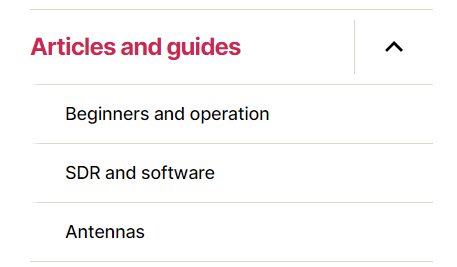
We have done some cleanup in the articles and posts on AMSAT-SM website. The “How to…”-articles and guidelines are now under three submenus:
Some articles can be found under more then one submenu, for example if it covers both “Beginners” and “SDR”.
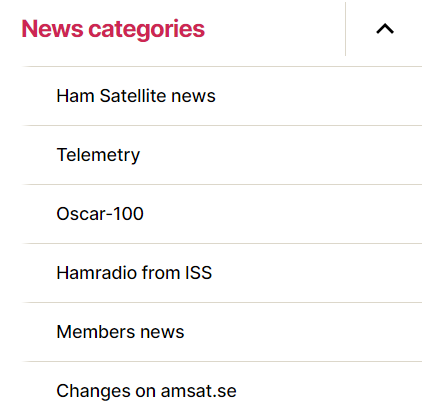
In news categories you find news in different areas. Some of these posts can also be categorized as an article and also be found under “Articles and guides”.
We also use tags. Let’s say you read a post about IC-705. If you would like to read all posts about IC-705 then click on the tag at the bottom of the post.
Finally, you can of course search in all posts and articles.
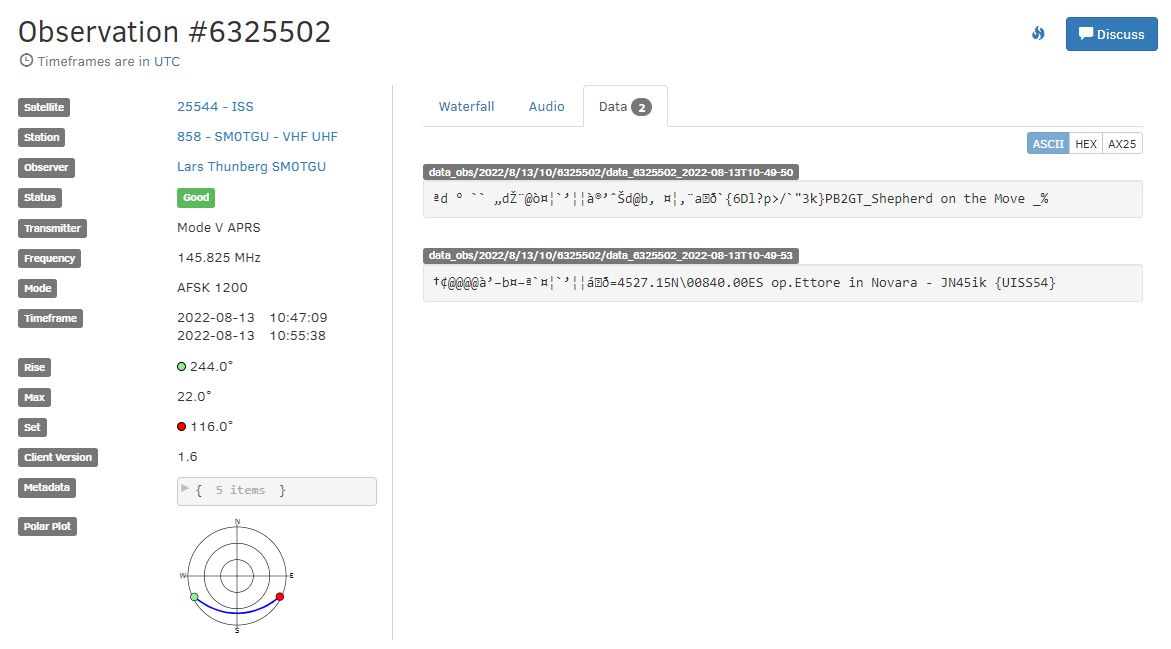
ARISS is pleased to announce that starting yesterday, August 11, simultaneous operations of the ARISS Voice Repeater and digital APRS communications on the International Space Station (ISS) is now a reality. Current ARISS operations include voice repeater transmissions with the JVC Kenwood D710GA in the Columbus module and APRS packet operation from an identical radio in the Service Module (Zvezda). Packet operations are on 145.825 MHz.
The ARISS Russia and USA teams have been working for several weeks to prepare the Service Module radio for APRS operations. ARISS Russia team member Sergey Samburov, RV3DR, led the effort, working with Russian mission controllers and the on-board ISS cosmonauts to configure the Service Module radio for APRS ops. On August 11, final checkouts were completed and the APRS packet mode was switched on for amateur radio use.
ARISS-International Chair Frank Bauer, KA3HDO states, “Simultaneous operation of APRS and the voice repeater on ISS is transformative for ARISS and represents a key element of our ARISS 2.0 initiative, providing interactive capabilities 24/7 that inspire, engage and educate youth and lifelong learners—especially life-long learning in ham radio operations.” Bauer continues, “Our heartfelt thanks to Sergey Samburov, RV3DR, for making this crucial ARISS 2.0 initiative become a reality.”
The Columbus Module radio uses the callsign NA1SS and the new Service Module radio uses RS0ISS. Aside from the callsigns, the radios are identical and packet operations are the same as before. You can use RS0ISS, ARISS, or APRSAT as the packet path. Also, both radios are expected to be on full time, except during educational contacts, EVAs, and dockings or undockings.
You can find operational status and expected downtimes of the ISS radios at https://www.ariss.org/current-status-of-iss-stations.
[ANS thanks Dave Jordan, AA4KN, ARISS PR, for the above information]
From ANS-212 Drew Glasbrenner, KO4MA, AO-91 Control Operator, and Mark Johns, K0JM:
Recent abuses on AO-91, and continued bedlam on FM satellites generally, have raised a growing number of complaints among operators and control stations. Here are some tips to help everyone enjoy these satellites and avoid being labeled as a bad actor:
LISTEN! These satellites are almost always busy when over populated areas. If you aren’t hearing activity on the downlink, it is unwise to make a “blind” call on the uplink frequency. Getting into the satellite is often easier than hearing it. Make certain you copy the downlink before transmitting.
NO CQs. FM satellites have a single channel and many stations are attempting to use the channel in a limited time. There is no time for calling CQ, or for repeatedly announcing your own call. Instead, listen for stations already active on the pass, and when you have an opportunity, make a call to a specific station you wish to work.
BE COURTEOUS. If Station A calls Station B, give Station B at least a millisecond or two to answer, and let them complete their brief QSO. Avoid interrupting or jumping on top of a contact in progress. Give priority to rovers or other special stations that many are anxious to contact.
BE WELCOMING. Make an effort to make calls to unfamiliar callsigns you’ve not yet worked before. Let newcomers have a chance, rather than shutting them out to say hello to stations you greet everyday.
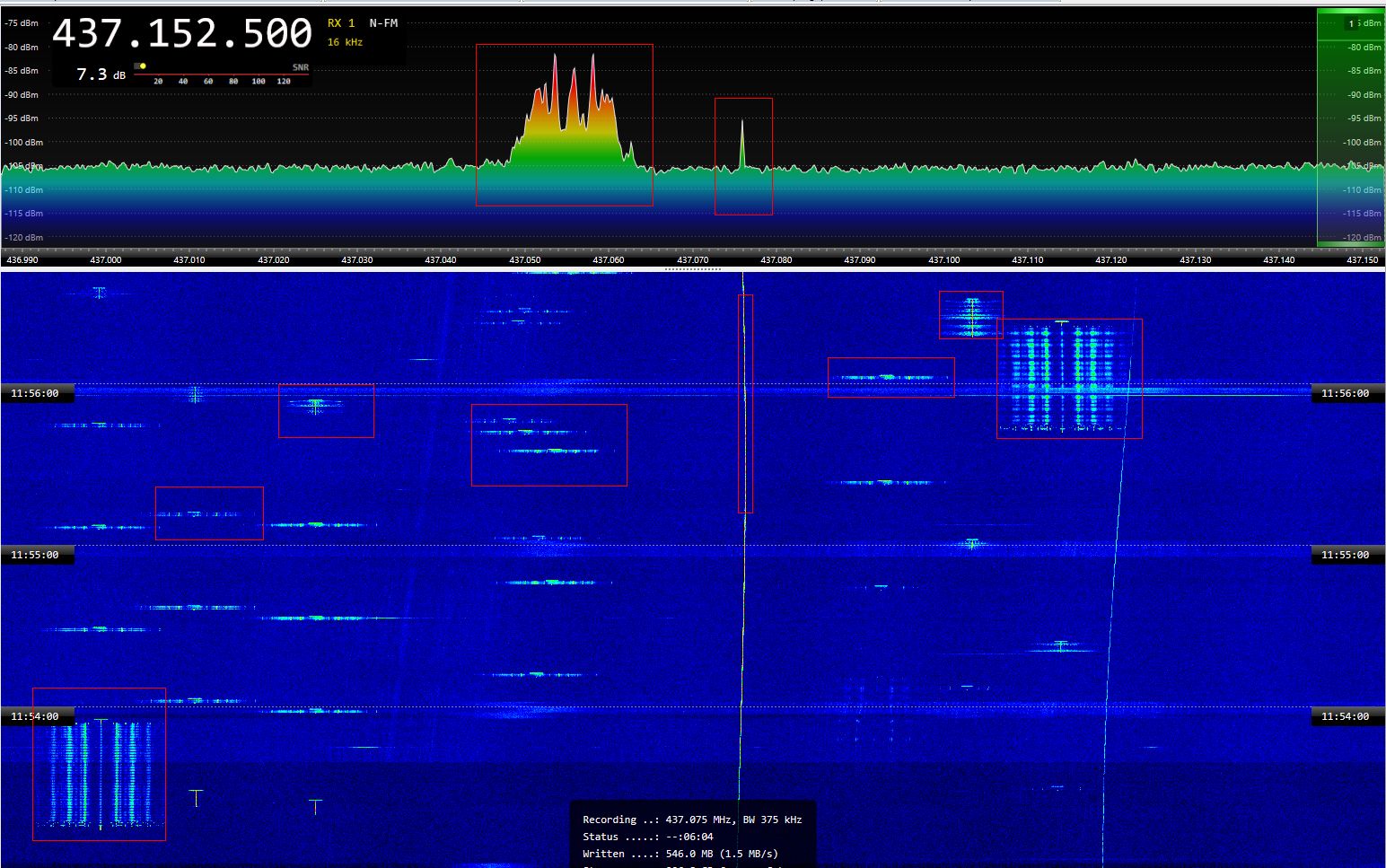
DON’T BE A LID! Do “testing,” whistling, or “hello” someplace else. Modes other than FM voice have no place on these satellites. If you wish to experiment with FT modes, please feel free to do so on AO-109, but definitely NOT on an FM satellite.