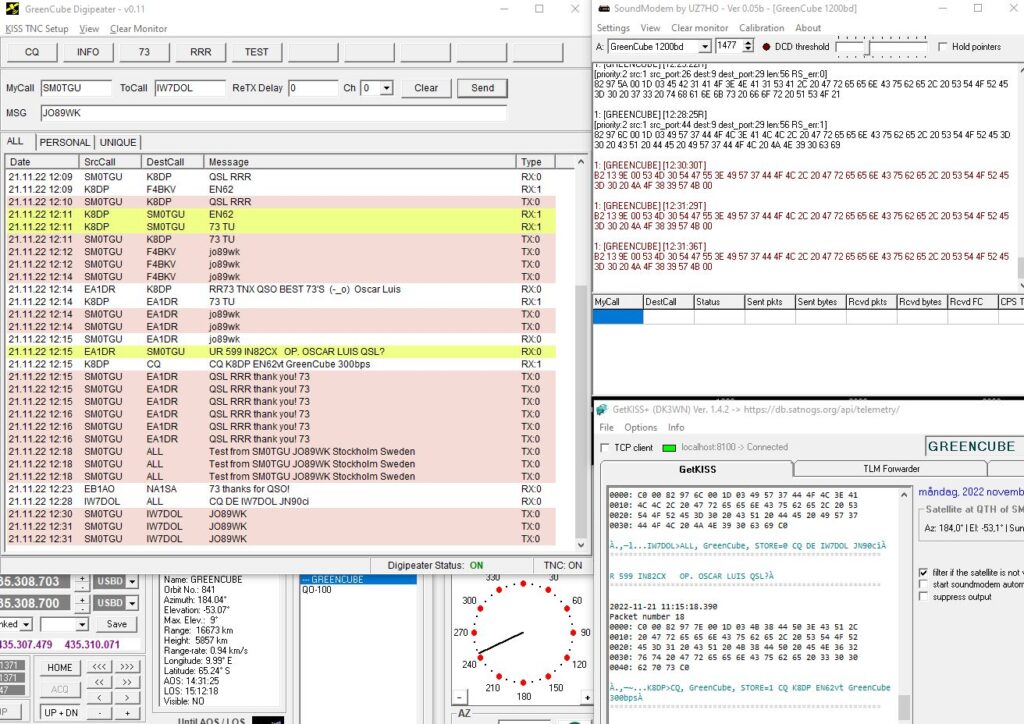
Managed to work two QSOs today with GreenCube at 300bd. K8DP and EA1DR. I think the decode was a little bit better with 300bd then 1200bd. TX power was about 30 watts and no problem getting in on the satellite.
 AMSAT-SM - Official Website of AMSAT-SM Sweden
Webmaster and member of the AMSAT-SM steering group.
Managed to work two QSOs today with GreenCube at 300bd. K8DP and EA1DR. I think the decode was a little bit better with 300bd then 1200bd. TX power was about 30 watts and no problem getting in on the satellite.
@FG8OJ has made an excellent guide of working GreenCube digipeater with IC-9700 and supporting software. I will not write a new guide as Burts guide fully covers everything.
Valid exchange messages for a QSO should be:
You can look at FT8 needed exchange : 2 exchanges from each side:
A:Grid
B:Report
A:R + Report
B:RR73
or
A:Report
B:R + Report
A:RR73
B:73

This is a re-post from ANS-324
As of Nov. 18, a total of 135 stations digipeated via the Italian GreenCube satellite. These stations represent 31 DXCC entities. Stations now report using various combinations of software to operated through the satellite. One constant is using SatPC32ISS for antenna tracking and doppler correction.
The S5Lab GreenCube team software is a bit more complicated and at the beginning that was all that was available. It used three programs, including GNURadio, GreenCubeTNC and GreenCubeDigi.
However, UZ7HO quickly created the digi app and custom soundmodem after the S5Lab release, most everyone has migrated to UZ7HO now. Note: UZ7HO has updated the program from time to time, so download it again once in a while to get the updates. It is available at: https://uz7.ho.ua/greentnc.zip (There are both FM and SSB soundmodems included in the package, but the FM one can ignored, as all are using USB-D for both uplink and downlink.) Note matching the rig bandpass filter with the Soundmodem one (900-2100 Hz) helps to have a better S/N particularly if you have local QRM.
The radio will interface with soundmodem via a soundcard or virtual audio cable. Soundmodem.exe is located in the \greentnc\usb directory, and is a separate program. This program needs to be configured to connect with your radio’s audio interface. The digipeater software is in the client directory, called GreenCubeDigi.exe. GreenCubeDigi automatically connects to soundmodem via TCP. So you should have two programs running, one the TNC and the other the digi “terminal.”
Ops may add GetKISS+ software, by Mike Rupprecht, DK3WN, in order to upload received packets to SatNOGS. This isn’t necessary, but it does help add coverage for telemetry. This software is a bit tricky to get working, but once you have one of Mike’s programs running other programs will work without any issues. Mike’s software can be found here: https://www.satblog.info/software/
Doug Papay, K8DP, recommends installing GetKISS+ v1.4.1 (he could not get v1.4.2 to work). It requires VB6 runtime, which should already be installed, and the ActiveX OCX controls need to be registered. See: https://www.pe0sat.vgnet.nl/decoding/tlm-decoding-software/dk3wn/ for instructions on how to do this. Make sure to run the command prompt as Administrator when performing the regsrv32.exe commands. Also, do not delete or move the OCX files after registering them. (The OCX files should be placed in C:\Libraries\OCX folder)
Mike also has a GreenCube Telemetry Decoder that you can download—it is a nice program that graphically displays the telemetry. He has also added a digipeater message display and list of unique callsigns heard—a nice feature.
The config.ini files will need to be updated to reflect your station details. These files are located in the folder where you keep GetKISS+ and GreenCube Telemetry Decoder.
GetKISS+ and GreenCube Telemetry Decoder connect via TCP to the soundmodem all using the same IP (localhost) and port number.
Some have been confused by the lack of an ACK message after transmitting a packet to the satellite. It is sent only if the Tx delay is used. However, it is better to use Tx delay 0 for real-time QSOs to avoid unnecessary transmission by the bird (saving on-board power). With Tx delay 0 you will receive your own message as an acknowledgement.
[ANS thanks Doup Papay, K8DP, and Jean Marc Momple, 3B8DU, for the above information]
Updated 2022-11-20:
AMSAT-China, or CAMSAT, http://www.camsat.cn, has announced December 18 as the release date for CAS-10/XW-4. Photos of this satellite may be seen at:
https://twitter.com/bd5rv/status/1592978613204586496 and
https://twitter.com/bd5rv/status/1593693879798497285
As previously reported by ANS, CAMSAT’s CAS-10/XW-4 satellite was launched on November 12, 2022, carried on the Tianzhou 5 cargo spacecraft to the Chinese Space Station. The satellite will be active immediately upon deployment into its own 400 km orbit with an inclination of 42.9 degrees. CAS-10 carries a VHF uplink and UHF downlink linear transponder with a bandwidth of 30kHz. Downlink frequencies for VHF/UHF linear transponder 435.180 MHz, for UHF CW telemetry beacon 435.575 MHz and for GMSK telemetry 435.725 MHz. Also an uplink for the transponder 145.870 MHz have been coordinated.
[ANS thanks Michael Chen, BD5RV/4, for the above information]
Repost from ANS-317:
CAMSAT’s CAS-10 (XW-4) satellite was launched on November 12, 2022, carried on the Tianzhou 5 cargo spacecraft to the Chinese Space Station. Deployment from the Chinese Space Station is expected on or about December 15th. The satellite will be active immediately upon deployment into its own 400 km orbit with an inclination of 42.9 degrees.
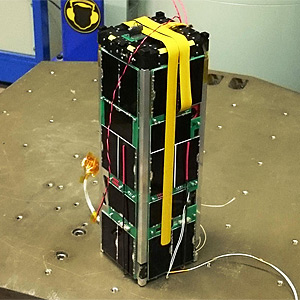
CAS 10 is an 8U CubeSat approx 228x455x100mm with 12kg Mass. A follow on mission from CAS-9 and also known as Hope-4 (XW-4) Carrying a V/U Mode Linear Transponder, a UHF – CW Telemetry Beacon, a UHF – AX.25 4.8k/9.6kbps GMSK Telemetry downlink and a space camera.
CAS-10 carries a VHF uplink and UHF downlink linear transponder with a bandwidth of 30kHz. This transponder will work all day during the life cycle of the satellite, and amateur radio enthusiasts around the globe can use it for two-way radio relay communications.
CAS-10 carries a camera, and the pictures it takes are stored in the flash memory on the satellite, we have designed a simple remote control system based on DTMF, and amateur radio enthusiasts around the globe can send DTMF commands to download the camera photos.
CW beacon uses Morse code to send satellite telemetry data, which is also a feature that is widely welcomed by amateur radio enthusiasts.
Downlink frequencies for VHF/UHF linear transponder 435.180 MHz, for UHF CW telemetry beacon 435.575 MHz and for telemetry 435.725 MHz. Also an uplink for the transponder 145.870 MHz have been coordinated.
[ANS thanks Alan Kung, BA1DU, CAMSAT, for the above information]
Reposted from ANS-303:
MESAT-1 to Carry AMSAT Linear Transponder Module
An AMSAT-constructed linear transponder module is included in the MESAT 3U satellite to be deployed as part of NASA’s upcoming ELaNa 43 mission.
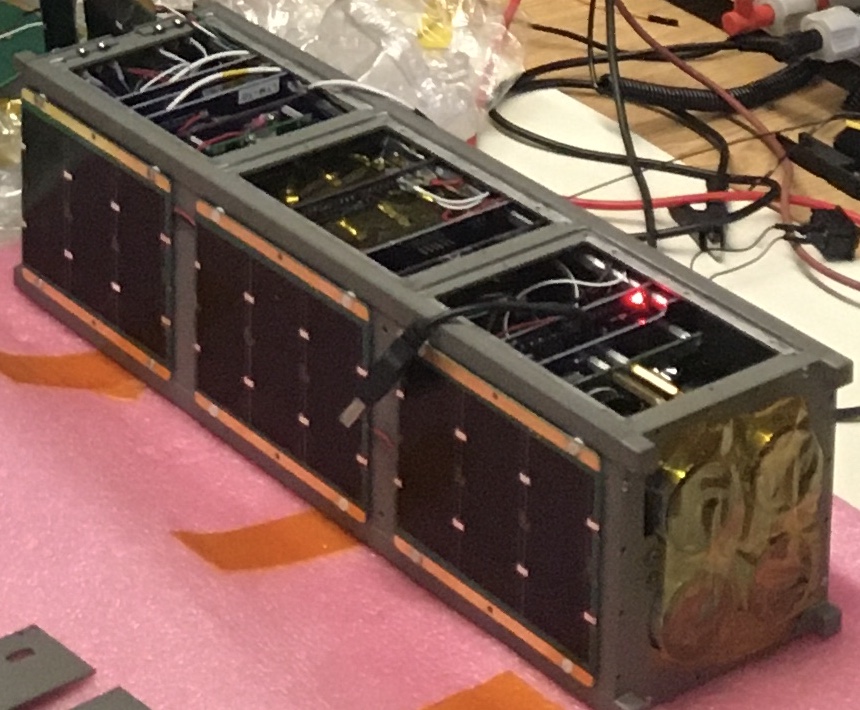
MESAT-1 is a stack of three tech-stuffed 4-inch cubes assembled at the University of Maine and destined for space in 2022. The first satellite of its kind ever built in Maine, MESAT-1 carries three imaging experiments proposed by Maine schools and a 2-way radio for use by ground control and amateur radio enthusiasts.
MESAT-1 was originally projected to launch from Vandenberg Space Force Base, California, in June 2022, but has been delayed. The satellite will be carried by a Firefly Aerospace “Alpha” rocket and released into a Sun-synchronous orbit about 555 kilometers (350 miles) above Earth. It will fly nearly over the poles traveling at about 7.8 kilometers per second (17,000 mph), making a full orbit in roughly 100 minutes. Any given location on Earth will experience 4 to 6 passes per day, with each pass lasting less than 15 minutes. MESAT-1 is expected to remain in space for well over a decade.
A statewide competition in 2019 drew payload proposals from schools across Maine. Three projects were selected for the MESAT-1 mission: ALBEDO, IMAGER, and HAB.
ALBEDO: Saco Middle School will study reflected light (albedo) and local temperature in urban and rural areas, with the idea that urban heat islands could be mitigated through architectural designs that reflect more light.
IMAGER: Fryeburg Academy will photograph shallow coastal waters as part of an effort to distinguish turbidity and phytoplankton concentration from space. The academy is collaborating with the Wells National Estuarine Research Reserve.
HAB: Falmouth High School will work on early detection of harmful algal blooms by measuring atmospheric temperature and water vapor levels around bloom areas. They will watch blooms develop, move, and disperse.
The main radio aboard MESAT-1 is a linear transponder module (LTM-1) built by the nonprofit Radio Amateur Satellite Corporation (AMSAT), a partner in the project. The ground station operator will command the satellite through LTM-1 and the module will transmit telemetry back to Earth. LTM-1 will also be made available to amateur radio operators for 2-way communication.
UMaine applied to the International Amateur Radio Union to coordinate its planned frequency use for MESAT-1. The IARU approved this plan on 22 November 2021:
Telemetry beacon downlink: 435.800 MHz 1200 baud BPSK
Transponder uplink: 145.910-145.940 MHz
Transponder downlink: 435.810-435.840 MHz
MESAT-1 carries a second radio, an EyeStar transmitter, originally intended to interface with the satellite’s built-in GPS and the GlobalStar network to provide the ground team with accurate, hourly position information. This aspect of the mission was altered during MESAT-1 construction. The EyeStar unit will serve only a minimal function on MESAT-1.
Background on Maine’s First CubeSat
MESAT-1 exists thanks to NASA’s CubeSat Launch Initiative (CSLI) and the Maine Space Grant Consortium. Through CSLI, NASA has selected more than 200 CubeSat missions for the Educational Launch of Nanosatellites program. More than 130 ELaNA satellites have been launched at NASA’s expense since 2011.
In 2018, Maine Space Grant kicked off a pilot Maine CubeSat Launch Initiative to involve students and teachers from across the state in designing CubeSat missions. Through a competitive process, the consortium selected three experiments to propose for NASA’s 2019 ELaNa opportunity.
The MESAT-1 proposal was accepted by NASA early in 2020. The satellite was paired with launch provider Firefly Aerospace for ELaNa mission 43.
Dr. Ali Abedi, director of the WiSe-Net Lab at UMaine Orono, assigned three UMaine graduate students the task of producing the satellite. With the support of the Maine Space Grant Consortium, they completed MESAT-1 in time for a 2022 launch.
[ANS thanks mainesat.org for the above information]
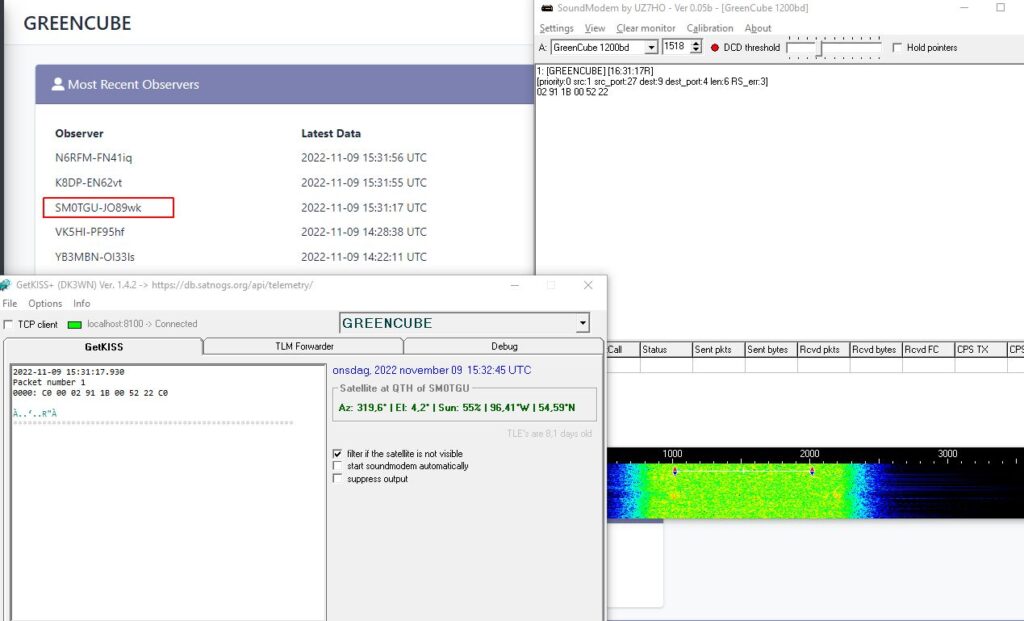
At 4 degree elevation from Stockholm Sweden, uploaded to #satnogs with GetKiss+ Distance to satellite over 10000 km.