Categories
Telemetry

LEDSAT telemetry 2023-07-02

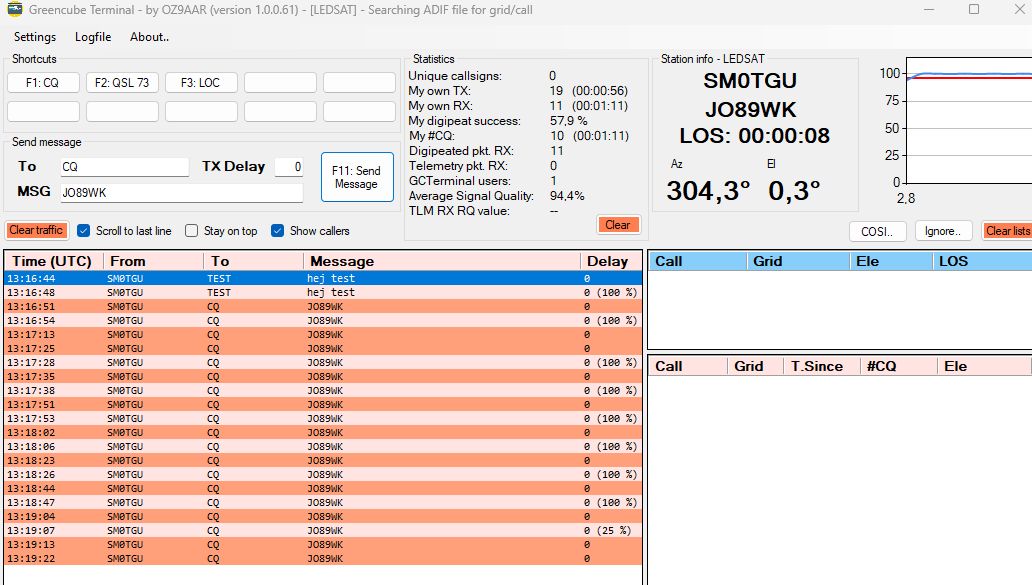
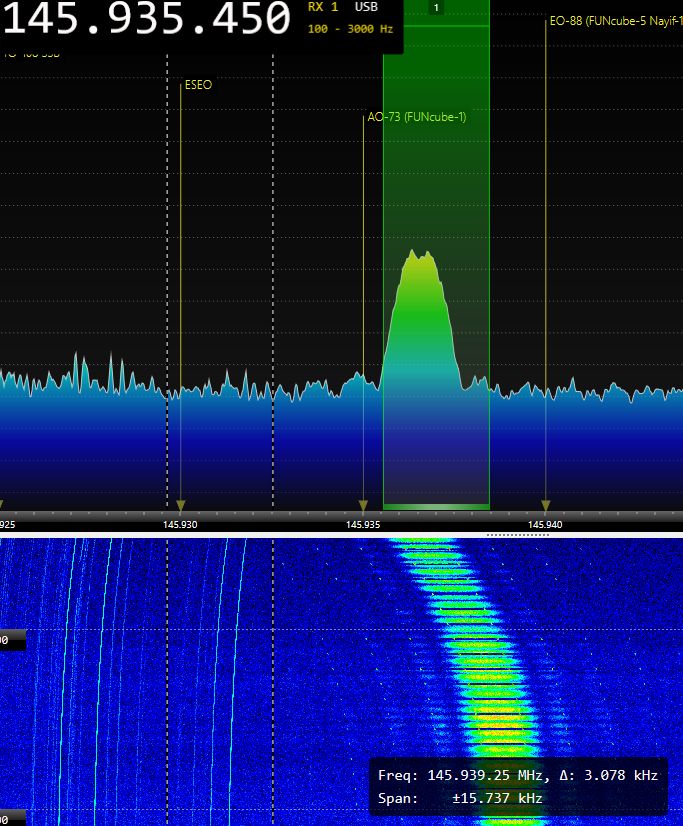
@LEDSAT_Team telemetry over Stockholm 2023-07-02. Good copy, nice S/N, but strong local interference. Software and hardware used:

  • RX at aprox 435.188 MHz USB
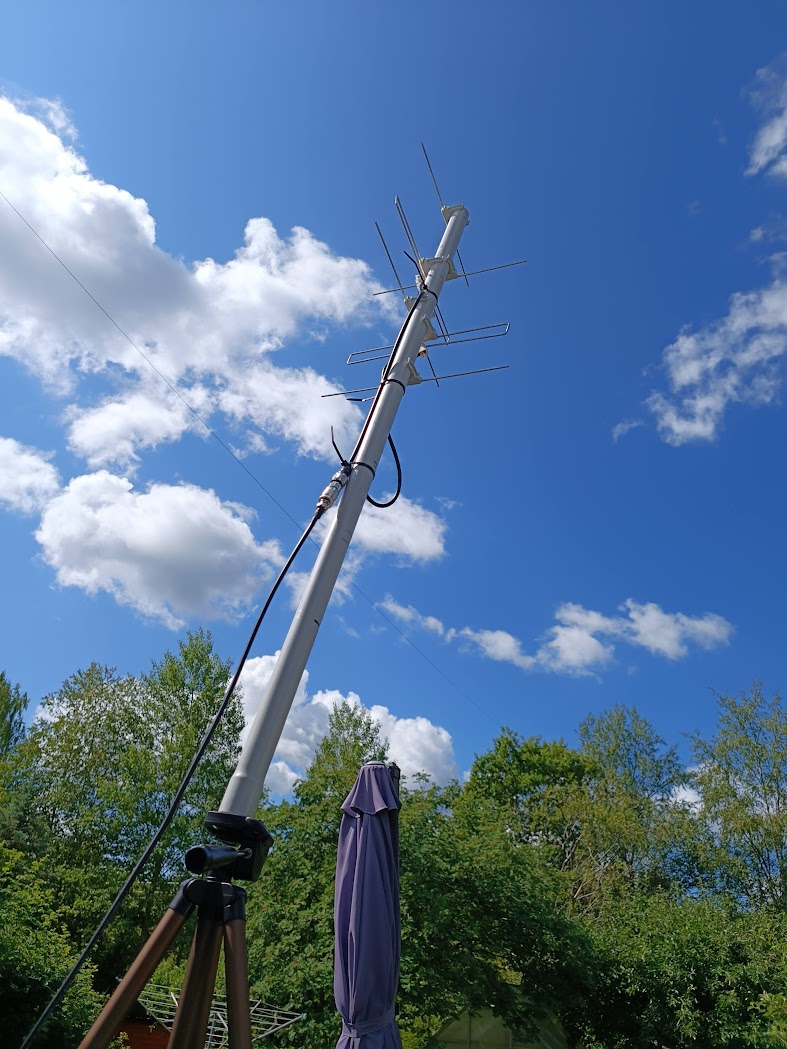
  • 2 x 13 el LFA X-Yagi (InnovAntenna) switched between HOR and VER polarisation
  • AlfaSpid RAS az/el rotor
  • LNA Mini-70 from SHF Elektronik
  • LMR-400 coax
  • Airspy Mini SDR
  • SDR-Console v3 with doppler correction of downlink and satellite tracking, rotor control
  • PstRotator for rotor control interface between SDR-Console and RAS controller
  • VB-Cable: virtual audio cable for piping audio from SDR Console to Soundmodem. Set to 96 kHz and 16 bit.
  • Greencube Soundmodem v0.08b at mode 1200bd
  • GetKISS+ v 1.4.2 from DK3WN for sending telemetry to SatNOGS dB
Categories
Telemetry

CubeBel-2 received 2023-07-02

CubeBel-2 telemetry @EU1SAT over Stockholm ar 2023-07-02. Software and hardware used:

  • RX at aprox 436.991 MHz Wide FM BW 12 kHz
  • 2 x 13 el LFA X-Yagi (InnovAntenna) switched between HOR and VER polarisation
  • AlfaSpid RAS az/el rotor
  • LNA Mini-70 from SHF Elektronik
  • LMR-400 coax
  • Airspy Mini SDR
  • SDR-Console v3 with doppler correction of downlink and satellite tracking, rotor control
  • PstRotator for rotor control interface between SDR-Console and RAS controller
  • VB-Cable: virtual audio cable for piping audio from SDR Console to Soundmodem. Set to 96 kHz and 16 bit.
  • HS-Soundmodem v0.27 at mode FSK G3RUH 9600bd.
  • GetKISS+ v 1.4.2 from DK3WN for sending telemetry to SatNOGS dB
Categories
Ham Satellite news

URESAT-1 Deployed

Information from ANS-176 and AMSAT-EA

The URESAT-1 satellite, also known as HADES-B according to its ITU designation, successfully launched into space as part of the SpaceX Transporter-8 mission from Vandenberg AFB on Monday, June 12. The satellite is a joint effort between AMSAT-EA, URE (the Spanish equivalent of ARRL), private companies, and universities.

The URESAT-1 satellite, contained within the D-Orbit ION Orbital Transfer Vehicle (OTV), was not deployed directly from the Falcon-9 rocket. Instead, approximately one hour and twenty minutes after launch, the Falcon-9 released the OTV. URESAT-1 was deployed from the OTV at approximately 12:10 UTC on June 22, 2023. As of this writing, signals have not yet been received from the satellite.

One of the primary objectives of URESAT-1 is to serve as an FM voice and FSK data repeater. Equipped with a Slow Scan Television (SSTV) camera, the satellite will transmit live images as well as stored images at regular intervals. It also features a chess game, enabling players on Earth to engage in a game against the satellite. Periodically, the satellite will transmit updates on the state of the game, including the chess board, the last movement made, and whether the next move belongs to the players or the satellite.

The specified frequencies for communication with URESAT-1 are as follows: for uplink transmissions, 145.975 MHz or 145.925 MHz (auxiliary frequency) using FM voice without subtone, FSK 50 bps, AFSK, AX.25, APRS 1200/2400 bps. For downlink transmissions, the frequency is set at 436.888 MHz, and modes include FM voice, CW, FSK 50 bps telemetry, SSTV Robot 36, and a voice beacon with the callsign AO4URE.

To provide further information regarding URESAT-1’s transmissions, the AMSAT-EA organization has made available a comprehensive document that can be accessed at the following link: https://www.amsat-ea.org/app/download/13366685/AMSAT+EA+-+URESAT-1+Transmissions+description.pdf

For those interested in decoding the telemetry, a Linux x86/ARM decoder is available for download at the following link: https://www.amsat-ea.org/app/download/13395017/URESAT-1_telemetry_decoder_Linux_X86_ARM_v1.0.zip

A sample file containing the audio of a telemetry file can be found here: https://www.amsat-ea.org/app/download/13398144/URESAT-1_sample_FSK_telemetry-chessboard_packet.wav

If URESAT-1 operates as intended, the project team plans to release a Linux program that will allow players to send their chess moves to the satellite, further enhancing the interactive experience.

[ANS thanks Félix Páez, EA4GQS, AMSAT-EA President for the above information]

Categories
Ham Satellite news

EO88 re-entry

Info from g3vzv / FunCube web

As everyone is aware, Solar Cycle 25 has already shown that we cannot yet predict what the sun will be doing with any great accuracy.

Sunspots, X-class solar flares and CMEs (coronal mass ejections) are increasing in frequency and intensity on a daily basis.

The peak of Solar Cycle 25 was not expected until late 2024 or early 2025 but it may be coming earlier and have a higher intensity than was predicted.

One result of this increased activity is that the upper atmosphere and ionosphere of the earth becomes warmer and expands upwards. This means that spacecraft in low earth orbit experience more drag or resistance as a result of the increase in the number atoms they are having to displace as they travel around the globe. As a consequence, the spacecraft loose more kinetic energy and start to descend lower in orbital height, which, of course, makes the problem worse and a fiery end to the spacecraft is hastened.

The actual effect is also dependant on the drag coefficient of the particular spacecraft…simply how much mass (the more the better) to how much surface area (the less the better). So in CubeSat terms, a 1U CubeSat, fairly full of stuff with a mass near the maximum of 1.3kg, will probably be better off than a half empty 3U CubeSat with deployable solar panels and other drag inducing protuberances.

All TLEs (Two Line Elements) include a parameter called drag, it is usually a very small number preceeded by four or more zeros! Although this parameter is calculated by the system, it is not usually precise or even stable, so cannot be used to accurately predict deorbit dates when looking forward many weeks/months. It can give us a guide though! Alarm bells should ring when we only see two leading zeros.

How does this effect our activities? Well for the FUNcube family, there are presently three active members!

FUNcube-1, AO73 was launched almost ten years ago in November 2013 into an elliptical polar orbit of approx 682×595 km. Presently those numbers are around 640×570 km so probably not too much to worry about. The drag number from the TLEs is, at the time of writing, 0.000074, a good number.

The same applies to JY1SAT, JO-97. This was launched in December 2018 into a 573×590 km polar orbit. Presently those numbers are around 557×573 km and the current drag is listed as 0.000076.

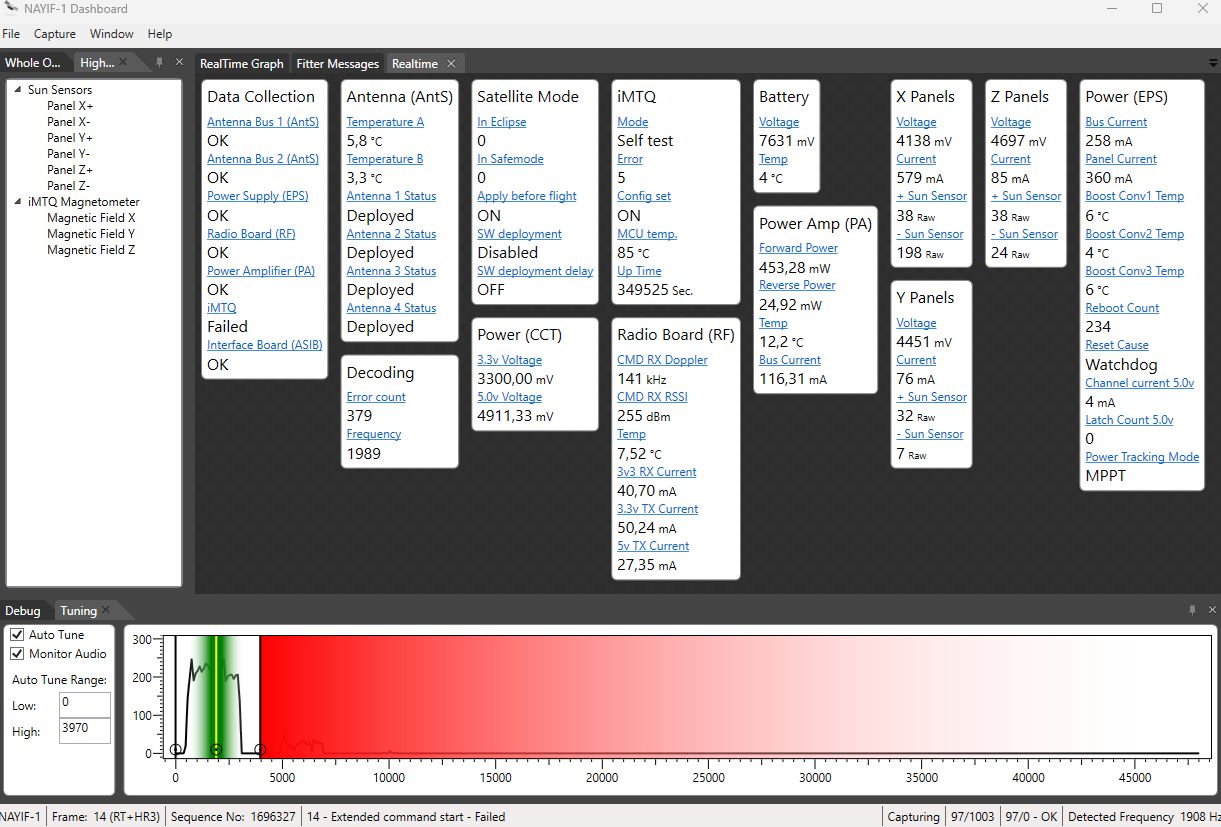
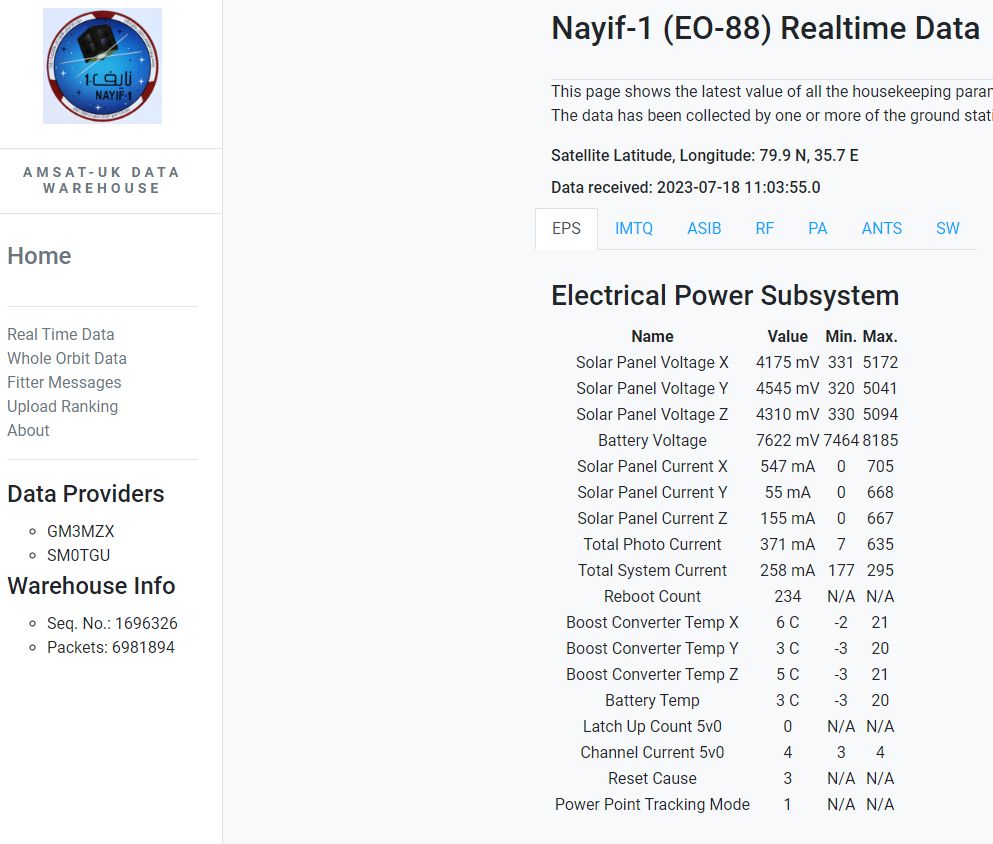
Unfortunately, however, the same cannot by said for Nayif-1, EO88. This spacecraft was launched in February 2017 into a 496×507 km polar orbit. Currently the orbit parameters show a height of around 320 km with the drag at 0.00319. It is now well below the ISS and much lower than at launch.

As mentioned, largely due to the random nature of the our star’s flux output on a day to day basis, it is not possible at this stage to accurately predict the likely deorbit date but it seems that it will certainly be before the end of this year. As the spacecraft continues to perform 100% nominally this is a great shame. Presently it is switching autonomously from high power telemetry when in daylight and with lower power telemetry and the transponder active when in darkness. The solar panels, battery and power system also continue to be reporting nominal numbers, essentially unchanged since the day of launch.

It will therefore be a really sad moment when re-entry occurs but in the meantime everyone is encouraged to use the spacecraft whilst it remains available.

To mark the event of EO88/Nayif’s demise, AMSAT-UK is offering two awards. These will be individual framed certificates.

Firstly, to the station who submits the last telemetry to the FUNcube Data Warehouse and also to who “guesses” or calculates the re-entry time and date most accurately. Submissions for this award must be made to EO88@amsat-uk.org before midnight (UTC) on July 4th 2023. So time is short to get your entries in. Good luck!

Categories
Ham Satellite news

LEDSAT Digipeater Challenge

The European Space Agency’s (ESA) Fly Your Satellite! program in collaboration with S5Lab is offering a unique opportunity for radio amateurs around the world. The challenge is to establish communication through the LEDSAT CubeSat digipeater, providing a chance to win a special prize: a QSL card issued by the ESA Education Office and the LEDSAT team. Running from June 26 to July 30, this challenge allows radio enthusiasts to engage with space technology and showcase their communication skills.

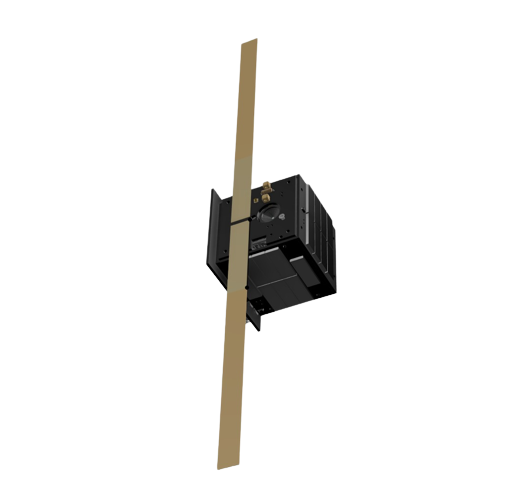
LEDSAT, developed by students from Sapienza University in Rome’s S5Lab research team with support from AMSAT Italia, is an educational 1U CubeSat that participated in the second edition of the Fly Your Satellite! program. Its primary objective is to demonstrate a LED-based payload for ground-based optical tracking. The successful launch of LEDSAT on Vega flight VV19 on August 17, 2021, marked a significant milestone for the project. To celebrate the launch, a competition was launched, encouraging participants from around the world to record the first signs of life from the spacecraft.

To participate in the challenge, radio amateurs are invited to send a message to the ESA Education Office ESTEC Ground Station, with the callsign PI9ESA. The digipeater will be activated during specific time windows, with operators stationed at the ground station to receive incoming messages. Upon successful reception of a message, the sender’s callsign and contact details will be documented on a personalized QSL card, acknowledging their accomplishment.

The LEDSAT digipeater can store and retransmit digital messages sent to the satellite, acting as a transponder for long-distance communication. Messages can be retransmitted immediately or with an optional delay of up to two days.

LEDSAT follows a Sun-Synchronous orbit, resulting in two communication windows each day – around midday and midnight – where contact can be established. Participants can predict passes precisely above the ESTEC ground station or their area of residence by using their favorite pass prediction software or obtaining the latest Two-Line Elements for LEDSAT from https://celestrak.org/NORAD/elements/gp.php?CATNR=49069.

Due to LEDSAT’s monitoring and housekeeping requirements and the potential high demand from operators, the digipeater activation time slots will follow a pattern of one day ON and one day OFF, with the switch-on/off always occurring at 00:00 UTC. This schedule will begin on Monday, June 26th at 00:00 UTC, and conclude on Sunday, July 30th at 24:00 UTC.

While the challenge is supported by operators on a voluntary basis, efforts will be made to cover as many LEDSAT passes as possible, especially those occurring around local midday on weekdays. A detailed schedule of pass coverage will be published, so participants are advised to regularly check for updates.

The LEDSAT digipeater uplink frequency is 435.310 MHz, the downlink frequency is 435.190 MHz, and the modulation type is GMSK using a CSP + Golay + ASM (AX100 Mode 5) protocol at 1200 baud. The LEDSAT team has prepared a software package and a user manual for connecting to the digipeater, available for download on the LEDSAT website at https://www.s5lab.space/index.php/ledsat-digipeater/.

It is important to note that transmitting to the satellite is prohibited for those who are not licensed radio amateurs. However, non-licensed individuals can still participate in the challenge by listening to the messages transmitted by the ESTEC ground station. If they provide evidence of successful reception, including the date and time, they may also receive a customized QSL card.

Participants are encouraged to mark their calendars, prepare their messages, and not miss the chance to connect and communicate with the LEDSAT spacecraft to receive their QSL card. Let’s come together and make this event a memorable celebration of our shared passion for space exploration and amateur radio communication.

For any inquiries regarding LEDSAT or the digipeater challenge, please email cubesats@esa.int.

[ANS thanks the European Space Agency along with S5Lab for the above information]

Categories
Ham Satellite news

2023 AMSAT Field Day

The following info is from ANS-134

2023 AMSAT Field Day Rules

The AMSAT Field Day 2023 event is open to all Amateur Radio operators.  Amateurs are to use the exchange as specified in ARRL rules for Field Day. The AMSAT competition is to encourage the use of all amateur satellites, both analog and digital. Note that no points will be credited for any contacts beyond the ONE allowed via each single-channel FM satellite. Operators are encouraged not to make any extra contacts via theses satellites (Ex: SO-50). CW contacts and digital contacts are worth three points as outlined below.

1.  Analog Transponders

ARRL rules apply, except:

- Each phone, CW, and digital segment ON EACH SATELLITE TRANSPONDER is considered to be a separate band.

- CW and digital (RTTY, PSK-31, etc.) contacts count THREE points each.

- Stations may only count one (1) completed QSO on any single channel FM satellite. If a satellite has multiple modes such as V/u and L/s modes both turned on, one contact each is allowed. If the PBBS is on - see Pacsats below, ISS (1 phone and 1 digital), Contacts with the ISS crew will count for one contact if they are active. PCSat (I, II, etc.) (1 digital),

- The use of more than one transmitter at the same time on a single satellite transponder is prohibited.

2.  Digital Transponders

We have only APRS digipeaters and 10m to 70cm PSK transponders (see Bob Bruninga's article in the March/April, 2016 issue of the AMSAT Journal). 

Satellite digipeat QSO's and APRS short-message contacts are worth three points each, but must be complete verified two-way exchanges. The one contact per FM satellite is not applied to digital transponders.

The use of terrestrial gateway stations or internet gateways (i.e. EchoLink, IRLP, etc.) to uplink/downlink is not allowed.

For the Pacsats (FalconSat-3) or 'Store and Forward' hamsats, each satellite is considered a separate band.  Do not post "CQ" messages.  Simply upload ONE greeting message to each satellite and download as many greeting messages as possible from each satellite.  The subject of the uploaded file should be posted as Field Day Greetings, addressed to ALL.  The purpose of this portion of the competition is to demonstrate digital satellite communications to other Field Day participants and observers.  Do not reply to the Field Day Greetings addressed to ALL.

The following uploads and downloads count as three-point digital contacts.

(a)  Upload of a satellite Field Day Greetings file (one per satellite).
(b)  Download of Satellite Field Day Greetings files posted by other stations. Downloads of non-Field Day files or messages not addressed to ALL are not to be counted for the event.  Save DIR listings and message files for later "proof of contact."

You may make contacts with GreenCube, IO-117 and each one will count as 3 points as do other digital contacts. 

Please note AMSAT uploaded messages do not count for QSO points under the ARRL rules.

Sample Satellite Field Day Greetings File:

Greetings from W5MSQ Field Day Satellite station near Katy, Texas, EL-29, with 20 participants, operating class 2A, in the AMSAT-Houston group with the Houston Amateur Television Society and the Houston QRP club.  All the best and 73!

Note that the message stated the call, name of the group, operating class, where they were located (the grid square would be helpful) and how many operators were in attendance.

3.  Operating Class

Stations operating portable and using emergency power (as per ARRL Field Day rules) are in a separate operating class from those at home connected to commercial power.  On the report form simply check off Emergency or Commercial for the Power Source and be sure to specify your ARRL operating class (2A, 1C, etc.). 

And Finally...

The Satellite Summary Sheet should be used for submission of the AMSAT Field Day competition and be received by KK5DO (e-mail) by 11:59 P.M. CDT, Tuesday, July 25, 2023. This year, we are using the same due date as the ARRL. The only method for submitting your log is via e-mail to kk5do@amsat.org or kk5do@arrl.net. I have not had a mail-in entry in over 6 years, probably even longer than that. 

Add photographs or other interesting information that can be used in an article for the Journal. 

You will receive an e-mail back (within one or two days) from me when I receive your e-mail submission. If you do not receive a confirmation message, then I have not received your submission. Try sending it again or send it to my other e-mail address. 

Certificates will be awarded for the first-place emergency power/portable station at the AMSAT General Meeting and Space Symposium in the fall of 2023. Certificates will also be awarded to the second and third place portable/emergency operation in addition to the first-place home station running on emergency power. A station submitting high, award-winning scores will be requested to send in dupe sheets for analog contacts and message listings for digital downloads.

You may have multiple rig difficulties, antenna failures, computer glitches, generator disasters, tropical storms, and there may even be satellite problems, but the goal is to test your ability to operate in an emergency situation.  Try different gear.  Demonstrate satellite operations to hams that don't even know the HAMSATS exist.  Test your equipment. Avoid making more than ONE contact via the FM-only voice HAMSATS or the ISS, and enjoy the event!


[ANS thanks Bruce Paige, KK5DO, AMSAT Director, for the above information.]

+=+=+=+=+=+=+=+=+=+=+=+=+=+=+=+=+=+=+=+=+=+=+=+=+=+=+=+=+=+=+=+=+=+


2023 Field Day - More Thoughts

It's that time of year again; summer and Field Day!  Each year the American Radio Relay League (ARRL) sponsors Field Day as a "picnic, a campout, practice for emergencies, an informal contest and, most of all, FUN!"  The event takes place during a 23-hour period on the fourth weekend of June.  For 2023 the event takes place during a 27-hour period from 1800 UTC on Saturday June 24, 2023 through 2100 UTC on Sunday June 25, 2023. Those who set up prior to 1800 UTC on June 24 can operate only 24 hours.  The Radio Amateur Satellite Corporation (AMSAT) promotes its own version of Field Day for operation via the amateur satellites, held concurrently with the ARRL event.

This year should be as easy as last year since we have more than 10 transponders and repeaters available. Users should check the AMSAT status page at http://www.amsat.org/status/ and the pages at  https://www.amsat.org/two-way-satellites/ for what is available in the weeks leading up to Field Day. To reduce the amount of time to research each satellite, see the current FM satellite table at https://www.amsat.org/fm-satellite-frequency-summary/  and the current linear satellite table at https://www.amsat.org/linear-satellite-frequency-summary/

If you are considering ONLY the FM voice satellites, there are ISS, SO-50, AO-91, PO-101 and possibly LilacSat. It might be easier this year to make that one FM contact for the ARRL bonus points with so many FM birds. The congestion on FM LEO satellites is always so intense that we must continue to limit their use to one-QSO-per-FM-satellite. This includes the International Space Station. You will be allowed one QSO if the ISS is operating Voice. 

It was suggested during past field days that a control station be allowed to coordinate contacts on the FM satellites. There is nothing in the rules that would prohibit this. This is nothing more than a single station working multiple QSO's. If a station were to act as a control station and give QSO's to every other field day station, the control station would still only be allowed to turn in one QSO per FM satellite while the other station would be able to submit one QSO. 

The format for the message exchange on the ISS or other digital packet satellite is an unproto packet to the other station (3-way exchange required) with all the same information as normally exchanged for ARRL Field Day, 
e.g.:

W6NWG de KK5DO 2A STX
KK5DO de W6NWG QSL 5A SDG
W6NWG de KK5DO QSL

If you have worked the satellites on Field Day in recent years, you may have noticed a lot of good contacts can be made on some of the less-populated, low-earth-orbit satellites like FO-29, AO-7, EO-88 or the XW satellites. During Field Day the transponders come alive like 20 meters on a weekend. The good news is that the transponders on these satellites will support multiple simultaneous contacts. The bad news is that you can't use FM, just low duty-cycle modes like SSB and CW.  

[ANS thanks Bruce Paige, KK5DO, AMSAT Director, for the above information.]