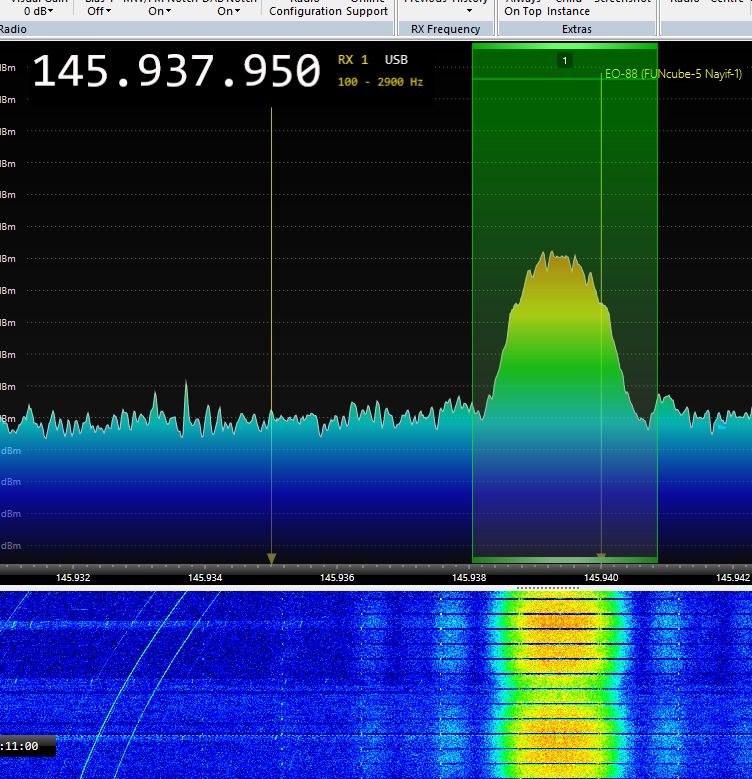
Altitude 253 km over Stockholm
 AMSAT-SM - Official Website of AMSAT-SM Sweden
Webmaster and member of the AMSAT-SM steering group.
Altitude 253 km over Stockholm
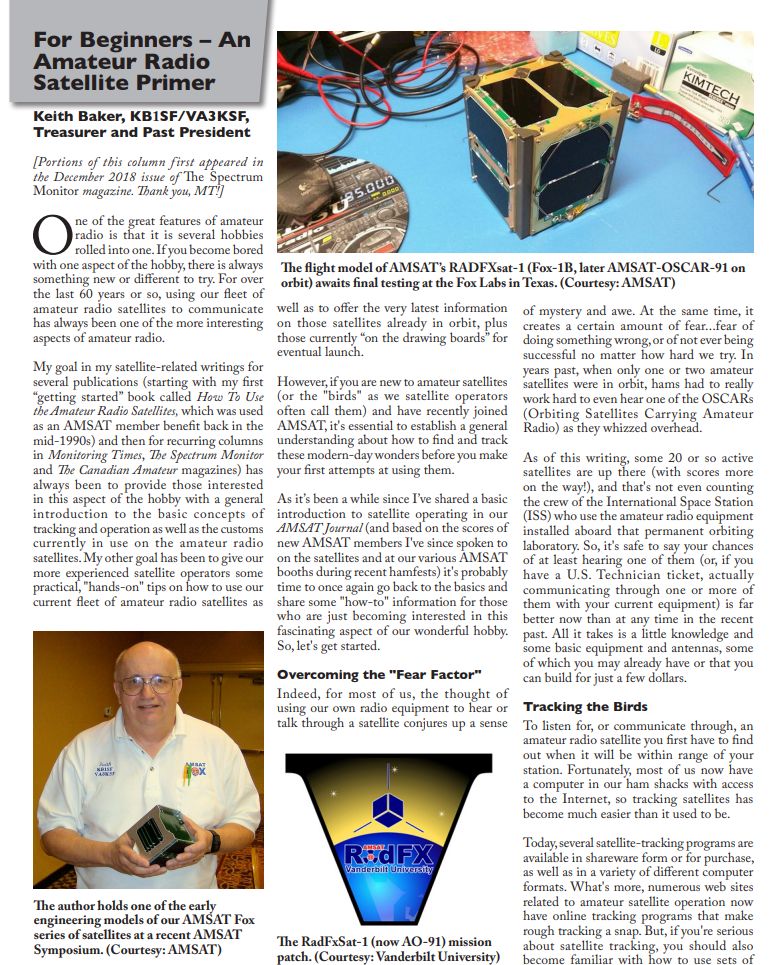
AMSAT-NA has a free “Getting Started” compendium available for download. AMSAT-NA tells us:
Here is a freely downloadable compendium of “getting started” articles written by Keith Baker, KB1SF/VA3KSF. These articles originally appeared in The AMSAT Journal from 2019 to 2021.
Unfortunately, because both satellites and URLs change over time, the currentness of information such as this can quickly be overcome by events. However, the tools and techniques outlined in Keith’s beginner series are still very much applicable to operating on current and future AMSAT satellites.
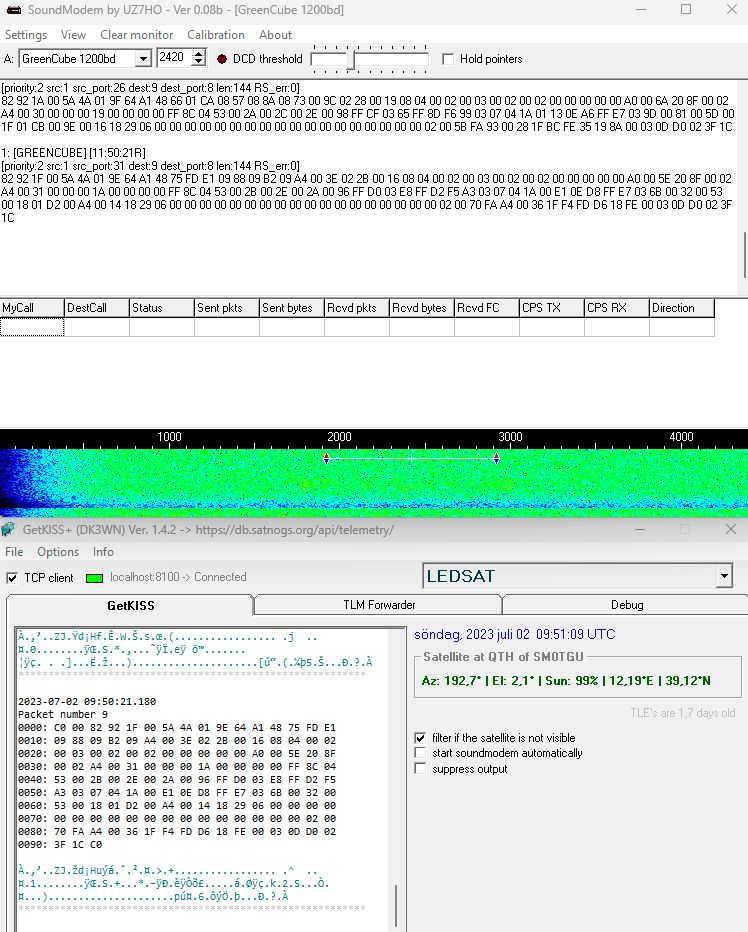
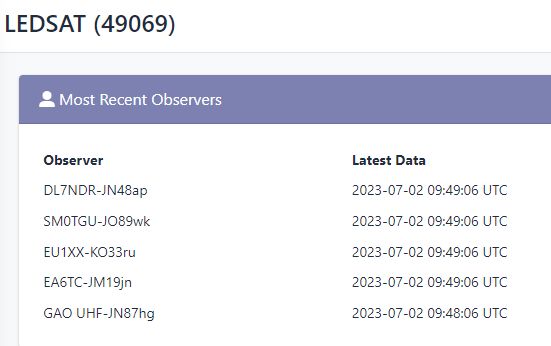
@LEDSAT_Team telemetry over Stockholm 2023-07-02. Good copy, nice S/N, but strong local interference. Software and hardware used:
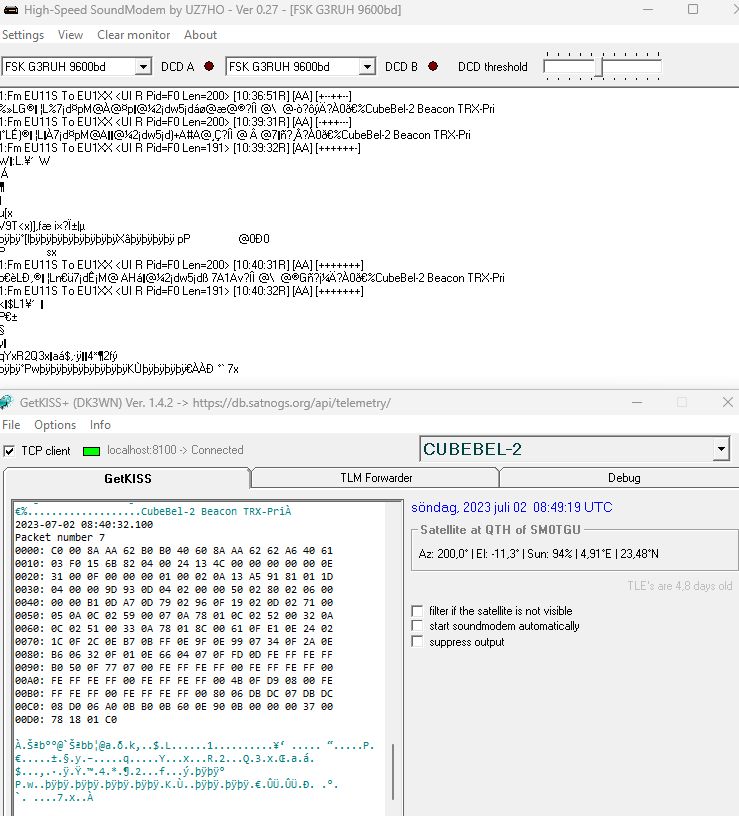
CubeBel-2 telemetry @EU1SAT over Stockholm ar 2023-07-02. Software and hardware used:
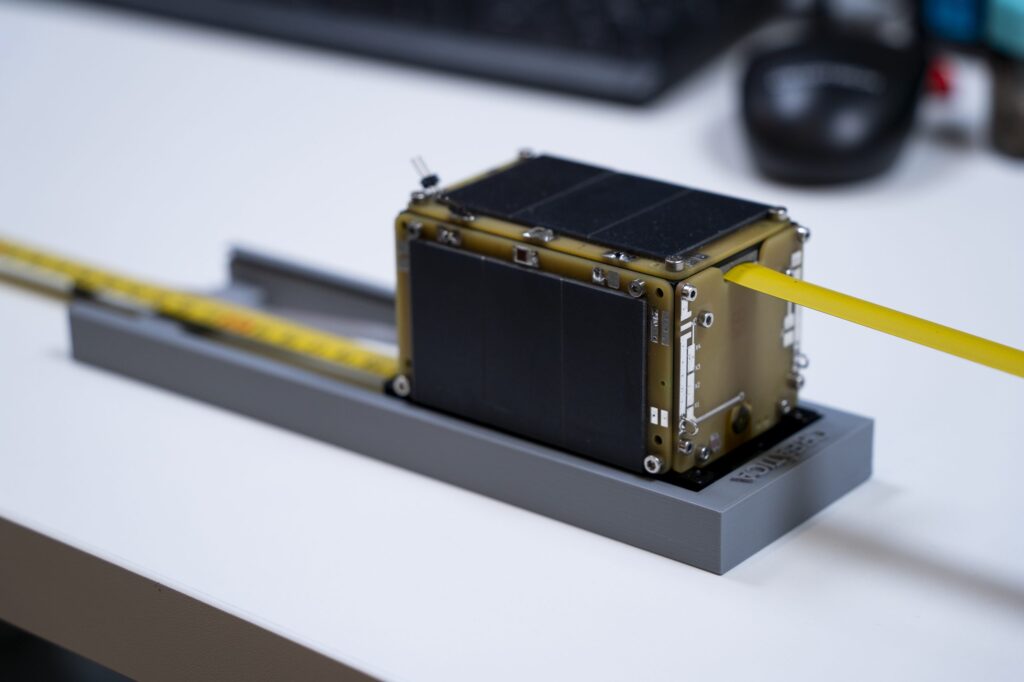
Information from ANS-176 and AMSAT-EA
The URESAT-1 satellite, also known as HADES-B according to its ITU designation, successfully launched into space as part of the SpaceX Transporter-8 mission from Vandenberg AFB on Monday, June 12. The satellite is a joint effort between AMSAT-EA, URE (the Spanish equivalent of ARRL), private companies, and universities.
The URESAT-1 satellite, contained within the D-Orbit ION Orbital Transfer Vehicle (OTV), was not deployed directly from the Falcon-9 rocket. Instead, approximately one hour and twenty minutes after launch, the Falcon-9 released the OTV. URESAT-1 was deployed from the OTV at approximately 12:10 UTC on June 22, 2023. As of this writing, signals have not yet been received from the satellite.
One of the primary objectives of URESAT-1 is to serve as an FM voice and FSK data repeater. Equipped with a Slow Scan Television (SSTV) camera, the satellite will transmit live images as well as stored images at regular intervals. It also features a chess game, enabling players on Earth to engage in a game against the satellite. Periodically, the satellite will transmit updates on the state of the game, including the chess board, the last movement made, and whether the next move belongs to the players or the satellite.
The specified frequencies for communication with URESAT-1 are as follows: for uplink transmissions, 145.975 MHz or 145.925 MHz (auxiliary frequency) using FM voice without subtone, FSK 50 bps, AFSK, AX.25, APRS 1200/2400 bps. For downlink transmissions, the frequency is set at 436.888 MHz, and modes include FM voice, CW, FSK 50 bps telemetry, SSTV Robot 36, and a voice beacon with the callsign AO4URE.
To provide further information regarding URESAT-1’s transmissions, the AMSAT-EA organization has made available a comprehensive document that can be accessed at the following link: https://www.amsat-ea.org/app/download/13366685/AMSAT+EA+-+URESAT-1+Transmissions+description.pdf
For those interested in decoding the telemetry, a Linux x86/ARM decoder is available for download at the following link: https://www.amsat-ea.org/app/download/13395017/URESAT-1_telemetry_decoder_Linux_X86_ARM_v1.0.zip
A sample file containing the audio of a telemetry file can be found here: https://www.amsat-ea.org/app/download/13398144/URESAT-1_sample_FSK_telemetry-chessboard_packet.wav
If URESAT-1 operates as intended, the project team plans to release a Linux program that will allow players to send their chess moves to the satellite, further enhancing the interactive experience.
[ANS thanks Félix Páez, EA4GQS, AMSAT-EA President for the above information]
Info from g3vzv / FunCube web
As everyone is aware, Solar Cycle 25 has already shown that we cannot yet predict what the sun will be doing with any great accuracy.
Sunspots, X-class solar flares and CMEs (coronal mass ejections) are increasing in frequency and intensity on a daily basis.
The peak of Solar Cycle 25 was not expected until late 2024 or early 2025 but it may be coming earlier and have a higher intensity than was predicted.
One result of this increased activity is that the upper atmosphere and ionosphere of the earth becomes warmer and expands upwards. This means that spacecraft in low earth orbit experience more drag or resistance as a result of the increase in the number atoms they are having to displace as they travel around the globe. As a consequence, the spacecraft loose more kinetic energy and start to descend lower in orbital height, which, of course, makes the problem worse and a fiery end to the spacecraft is hastened.
The actual effect is also dependant on the drag coefficient of the particular spacecraft…simply how much mass (the more the better) to how much surface area (the less the better). So in CubeSat terms, a 1U CubeSat, fairly full of stuff with a mass near the maximum of 1.3kg, will probably be better off than a half empty 3U CubeSat with deployable solar panels and other drag inducing protuberances.
All TLEs (Two Line Elements) include a parameter called drag, it is usually a very small number preceeded by four or more zeros! Although this parameter is calculated by the system, it is not usually precise or even stable, so cannot be used to accurately predict deorbit dates when looking forward many weeks/months. It can give us a guide though! Alarm bells should ring when we only see two leading zeros.
How does this effect our activities? Well for the FUNcube family, there are presently three active members!
FUNcube-1, AO73 was launched almost ten years ago in November 2013 into an elliptical polar orbit of approx 682×595 km. Presently those numbers are around 640×570 km so probably not too much to worry about. The drag number from the TLEs is, at the time of writing, 0.000074, a good number.
The same applies to JY1SAT, JO-97. This was launched in December 2018 into a 573×590 km polar orbit. Presently those numbers are around 557×573 km and the current drag is listed as 0.000076.
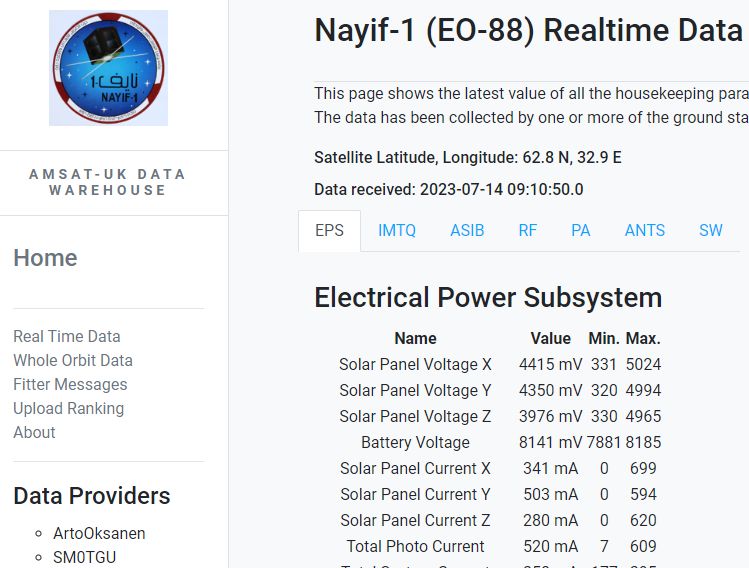
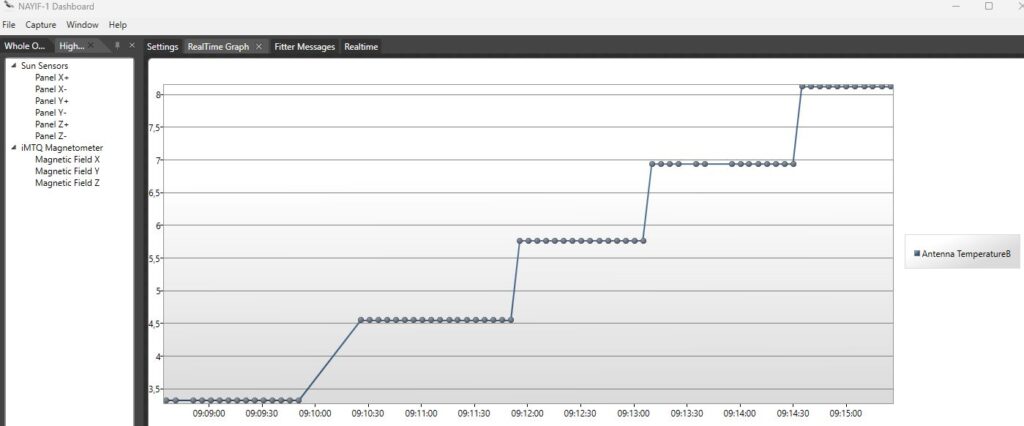
Unfortunately, however, the same cannot by said for Nayif-1, EO88. This spacecraft was launched in February 2017 into a 496×507 km polar orbit. Currently the orbit parameters show a height of around 320 km with the drag at 0.00319. It is now well below the ISS and much lower than at launch.
As mentioned, largely due to the random nature of the our star’s flux output on a day to day basis, it is not possible at this stage to accurately predict the likely deorbit date but it seems that it will certainly be before the end of this year. As the spacecraft continues to perform 100% nominally this is a great shame. Presently it is switching autonomously from high power telemetry when in daylight and with lower power telemetry and the transponder active when in darkness. The solar panels, battery and power system also continue to be reporting nominal numbers, essentially unchanged since the day of launch.
It will therefore be a really sad moment when re-entry occurs but in the meantime everyone is encouraged to use the spacecraft whilst it remains available.
To mark the event of EO88/Nayif’s demise, AMSAT-UK is offering two awards. These will be individual framed certificates.
Firstly, to the station who submits the last telemetry to the FUNcube Data Warehouse and also to who “guesses” or calculates the re-entry time and date most accurately. Submissions for this award must be made to EO88@amsat-uk.org before midnight (UTC) on July 4th 2023. So time is short to get your entries in. Good luck!