Categories
Hamradio from ISS

SSTV Event Scheduled for ARISS on October 3 2023

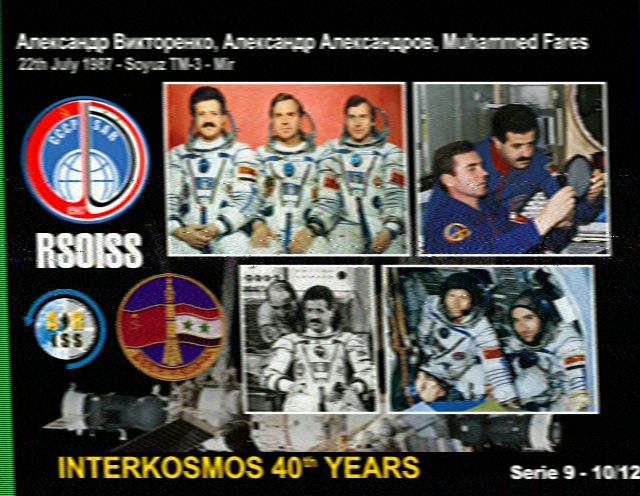
R4UAB reports that from October 3, 2023 to October 5, 2023 images will be transmitted from the International Space Station via the SSTV protocol as part of the “About Gagarin from Space” experiment. The topic of the program is the first artificial Earth satellite, amateur radio satellites, school satellites.

SSTV images will be transmitted on 145.800 MHz using a Kenwood TM-D710 transceiver. They are expected to use the PD-120 SSTV format.

The scheduled start of transmission is October 03, 2023 at approximately 14:40 UTC. The end of transmission is scheduled at October 05, 2023 at approximately 18:15 UTC. The date and time may change.

The “Russia ISS SSTV” diploma is awarded to radio amateurs (observers) for receiving SSTV (slow-scan television) broadcasts from aboard the International Space Station (ISS) as part of the space experiment (SE) “About Gagarin from Space.” To receive the “Russia ISS SSTV” Diploma, one must receive and decode three images transmitted over a radio channel from on board the ISS using the SSTV protocol only on the days of the SE . Each image must be at least 90% complete and of acceptable quality. Information on earning the certificate is available at https://r4uab.ru/diplom-iss-sstv/.

AMSAT Argentina is also offering a diploma for reception of ISS SSTV images. Learn more at http://amsat.org.ar/?f=9.

[ANS thanks AMSAT Argentina and R4UAB for the above information.]

Categories
SDR and software

WSJT-X Full Duplex FT4 test with IC-9700 via RS-44

The latest version of WSJT-X Improved, from v2.7.1, it is possible to use full duplex, that is listening and decoding at the same time you are transmitting. For satellite operators, mainly QO-100, you can now have full duplex control over your transmission avoiding drifting of your FTx signal.

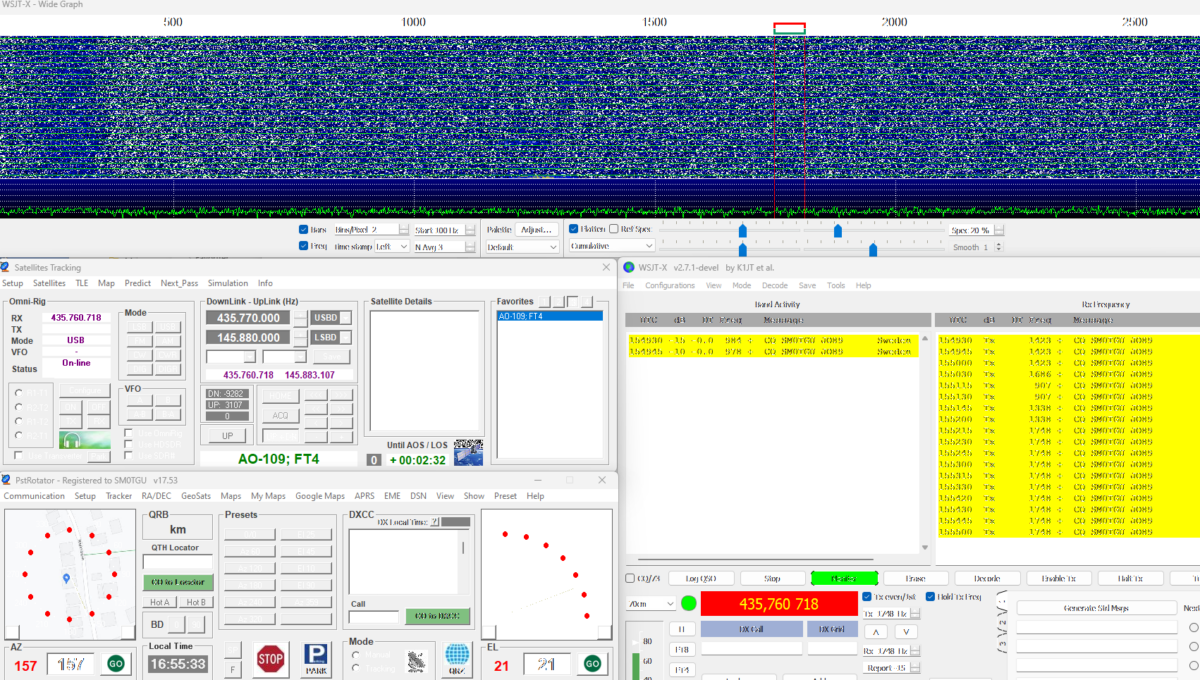
I did a test with FT4 over RS-44 as I will try to describe here in this post. I’m using Icom IC-9700 and PstRotator for doppler control but the concept is the same if you are using other rigs and doppler control software.

First download WSJT-X Improved, use version from v2.7.1.

To be able to use doppler control from PstRotator and at the same time control PTT from WSJT-X use Omnirig (this setup is not described in this post).

When using the “Satellite mode” with IC-9700 the RX is the main band and the TX is the sub band.

For IC-9700 you must set up the USB soundcard in Windows to use both channels (“Kanal 2” in swedish means “2 channels”):

Note – sometimes this setting can change during a Windows update and be reverted to one channel again.
Updated 2026-02-01: It seams that it works also if just using one channel as the IC-9700 then only outputs the main band.

In WSJT-X use the USB left channel from the IC-9700 – left channel is the main band audio. A very good article by GM4VVM about the sound card setting in IC-9700 can be found here.

Set up for Full Duplex Mode in WSJT-X:

Below is an animated GIF when using FT4 via RS-44. Transmitting power is at 0% (zero) so very little uplink power is needed. You see that after every TX sequence WSJT-X is decoding my signal:

And below you see the WSJT-X spectrum as an animated GIF. What you see is my transmitted FT4 signal received in full duplex.

Summary:

The Full Duplex version of WSJT-X improved is working perfect for FT4 via satellite!

Categories
Ham Satellite news

AMSAT SA Space Symposium 2023

AMSAT South Africa has announced that the 2023 AMSAT SA Space Symposium will be held on Saturday, 23 September 2023.

It will be a virtual event opening participation to people anywhere in the world. The event will be hosted on the Bluejeans platform from 09:00 – 15:00 SAST (07:00 – 13:00 UTC). Those registered will receive an email with logon details.

The aim of the AMSAT SA Space symposium is to take amateur radio into space, encourage more amateur satellite operation, development, and research.

Registration is required and will be free but a donation to the AMSAT SA managed SARL Next Generation Beacon fund would be appreciated. Registration opened 24 August at bit.ly/45SynOJ

Call for papers

Proposals for papers are invited. Send a summary of the proposed paper in MS word to admin@amsatsa.org.za. The closing date for paper proposals is 4 September 2023. The final programme will be published on on 6 September 2023.

[ANS thanks AMSAT SA for the above information]

Categories
Ham Satellite news

UVSQ-Sat activation on September 5

UVSQ-Sat transponder scheduled for activation on September 5, 2023:

  • Starting from 10h00 (UTC)
  • During non-stop 11 hours
  • Uplink 145.905 MHz
  • Downlink 437.020 MHz
  • FM mode, no tone.
https://twitter.com/uvsqsat/status/1698267074332602467
Categories
Changes on amsat.se

New startpage for amsat.se

Starting today we are testing a new startpage for amsat.se. The three most asked question now has large menu items (in Swedish).

It is “How to start listen”, “How to make first QSO” and “What satellites are QRV?”

Latest news posts can be found under these menu items.

Hopefully this can lead to more visitors find beginner information quicker.

Categories
Ham Satellite news

AM1SAT Satellite Contest, September 2023

Info from AMSAT-EA and ANS-225:

AMSAT-EA will be on the air on all available satellites with the callsigns AM1SAT and AM2023SAT from September 4th to 17th, 2023 to celebrate the fourth edition of the AM1SAT trophy contest as part of the URE activities within the IberRadio 2023 event, the largest one in the world of amateur radio in Spain and Portugal (http://www.iberradio.es), and which will open its doors during the weekend of 16-17 in Avila, a city near Madrid, capital of Spain.

The AMSAT-EA operators will activate the aforementioned callsigns from the different states and autonomous cities of Spain during the said period of time and with the objective in this edition to promote contacts with the maximum number of them.

As part of this activity and to encourage participation, SILVER and GOLD diplomas will be available for the different modalities of satellites according to their footprint and orbital height, LEO, MEO (IO-117 satellite) and GEO (QO-100 satellite), as well as a trophy for the station that works the greatest number of states in the total number of available satellites and another trophy for the one that contacts the greatest number of states on the satellite with the largest footprint and coverage (in this case, IO-117). These trophies will be physically sent at no cost to the winners.

The third edition of the AM1SAT satellite contest, in 2021, finished with 1327 QSOs including GEO and LEO contacts, with 57 different radio-countries, using 20 satellites and with the participation of 419 different competitors (callsigns).

Full rules can be found here:
https://www.amsat-ea.org/app/download/13570625/AM1SAT+CONTEST+2023+-+RULES.pdf

[ANS thanks Félix Páez, EA4GQS, AMSAT-EA President, for the above information]