Categories
Ham Satellite news Telemetry

Help decode Delfi-C3 DO-64 before re-entry

After more than 15 years in orbit the satellite Delfi-CE DO-64 is soon to re-entry. The Delfi team predict that re-entry will take place around November 16th 2023. For more info scroll down to see the full info.

All amateur radio operators / SWL’s / satellite enthusiasts worldwide are open to help listen and decode telemetry before the re-entry.

The old software RASCAL has been updated and now supports upload to the telemetry server at the Delfi team.

DO-64

Follow these steps to install and start decoding:

  1. Download the latest version here (need Java v8):
    https://filesender.surf.nl/?s=download&token=e9eb2f59-2f93-4d47-94f5-71f83d7a8bdc
    Note that the old version at Delfi-C3 website is not the correct one to use
  2. Run the software (just click on the JAR file)
  3. If you have an old account to the telemetry server, use it. Else let the guest account be as is. According to the Delfi team the IP address to the server is not important
  4. The telemetry downlink is at 145.870 MHz USB and is sending in 1200 BPSK. If found it a little below at aprox 145.865 MHz
  5. If you see the frequency “Sync” in the RASCAL software you will soon see telemetry sent to the server under the “Status messages”

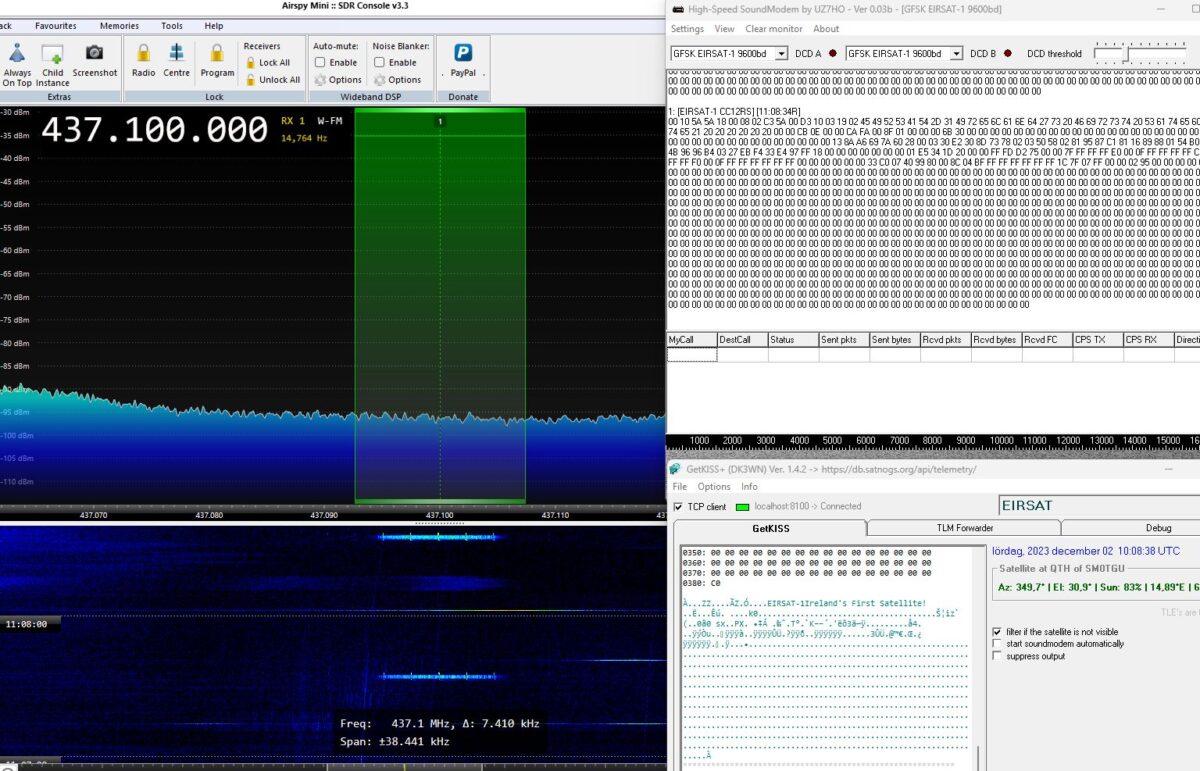
As an alternative way of decoding the telemetry, you can use Soundmodem 1200 BPSK and GetKISS+ software for upload to SatNOGS database.

Also see @Marco_Langbroek on Twitter for a re-entry prediction:
https://twitter.com/Marco_Langbroek/status/1720110996499349663

The full re-entry info:

Wouter Weggelaar, PA3WEG, says, “We would like to request all amateur radio operators / SWL’s / satellite enthusiasts worldwide to listen for Delfi-C3’s telemetry downlink on 145.867 MHz, 1200 baud AX.25 BPSK. We will hand out an award certificate to the person submitting the last Delfi-C3 telemetry frame.”

This can be done either through the RASCAL software (updated version coming), through the SATNOGS network or by sending us decoded telemetry frames with reception time and location via email to Delfi_at_tudelft.nl.

On behalf of the entire Delfi-C3 team, we would like to sincerely thank the worldwide amateur radio/SWL/satellite community for assisting the team by forwarding received telemetry and reception reports.

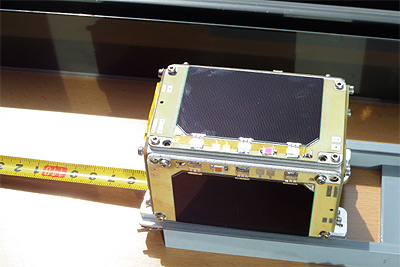
Delfi-C3 is a CubeSat satellite constructed by students at the Delft University of Technology in the Netherlands. It is a 3U CubeSat launched on April 28, 2008. Wouter recalls, “Back in 2008 we could not imagine the great support received so far and the many first we had, including a successful ground network and flying the first linear transponder in a CubeSat. We strongly believe that Delfi-C3 has paved the way for many follow-on missions, both amateur and commercial, and has been a great step towards maturing CubeSat technology as well as training the next generation of space engineers. Stay tuned for updates!

Categories
Ham Satellite news

Final FO-99 Schedule before re-entry

According to AMSAT Japan website the FO-99 satellite should re-enter the atmosphere by the end of this month (Nov 2023).

Due to the rapid loss of altitude of the satellite, it is expected to re-enter the atmosphere by the end of this month. Along with this, the operation of NEXUS is about to enter its final stage. JAMSAT would like to continue operation as long as possible until NEXUS re-enters the atmosphere. We would like to inform you that we have decided to conduct a special operation including weekdays as follows.

Important!  The values shown in the table include errors.
Check “Satellite Tracking” on the JAMSAT website for exact transit times.

NEXUS operations team. JH4DHX/3 Y.Ohtani

Categories
Ham Satellite news

41st AMSAT Space Symposium & Annual General Meeting YouTube Videos Available

Did you miss the recent AMSAT Space Symposium in Irving, Texas? Were you unable to participate in the Symposium Livestream event? Perhaps you are eager to rewatch a specific presentation. You’re in luck because AMSAT has shared more than twelve hours of video recordings on their YouTube page. You can easily find these videos by clicking on the Live tab under The Radio Amateur Satellite Corporation channel. Furthermore, YouTube offers Closed Captioning for these recordings; just click on the ‘CC’ icon in the video player’s lower right corner. If you’d prefer, you can also enable subtitles in multiple languages by clicking the gear icon, then choosing Subtitles/CC > Auto-translate and selecting your preferred language. To help you quickly access video from the AMSAT Annual General Meeting along with the sixteen presentations given at this year’s AMSAT Symposium, we have included direct links for you below.

AMSAT 41st AMSAT Space Symposium Welcome Robert Bankston, KE4AL, AMSAT President https://www.youtube.com/watch?v=pcO4-h7bbxs&t=380s

A Survey of Small Satellite Propulsion Systems Jonathan Brandenburg, KF5IDY, AMSAT Assistant VP Engineering https://www.youtube.com/watch?v=pcO4-h7bbxs&t=465s

Microwave Ambitions for GOLF Satellites Zach Metzinger, N0ZGO, AMSAT Board of Directors https://www.youtube.com/watch?v=pcO4-h7bbxs&t=2270s

AMSAT Engineering Update Jerry Buxton, N0JY, AMSAT VP Engineering https://www.youtube.com/watch?v=pcO4-h7bbxs&t=3825s

ASCENT and Fox-Plus Updates Jonathan Brandenburg, KF5IDY, AMSAT Assistant VP Engineering https://www.youtube.com/watch?v=pcO4-h7bbxs&t=8575s

PACSAT Update and Demonstration Bill Reed, NX5R, PACSAT Project Manager https://www.youtube.com/watch?v=pcO4-h7bbxs&t=10095s

CubeSatSim Update and Demonstration Alan Johnston, KU2Y, AMSAT VP Educational Resources https://www.youtube.com/watch?v=DzKKHTBxyY8&t=720s

ThinSat Project for High Schools Nick Pugh, K5QXY, and Bob Twiggs, KE6QMD https://www.youtube.com/watch?v=DzKKHTBxyY8&t=4040s

AMSAT Youth Initiative Frank Karnauskas, N1UW, AMSAT VP Development https://www.youtube.com/watch?v=DzKKHTBxyY8&t=6595s

Amateur Radio Spectrum Use in the Lunar Environment Frank Bauer, KA3HDO, ARISS-NA Executive Director https://www.youtube.com/watch?v=DzKKHTBxyY8&t=8650s

Amateur Satellite Secondary Payloads Drew Glasbrenner, AMSAT Board of Directors/VP Operations https://www.youtube.com/watch?v=DzKKHTBxyY8&t=10500s

AMSAT-HB Update Michael Lipp, HB9WDF, President, AMSAT-HB https://www.youtube.com/watch?v=DzKKHTBxyY8&t=12150s

AMSAT-UK Update David Bowman, G0MRF, https://www.youtube.com/watch?v=DzKKHTBxyY8&t=13205s

ARISS Update Dave Taylor, W8AAS, AMSAT US Delegate to ARISS International https://www.youtube.com/watch?v=DzKKHTBxyY8&t=18600s

40th Anniversary of Hams in Space & 2024 Anniversary Event Frank Bauer, KA3HDO, ARISS-NA Executive Director https://www.youtube.com/watch?v=DzKKHTBxyY8&t=21305s

Planned Non-AMSAT Amateur Satellites Paul Stoetzer, N8HM, AMSAT Executive Vice President https://www.youtube.com/watch?v=DzKKHTBxyY8&t=22970s

Space Qualified Antennas Kent Britain, WA5VJB https://www.youtube.com/watch?v=DzKKHTBxyY8&t=23880s

AMSAT Annual General Meeting & Awards Ceremony Robert Bankston, KE4AL, AMSAT President https://www.youtube.com/watch?v=DzKKHTBxyY8&t=27575s

Categories
Hamradio from ISS

SSTV Event Scheduled for ARISS on October 3 2023

R4UAB reports that from October 3, 2023 to October 5, 2023 images will be transmitted from the International Space Station via the SSTV protocol as part of the “About Gagarin from Space” experiment. The topic of the program is the first artificial Earth satellite, amateur radio satellites, school satellites.

SSTV images will be transmitted on 145.800 MHz using a Kenwood TM-D710 transceiver. They are expected to use the PD-120 SSTV format.

The scheduled start of transmission is October 03, 2023 at approximately 14:40 UTC. The end of transmission is scheduled at October 05, 2023 at approximately 18:15 UTC. The date and time may change.

The “Russia ISS SSTV” diploma is awarded to radio amateurs (observers) for receiving SSTV (slow-scan television) broadcasts from aboard the International Space Station (ISS) as part of the space experiment (SE) “About Gagarin from Space.” To receive the “Russia ISS SSTV” Diploma, one must receive and decode three images transmitted over a radio channel from on board the ISS using the SSTV protocol only on the days of the SE . Each image must be at least 90% complete and of acceptable quality. Information on earning the certificate is available at https://r4uab.ru/diplom-iss-sstv/.

AMSAT Argentina is also offering a diploma for reception of ISS SSTV images. Learn more at http://amsat.org.ar/?f=9.

[ANS thanks AMSAT Argentina and R4UAB for the above information.]

Categories
SDR and software

WSJT-X Full Duplex FT4 test with IC-9700 via RS-44

The latest version of WSJT-X Improved, from v2.7.1, it is possible to use full duplex, that is listening and decoding at the same time you are transmitting. For satellite operators, mainly QO-100, you can now have full duplex control over your transmission avoiding drifting of your FTx signal.

I did a test with FT4 over RS-44 as I will try to describe here in this post. I’m using Icom IC-9700 and PstRotator for doppler control but the concept is the same if you are using other rigs and doppler control software.

First download WSJT-X Improved, use version from v2.7.1.

To be able to use doppler control from PstRotator and at the same time control PTT from WSJT-X use Omnirig (this setup is not described in this post).

When using the “Satellite mode” with IC-9700 the RX is the main band and the TX is the sub band.

For IC-9700 you must set up the USB soundcard in Windows to use both channels (“Kanal 2” in swedish means “2 channels”):

Note – sometimes this setting can change during a Windows update and be reverted to one channel again.
Updated 2026-02-01: It seams that it works also if just using one channel as the IC-9700 then only outputs the main band.

In WSJT-X use the USB left channel from the IC-9700 – left channel is the main band audio. A very good article by GM4VVM about the sound card setting in IC-9700 can be found here.

Set up for Full Duplex Mode in WSJT-X:

Below is an animated GIF when using FT4 via RS-44. Transmitting power is at 0% (zero) so very little uplink power is needed. You see that after every TX sequence WSJT-X is decoding my signal:

And below you see the WSJT-X spectrum as an animated GIF. What you see is my transmitted FT4 signal received in full duplex.

Summary:

The Full Duplex version of WSJT-X improved is working perfect for FT4 via satellite!

Categories
Ham Satellite news

AMSAT SA Space Symposium 2023

AMSAT South Africa has announced that the 2023 AMSAT SA Space Symposium will be held on Saturday, 23 September 2023.

It will be a virtual event opening participation to people anywhere in the world. The event will be hosted on the Bluejeans platform from 09:00 – 15:00 SAST (07:00 – 13:00 UTC). Those registered will receive an email with logon details.

The aim of the AMSAT SA Space symposium is to take amateur radio into space, encourage more amateur satellite operation, development, and research.

Registration is required and will be free but a donation to the AMSAT SA managed SARL Next Generation Beacon fund would be appreciated. Registration opened 24 August at bit.ly/45SynOJ

Call for papers

Proposals for papers are invited. Send a summary of the proposed paper in MS word to admin@amsatsa.org.za. The closing date for paper proposals is 4 September 2023. The final programme will be published on on 6 September 2023.

[ANS thanks AMSAT SA for the above information]