On October 29, 2018, the Diwata-2 microsatellite was launched on a
H-2A launch vehicle from the Tanegashima Space Center, Tanegashima,
Japan. Diwata-2 was developed by the PHL-Microsat program now
succeeded by the STAMINA4Space program, and in cooperation with
Tohoku University and Hokkaido University. The satellite carries an
amateur radio payload that has been tested and is now ready for
service.
At the request of the STAMINA4Space program, AMSAT hereby designates
Diwata-2 as Philippines-OSCAR 101 (PO-101). We congratulate the
owners and operators of PO-101, thank them for their contribution to
the amateur satellite community, and wish them continued success on
this and future projects.
73,
Drew Glasbrenner, KO4MA
AMSAT VP Operations / OSCAR Number Administrator
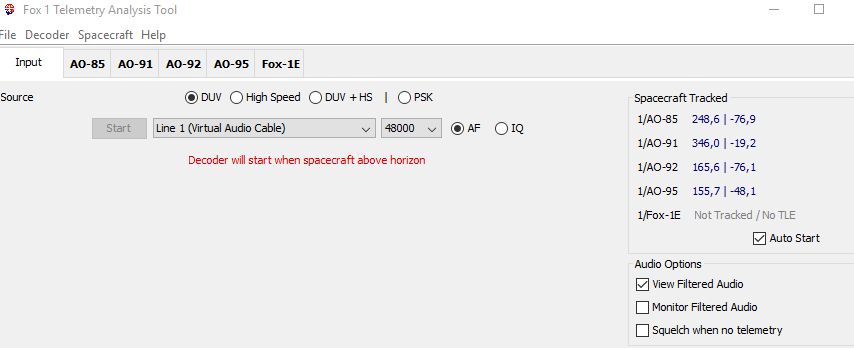
Chris Thompson has officially released version 1.07 of FoxTelem. A
test version has been out for a while, but it had several issues,
including a lower decode rate than 1.06. That prevented release for
a while. Those issues (and something like 65 other defects) are now
all fixed and this decoder performs better than 1.06. Feel free to
test them side by side and report back if that is not the case for
you. We are always interested in any comparative results.
In addition to defects in FoxTelem 1.06 and earlier versions of
1.07, this also introduces Doppler calculation with automatic
adjustment of the decoder frequency. This is especially useful for
decoding beacons and has been helpful in testing for Fox-1A / AO-85
and Fox-1Cliff / AO-95 which are both in SAFE mode. Decoding from
Doppler takes a bit of configuration to get right. Have a read of
the new sections in the manual or ask for help if you want to give it
a try. There are pros and cons vs “Find Signal” for sure.
Version 1.07 changes the core SDR within FoxTelem to use a
Numerically Controlled Oscillator (NCO) rather than an FFT Filter for
the conversion to base-band. This produces better decodes and will
allow the support of wider bandwidth SDRs in the future. The old
decoder is available still if needed from the settings screen. Read
the manual for details.
Version 1.07 also introduces two new BPSK decoders in advance of the Fox-1E launch. (Chris has no inside information about when that will be, but he has the decoder ready Chris also wrote some notes on the comparison between the two decoders, which you can read if you are interested in BPSK decoding performance, or just wonder what I do with my time in the evenings: http://www.g0kla.com/workbench/2019-03-09.php
The releases are here:
http://amsat.us/FoxTelem/windows/foxtelem_1.07y_windows.zip
http://amsat.us/FoxTelem/linux/foxtelem_1.07y_linux.tar.gz
http://amsat.us/FoxTelem/mac/foxtelem_1.07y_mac.tar.gz
KEY CHANGES in 1.07
Ability to add a new spacecraft from the menu. You can also
remove them.
Doppler calculation and tracking as an option instead of “Find
Signal”
A better SDR based on a Numerically Controlled Oscillator, ready for
wider SDRs
Two new PSK decoders – Costas Loop and Dotproduct
RTL dongle implemented for testing, though more work to do
Stops downloading keps when position calc is off
Allows toggling of high speed / DUV display when in auto mode
Fixed plotting issues for Earth plots
Fixes several crashes and bugs
Fixes copy paste issues with tables
Respects left/right audio preference when processing wav files
Implements formats for later spacecraft – Fox-1E and HuskySat
Linux and Mac launch script updated to locate the JVM (especially on
Mac). Please report if when this works/does not work
MEMS gyro calibration updated
Fixed a bug where AO-85 data from the server could not be stepped
through
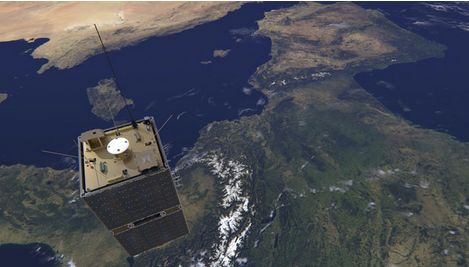
Following the launch from Space Launch Complex 4E (SLC-4E) at Vandenberg Air Force Base, ESEO separated from the launch vehicle and automatically activated the periodic transmission of its telemetry beacon. However, by the time out of a predefined period, having not received commands from the ground station, the spacecraft automatically entered into safe mode.
Some initial communications issues were experienced by ESEO in receiving commands from the ground stations in Forli’ (Italy) and Vigo (Spain), but they were resolved when the ESEO team of the Observatory of Tartu offered the possibility to use a ground station in Estonia. This is capable of transmitting with higher power, for a temporary contingent use. The Estonian ground station has been configured to be operated remotely by the ESEO MCC team, which involves students of the University of Bologna.
ESEO then started executing the commands transmitted from ground.
ESEO has now completed the LEOPS (Launch and Early OPerationS) phase
of its mission, reaching the platform nominal mode and has begun the
process of commissioning the whole satellite: firstly the platform
functions, with the payloads functions following.
As part of
this commissioning process, but subject to the successful completion of
other preparatory tasks of the platform subsystems commissioning, it is
anticipated that initial testing of the AMSAT communications payload
will be carried out within the next few weeks.
AMSAT-UK will
endeavour to provide some advance notice of these tests being
undertaken, but the first step will be activation of the 1200bps BPSK
telemetry beacon on 145.895MHz. The telemetry format matches previous
FUNcube missions and data from this beacon will be forwarded to the
FUNcube Data Warehouse using any of the FUNcube dashboards. However, to
see the decoded values and graphical displays, please download the
dedicated ESEO mission dashboard which is available here https://download.funcube.org.uk/ESEO_Dashboard_v1177.msi
The payload has, additionally, a high speed, 4800bps BPSK data format
downlink and also a Mode L/V FM transponder both of which will be
tested.
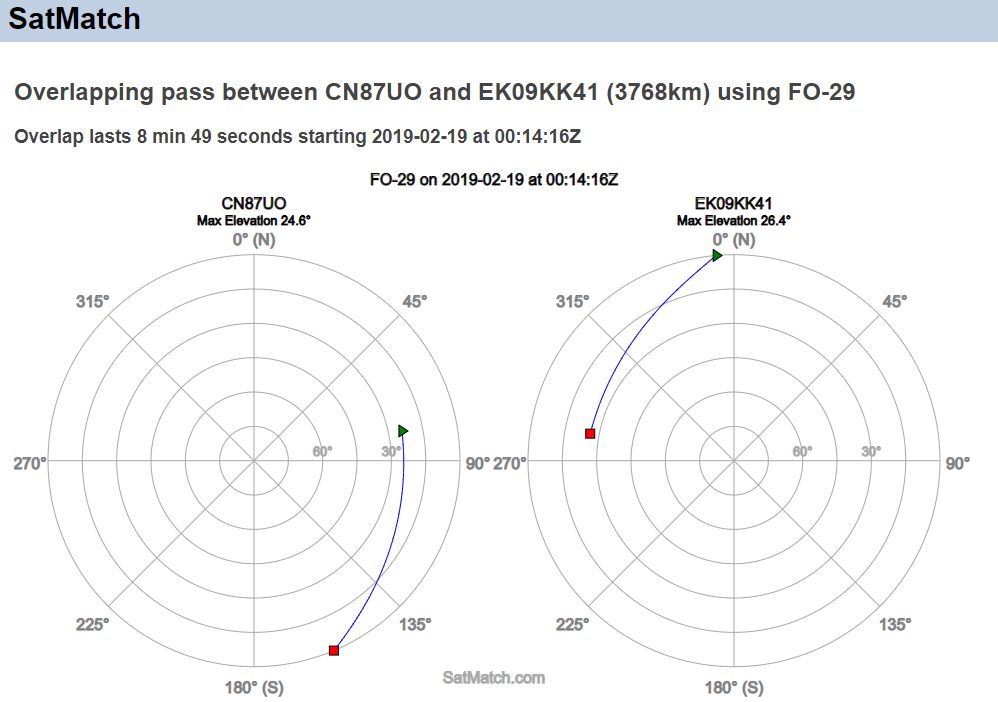
SatMatch är ett online-verktyg för att se om en satellitpassage täcker in två olika positioner. Väldigt enkelt att använda. Finns på denna länk: https://www.satmatch.com/
For english summary please see below the swedish text.
Det verkar som es hailsat II närmar sig sin slutposition mer och mer: https://eshail.batc.org.uk/ Det skall bli väldigt intressant att se den initiala transponderaktiviteten. För oss i SM så ser det fortsatt mörkt ut vad det gäller upplänk. (Vi är begränsade till 100mW in i antennsystemet). Det finns en ansökan som avslogs men den har överklagats och vi avvaktar slutligt besked. Skulle inte överklagan ge oss en bättre position så finns det planer på hur vi går vidare.
Det sker även förberedande arbete i VUSHF sektionen SSA för ett framtida planerat möte med PTS där vi så exakt som möjligt skall precisera vad vi behöver som ett minimum i tillförd effekt för att vi inom SM ska få vara med på den första Geostationära amatörtranspondern. Det kommer behövas lite initiala tester i verkliga livet för att se hur väl den hör när den öppnar för trafik och vi lite mer exakt vet vad som krävs.
— This is the present situation for swedish radio amateurs regarding P4-A uplink:
The maximum output is limited to 100mW
SSA (Amateur radio organisation in Sweden) is working to be able to have a future meeting with PTS (Swedish radio government) about this issue. This will probably be after the first real tests with the P4-A transponder.