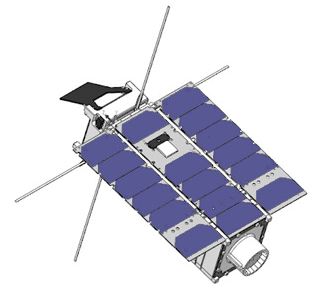
On November 2, 2019, the HuskySat-1 cubesat launched on the Cygnus NG- 12 mission from Wallops Island, Virginia, USA. The satellite was con- structed by the Husky Satellite Lab at the University of Washington, and utilizes an AMSAT-constructed radio system for primary communica- tions. Deployed from the Cygnus vehicle on January 31, 2020 after de- parting the ISS, HuskySat-1 began a 3-month educational mission. Upon completion of that mission, the satellite began operation of a V/u linear transponder in amateur service.
At the request of the Husky Satellite Lab and AMSAT teams, AMSAT here- by designates HuskySat-1 as HuskySat-OSCAR 107 (HO-107). We congratu- late the Husky Satellite Lab, thank them for their contribution to the amateur satellite community, and wish them continued success on this and future projects. 73 Drew Glasbrenner, KO4MA AMSAT VP Operations / OSCAR Number Administrator
Info from ANS-131 about a new interesting satellite with HF: Two new Chinese amateur radio satellites are now expected to launch on September 15, 2020. The first of these satellites, CAS-7A, is a 27 kg microsat (750 mm x 650 mm x 260 mm) with three-axis stabilization and several transponders. The transponders include a 15m to 10m linear transponder (H/t), a 15m to 70cm linear transponder (H/u), and a 2m to 70cm linear transponder(V/u). The satellite also includes a 2m to 70cm (V/u) FM transponder. Several beacons and data downlinks are also feat- ured, CW beacons on 10m and 70cm, 4.8k or 9.6k GMSK telemetry on 70cm, and a 1 Mbps GMSK image data downlink on 3cm for the on board camera. IARU coordinated frequencies for the uplinks and downlinks are listed below.
This launch is also expected to carry CAS-7C, a 2U CubeSat with a V/u linear transponder and a CW beacon. Frequencies for CAS-7C have not been coordinated by the IARU at the time of this writing. CAS-7C will also deploy a 1 mm diameter 1080 meter long carbon fiber rope.
CAS-7A and CAS-7C will launch from Jiuquan Satellite Launch Center into a 500 km sun-synchronous orbit with an inclination of 98 degrees.
Frequencies:
CAS-7A H/t Linear Transponder Uplink – 21.245MHz through 21.275 MHz Downlink – 29.435MHz through 29.465 MHz CW Beacon 29.425 MHz
CAS-7A H/u Linear Transponder Uplink – 21.3125 MHz through 21.3275 MHz Downlink – 435.3575 MHz through 435.3725 MHz CW Beacon 435.430MHz
CAS-7A V/u Linear Transponder Uplink – 145.865 MHz through 145.895 MHz Downlink – 435.385 MHz through 435.415 MHz CW Beacon 435.430MHz
CAS-7A V/u FM Transponder Uplink 145.950 MHz Downlink 435.455 MHz
From ANS 131b: After a week of testing, the transponder on HuskySat-1 is enabled and open for use and testing. It’s fairly sensitive, and 5-10 watts is plenty most of the time. There are some fades due to satellite orien- tation, and some passes are definitely better than others. The opera- tions and engineering teams are also watching a few anomalies. Please keep an eye on the beacon during transponder ops, for those with spec- trum scopes. Strong signals may impact the beacon strength.
HuskySat-1 is the Husky Satellite Lab at University of Washington’s first cubesat, and the first mission with AMSAT’s linear transponder module (LTM-1), a V/u transponder and integrated telemetry beacon and command receiver. UW recently completed their Part 5 operations and have graciously let AMSAT’s Part 97 transponder operations commence. This transponder module is available for use in educational cubesat missions willing to enable the transponder for worldwide use. Contact myself or VP Engineering Jerry Buxton for additional details.
Reports and observations are welcome to the amsat-bb mailing list.
Congratulations to Husky Satellite Lab, and to the entire AMSAT Engineering team for keeping amateur radio in space. Thanks to Dr. Mark Hammond, N8MH for commissioning and operations support.
73, Drew KO4MA
AMSAT VP Operations
HuskySat-1 V/u inverting transponder, 145.910 to 145.940 uplink, 435.810 to 435.840 downlink, telemetry beacon 1200 baud BPSK at 435.800
En rysk satellit som har amatörradiotransponder som payload har startats upp. Den har en linjär transponder och en bra bana. Enligt rapporter har flera kört den under dagen och den ska låta riktigt bra.
Info: NORAD ID: 44909 Uplink 145.935 MHz – 145.995 MHz Downlink 435.610 MHz – 435.670 MHz (inverting) CW beacon 435.605 MHz Banas 1511 km x 1175 km, 82.5 graderas inclination
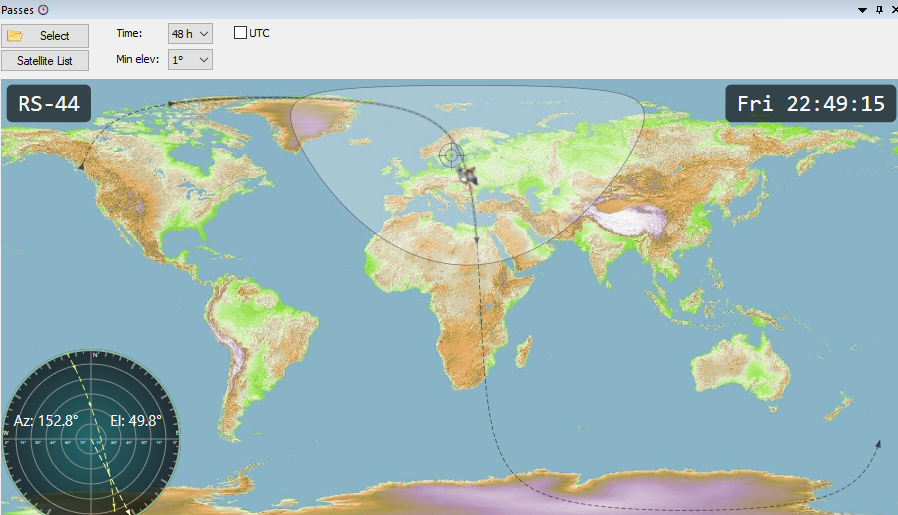
Vi får hoppas att de låter denna satellit vara på… Mycket fin footprint:
Lite mera info från ANS: The amateur satellite world was surprised to wake up to the news on April 30th that a new transponder was activated for testing and open for use by amateurs worldwide
Constructed by specialists at Information Satellite Systems and Students at Siberian State Aerospace University, DOSAAF-85 was launched on a Rockot/Breeze-KM launch vehicle from Plesetsk Cosmo- drome on December 26, 2019. The satellite apparently failed to separate from the upper stage of the launch vehicle and remains attached. The satellite’s name commemorates the 85th anniversary of the Voluntary Society for the Assistance to the Army, Aviation, and Navy (DOSAAF), the organization responsible for the military training of Soviet youth.
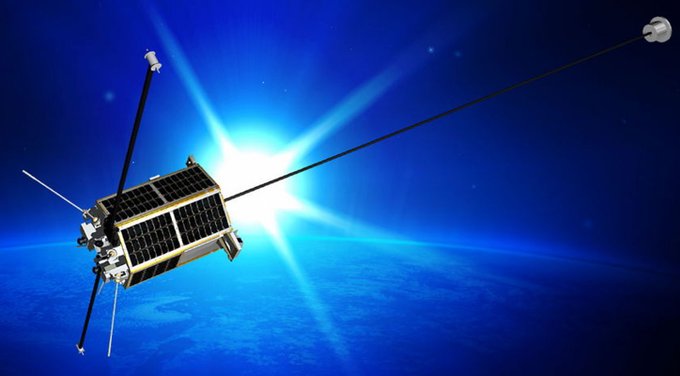
Designated RS-44, or Radio Sputnik 44, the satellite carries a 60 kHz wide V/u linear transponder and a CW beacon. With an orbit of 1511 km x 1175 km and an inclination of 82.5 degrees, this is the highest orbiting functioning amateur satellite available worldwide. Due to the 1511 km apogee, regular DX contacts should be easy to make. The first claimed DX record came from Joe Werth, KE9AJ, and Jérôme LeCuyer, F4DXV, who reported a 6,993 km trans-Atlantic QSO between EN50gn09 in Illinois and JN04iu40 in France. This was quickly eclipsed less than 24 hours later when Casey Tucker, KI7UNJ, and Tetsurou Satou, JA0CAW, reported the first trans-Pacific QSO between CN93jw (Oregon, USA) and PM97nw (Niigata, Japan), a distance of 7,859 km. The theoretical max- imum range for QSOs via RS-44 is 7,942 km.
The NORAD ID is 44909, object 2019-096E.
Initial reports from the first days of operation suggest that the transponder is very sensitive and easily workable with low power and handheld antennas, however significant periodic fading is reported, likely due to the fact that the satellite remains attached to the upper stage of the launch vehicle and is unable to deploy its gravity gradient boom to stablize itself.
The satellite is planned to remain continuously available for testing purposes until May 11th at which time a decision on further operations will be made.
The Keplerian elements for RS-44 have been added to the AMSAT and CelesTrak distributions, as well as several popular tracking apps. The ARRL has released version 11.10 of the TQSL configuration file to add support for RS-44 to LoTW.
RS-44 – V/u Inverting Analog SSB/CW Uplink (LSB) 145.935 MHz through 145.995 MHz Downlink (USB) 435.610 MHz through 435.670 MHz CW Beacon 435.605 MHz