Categories
Ham Satellite news

CatSat to Open Microwave Linear Transponder Access for Amateur Radio Community

Re-post from ANS-313:

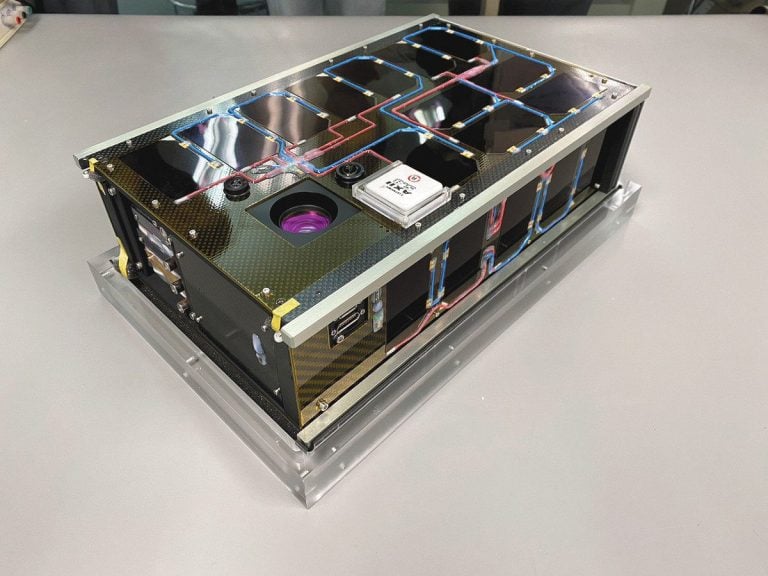
The CatSat team has announced that preparations are underway to open public operation of the spacecraft’s linear transponder, offering the amateur-radio community a new microwave-band satellite resource. CatSat, a 6U CubeSat developed and flown by students, faculty, and staff at the University of Arizona in partnership with FreeFall Aerospace and Rincon Research, has been on orbit since July 2024 and is now entering the phase of its mission focused on community engagement and technology demonstration.

CatSat was launched aboard a Firefly Aerospace Alpha rocket from Vandenberg Space Force Base as part of NASA’s CubeSat Launch Initiative. Measuring roughly the size of a family-size cereal box, the spacecraft carries a suite of experimental payloads, including a novel inflatable antenna capable of enabling large-aperture communications from a small satellite platform. In addition to ionospheric monitoring via high-frequency (HF) radio measurements and imaging of the Earth, CatSat includes a linear transponder for amateur radio, extending the University of Arizona’s long legacy in space science down to hands-on student involvement.

The satellite orbits Earth in a nearly sun-synchronous polar orbit, circling the globe approximately every 90 minutes. As part of its student-driven mission, CatSat is demonstrating how cutting-edge antenna systems and commercial-off-the-shelf radio hardware can support meaningful research and amateur communications from a compact form factor. The mission is funded by the University of Arizona Office of the Vice President for Research and the Arizona Space Institute, with additional support from industry partners.

When the linear transponder is active, CatSat listens on 5.663 GHz (uplink) and transmits on 10.47 GHz (downlink), providing approximately 200 kHz of bandwidth. Patch antennas on the spacecraft’s −Y face offer roughly 60-degree beam coverage, and the attitude-control system can point the antenna footprint at ground stations for up to 10 minutes per pass. Power considerations limit each activation to about 15 minutes, a balance that allows the spacecraft to support both mission science and amateur communications.

Early on-orbit demonstrations used a 1-meter C-band uplink dish and a 6.1-meter X-band downlink dish to confirm transponder functionality, successfully relaying Morse code. The CatSat team is now constructing a more accessible ground station using 1-meter-class commercial antennas to show that amateur access is practical with reasonably sized equipment. Operators will be able to monitor schedule updates — informally known as the “five and dime” plan — through the CatSat mission website.

Commissioning passes targeting the CatSat ground stations in Tucson took place on October 29 and November 2, with one final activation scheduled for November 9 at approximately 7:50 PM MST (UTC-7) — just hours after this bulletin’s publication. As testing continues, dates may shift as the team evaluates performance and power-budget constraints. Operators can follow activation plans and future opportunities at https://catsat.arizona.edu.

Read the full announcement at: https://catsat.arizona.edu/news/catsat-team-preparing-public-linear-transponder-operations

[ANS thanks the CatSat Team and the University of Arizona for the above information]

Categories
Ham Satellite news

AMSAT-NA President Outlines Future Directions

From ANS-299:

At the Annual General Meeting of AMSAT members, held as part of the AMSAT Symposium in Phoenix, Ariz. last weekend, newly elected AMSAT President Drew Glasbrenner, KO4MA, outlined some future directions for the organization.

Noting that membership in organizations and voluntary associations of all types has been declining across the board, in all areas of society, Glasbrenner suggested a two-pronged approach.

First, reduce the cost per member. AMSAT has already made major steps in that direction, by closing the office and changing to an all-volunteer administration, and also by changing the AMSAT Journal from print to a digital publication. The organization should seek more opportunities to economize.

Second, increase membership by creating a strategy to actively seek and invite new hams. The Board has just approved a free student membership to bring young hams into the organization. Reinstating a College Activity Night on the satellites, an AMSAT Youth Net, and publicizing youth satellite activities are priorities. Another possibility might be a two-tiered membership structure with a low-fee introductory membership.

Glasbrenner also noted that government budget cuts have caused NASA to eliminate the CubeSat Launch Initiative program (CSLI), which provided free launch opportunities to educational projects. AMSAT has benefited from CSLI, but has also purchased commercial launches in the past. He indicated that AMSAT should not wait to see if CSLI is reinstated or replaced with a similar program, but that the organization should move forward to fund commercial launches for GOLF-Tee and Fox Plus satellites that are nearing readiness in coming months.

Another challenge facing AMSAT is that it is becoming increasingly difficult to operate in Low Earth Orbit (LEO). While orbital debris regulations forbid launches to higher orbits without meeting stringent technical requirements for deorbiting, reentry devices are largely unavailable or unproven. The GOLF program is meant to address this, but launches to higher orbits are also difficult to find. Future rules may mandate propulsion for collision avoidance in LEO.

A strategy to meet these orbital challenges is to focus on developing amateur radio payloads that can fly on other satellites. The Italian Greencube satellite, IO-117, was an example. To take advantage of these opportunities, AMSAT engineers must focus on developing payloads as a series, rather than as single projects, so that units are “on the shelf” and available on short notice. The SDR Gen2 transverter board – an updated version of the units flown on HuskySat and MESAT1 – is a major step in this direction, as is the updated PacSat board under development. The GOLF and Fox Plus programs are also being crafted to create satellites in a series with iterative improvements and an up-tempo launch cadence.

Finally, Glasbrenner called for strengthening international collaboration with other AMSAT organizations around the world, as well as establishing mechanisms for strategic planning at the Board of Directors level. His address was received enthusiastically by those in attendance.

[ANS thanks Mark Johns, KØJM, News Service Senior Editor, for the above information.]

Categories
Ham Satellite news

e-kagaku-1 and BOTAN

Three Japanese CubeSats were deployed from the ISS using the Japanese J-SSOD on October 10, 2025. Two of the satlelites transmit in the amateur radio bands.

e-kagaku-1
CW, DigiTalker, 1.2kbps AFSK, 9.6kbps GMSK  145.840MHz
https://ekagaku-sat.net/   This web site is in Japanese
https://iaru.amsat-uk.org/finished_detail.php?serialnum=888

BOTAN
APRS 145.825MHz
Digital 437.375MHz
https://sites.google.com/p.chibakoudai.jp/gardens-04/
https://iaru.amsat-uk.org/finished_detail.php?serialnum=938

[ANS thanks JAXA and Masahiro Arai, JN1GKZ, for the above information]

Categories
Ham Satellite news

FutureGEO Workshop 2025 in Bochum

Thanks to ANS and AMSAT-DL for this info:

On September 19, 2025, the futureGEO workshop took place under the radome of the Bochum Observatory. Organized by AMSAT-DL with the support of ESA, the event brought together international experts, representatives of amateur radio organizations and dedicated radio amateurs who had previously declared their active participation in an appeal and submitted corresponding proposals. In the spring, AMSAT-DL had invited potential interested parties as part of an RFEI. The aim was to build on the experience gained with QO-100 and to jointly define the first concrete mission ideas for a future amateur radio payload in geostationary orbit.

The workshop was held as a hybrid event. The group was made up of one half who were present on site and the other half who took part online via ZOOM. Andrew Glasbrenner, K04MA, AMSAT VP – Operations represented AMSAT-USA at the meeting.

The purpose of the workshop was to collect, cluster and prioritize ideas:

  • Mission & Services – Which communication services and experiments should a new GEO payload enable?
  • Payload & antennas – What technical solutions are conceivable?
  • Ground station & operation – How can control and operation be organized?
  • User segment – Who should have access and how?

In a concluding reflection among the participants, it became clear how much QO-100 has revitalized and enriched the amateur radio community:

  • Affordable entry into microwave communication with low-cost SDRs and LNBs.
  • Development of open source software such as DVB-S2 encoders and decoders.
  • Educational projects from schools to schools contacts with Antarctica and other events.

The participants hope that radio amateurs can be even more involved in the construction of the hardware of a futureGEO with appropriate personal contribution, transparency and participation than was possible with QO-100 due to NDAs with the manufacturers and owners of the parent satellite.

The next steps are clear: The mission ideas developed in the workshop will be further concretized and should be available by the end of 2025 in the form of 1-3 consolidated mission concepts that are both technically exciting and attractive to the international amateur radio community and must also be technically feasible.

Read the entire story at https://amsat-dl.org/en/review-futuregeo-workshop-2025-in-bochum/ .

[ANS thanks AMSAT-DL for the above information.]

Categories
Ham Satellite news Members news

Tävling – vinn en VHF/UHF Cube Yagi

Sorry all international visitors! This competition is only open to Swedish hams and SWLs!

Tävlingen är avslutad. Vinnare blev Jan Emanuelsson SM7KOJ. Grattis!

AMSAT-SM-gruppen vill gärna att fler radio- och lyssnaramatörer bosatta i Sverige intresserar sig för amatörradiosatelliter. Därför vill vi nu ge er möjlighet att vinna en ny typ av VHF/UHF yagi som vi kan erbjuda i samarbete med FW Cubelabs i Spanien.

För att deltaga i tävlingen vill vi att du beskriver nedan vad du skulle behöva för hjälp eller motivation för att komma igång med amatörradiosatelliter. Det ger oss möjlighet att förbättra vår verksamhet som just är att informera om vår hobby.

Tävlingen pågår till sista oktober 2025 och vi kan endast skicka antennen till en adress i Sverige. Vinnaren meddelas här på hemsidan och kontaktas via e-mail, så det är viktigt att du anger det korrekt.

Lycka till önskar styrgruppen i AMSAT-SM!

    Ditt namn

    Din signal (valfri)

    Din e-post

    Vilken hjälp eller information skulle du behöva för att komma igång med amatörradiosatelliter? Finns det något på vår hemsida som kan förbättras?

    Categories
    Ham Satellite news

    CubeSats Deploy ISS September 19 2025

    Repost from ANS-257:

    JAXA, the Japan Aerospace Exploration Agency, has announced that five Japanese CubeSats will be deployed from the International Space Station (ISS) on September 19 (though the date and time of the deployment are subject to change due to the ISS schedule modification). The deployment event for those satellites will be broadcast via YouTube JAXA Channel. Four of the CubeSats, carrying scientific and educational payloads, will operate in the amateur bands, and radio amateurs around the world are invited to participate in the projects:

    GHS-01 is a 2U size CubeSat equipped with a camera for photographing the earth, a sensor for checking the state of the satellite, and an attitude control device. In response to commands from the ground station, the satellite-mounted camera photographs the earth from space and transmits the image data to the ground. In order for amateur radio users around the world to voluntarily acquire image data taken by this satellite by radio, the date and time of image transmission will be published on the website https://gifuhs2022.wordpress.com/. Also, the satellite carries a digitalker mission. Audio data is transmitted from a ground station and stored in the satellite. The voice data is transmitted from the satellite as an analog FM voice signal, and a message is broadcast from space. The date and time the message will be sent will be published on the website. The satellite was built by Gifu University with technical cooperation for using satellite radio waves with sister schools of universities and high schools such as Lithuania, Australia, Kenya, South Korea, and Taiwan. A downlink on 437.090 MHz has been coordinated with 20 wpm CW, 1k2 AFSK, 9k6 GMSK and digitalker voice.

    DRAGONFLY, coordinated by Kyushu Institute of Technology, is part of the Joint Global Multi-Nation Birds Satellite project, BIRDS-X, and funded by Amateur Radio Digital Communications in the U.S. The 2U CubeSat will carry APRS digipeaters on 145.825 MHz, as well as a Store and Forward messaging system. In addition to the VHF APRS frequency, a UHF downlink for CW beacon and telemetry using 4k8 GMSK will transmit at 437.375 MHz. A ground terminal competition will be held on DRAGONFLY. More information is available at https://birds-x.birds-project.com/

    STARS-Me2, a 1U CubeSat built by Shizuoka University features an earth observation camera, but the real experimentation takes place on the AX.25 radio downlinks on which those photos are transmitted back to earth. Reception success rates at receiving ground stations will be measured at baud rates of 1.2kbps, 9.6kbps and 115.2kbps. The coding gain of the error correction scheme will be measured on the downlinks. And the reception performance with polarization diversity at multiple terrestrial receiver stations (developed by amateur radio operators) will be evaluated. The goal is to learn more about how large data sets, such as images, are best transmitted from space. UHF downlinks with CW, 1k2 AFSK, 9k6 FSK and 115.2 bps GMSK are coordinated for 437.350 MHz, 437.400 MHz and 437.200 MHz.

    RSP-03 is also a 1U CubeSat carrying a camera, but in this case the camera will not be aimed at earth, but at the stars. The main mission is to capture the star data by camera, convert it to “audible data,” and deliver the audio to the ground as a “Stellar Symphony.” After acquiring data of stars and constellations captured by the onboard camera an on-board AI will compose sounds from the star data and transmit it to the ground via an FM Digi-talker. In addition, digital data will be sent using various baud rates and modulation modes, and a digital “QSL card,” stored on the satellite before launch will be transmitted via SSTV after amateurs have uploaded their callsigns from the ground. A downlink at 437.050 MHz will be shared by the FM Digi-talker, 1200 BPS (AFSK on FM), 9600 BPS (GMSK), and 24000 BPS (4FSK, OQPSK). Details are at https://rsp03.rymansat.com/en.

    [ANS thanks Masa Arai, JN1GKZ, IARU, and JAXA for the above information.]