
Thanks to ANS and AMSAT-DL for this info:
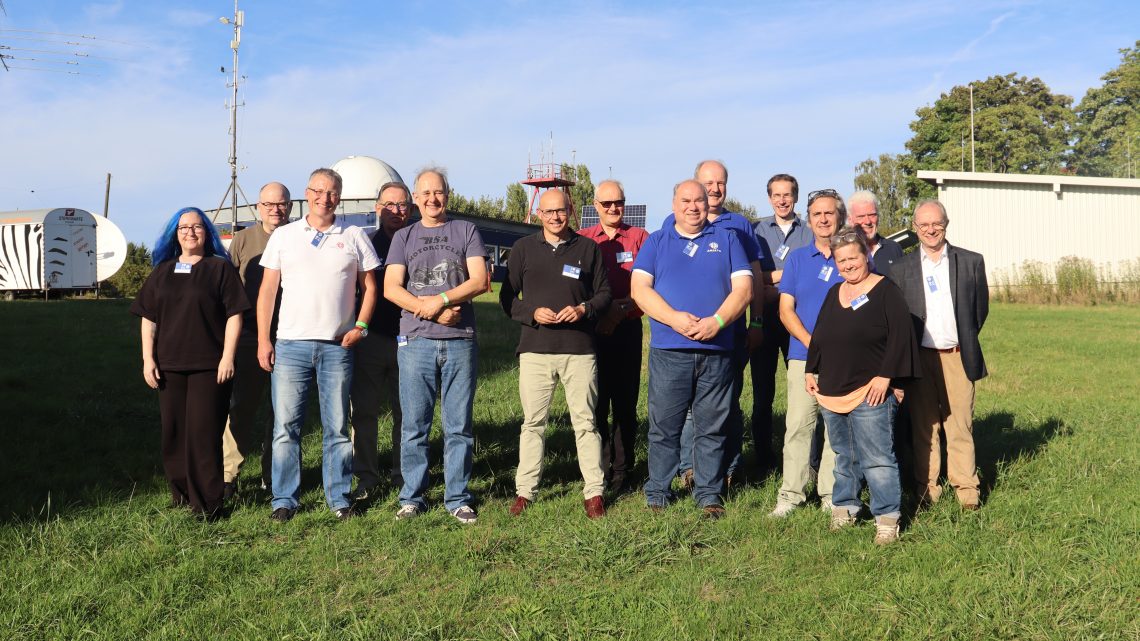
On September 19, 2025, the futureGEO workshop took place under the radome of the Bochum Observatory. Organized by AMSAT-DL with the support of ESA, the event brought together international experts, representatives of amateur radio organizations and dedicated radio amateurs who had previously declared their active participation in an appeal and submitted corresponding proposals. In the spring, AMSAT-DL had invited potential interested parties as part of an RFEI. The aim was to build on the experience gained with QO-100 and to jointly define the first concrete mission ideas for a future amateur radio payload in geostationary orbit.
The workshop was held as a hybrid event. The group was made up of one half who were present on site and the other half who took part online via ZOOM. Andrew Glasbrenner, K04MA, AMSAT VP – Operations represented AMSAT-USA at the meeting.
The purpose of the workshop was to collect, cluster and prioritize ideas:
- Mission & Services – Which communication services and experiments should a new GEO payload enable?
- Payload & antennas – What technical solutions are conceivable?
- Ground station & operation – How can control and operation be organized?
- User segment – Who should have access and how?
In a concluding reflection among the participants, it became clear how much QO-100 has revitalized and enriched the amateur radio community:
- Affordable entry into microwave communication with low-cost SDRs and LNBs.
- Development of open source software such as DVB-S2 encoders and decoders.
- Educational projects from schools to schools contacts with Antarctica and other events.
The participants hope that radio amateurs can be even more involved in the construction of the hardware of a futureGEO with appropriate personal contribution, transparency and participation than was possible with QO-100 due to NDAs with the manufacturers and owners of the parent satellite.
The next steps are clear: The mission ideas developed in the workshop will be further concretized and should be available by the end of 2025 in the form of 1-3 consolidated mission concepts that are both technically exciting and attractive to the international amateur radio community and must also be technically feasible.
Read the entire story at https://amsat-dl.org/en/review-futuregeo-workshop-2025-in-bochum/ .
[ANS thanks AMSAT-DL for the above information.]