Categories
Oscar-100

Oscar-100 QO-100 Es’hail-2

For english information please visit AMSAT-DL.

Uppdaterad: november 2025

Lyssna med WebSDR

Goonhilly Earth Station i Cornwall har en WebSDR som funnits med sedan start. Även IS0GRB har en WebSDR.
Lyssna på QO-100 utan egen utrustning!

Länkar

Numera finns hur mycket information som helst genom att söka på Google. Nedanstående är bara ett axplock av artiklar:

Utrustning

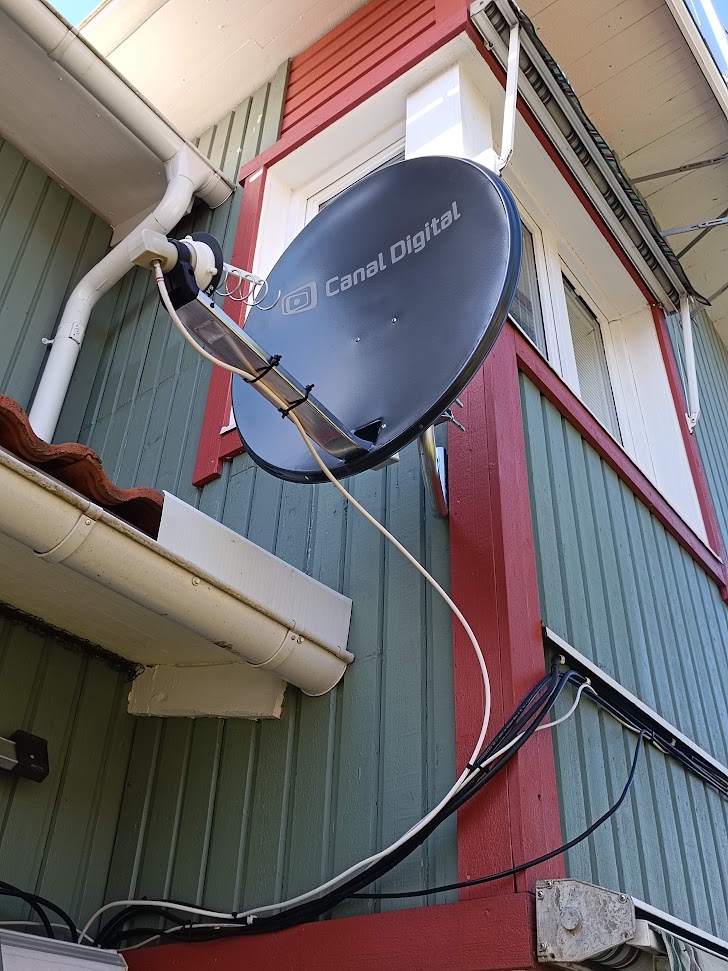
Här finns länkar till lämplig utrustning att bygga och företag som säljer tillbehör (finns dock många fler – sök på Google):

Föredrag av SM3BYA

Vi har fått tillåtelse att publicera Gudmund Wannberg SM3BYA fina föredrag från oktober 2020. Ladda ner den här (PDF).

Avkoda PSK beacon

Det går att ta emot PSK Beacon på 10489,745 MHz med hjälp av följande program:

Se en kort video från mottagning här:

Bandplan och frekvenser

Gällande publicerad Narrowband (NB) bandplan från april 2021 är följande (all information kommer från AMSAT-DL):
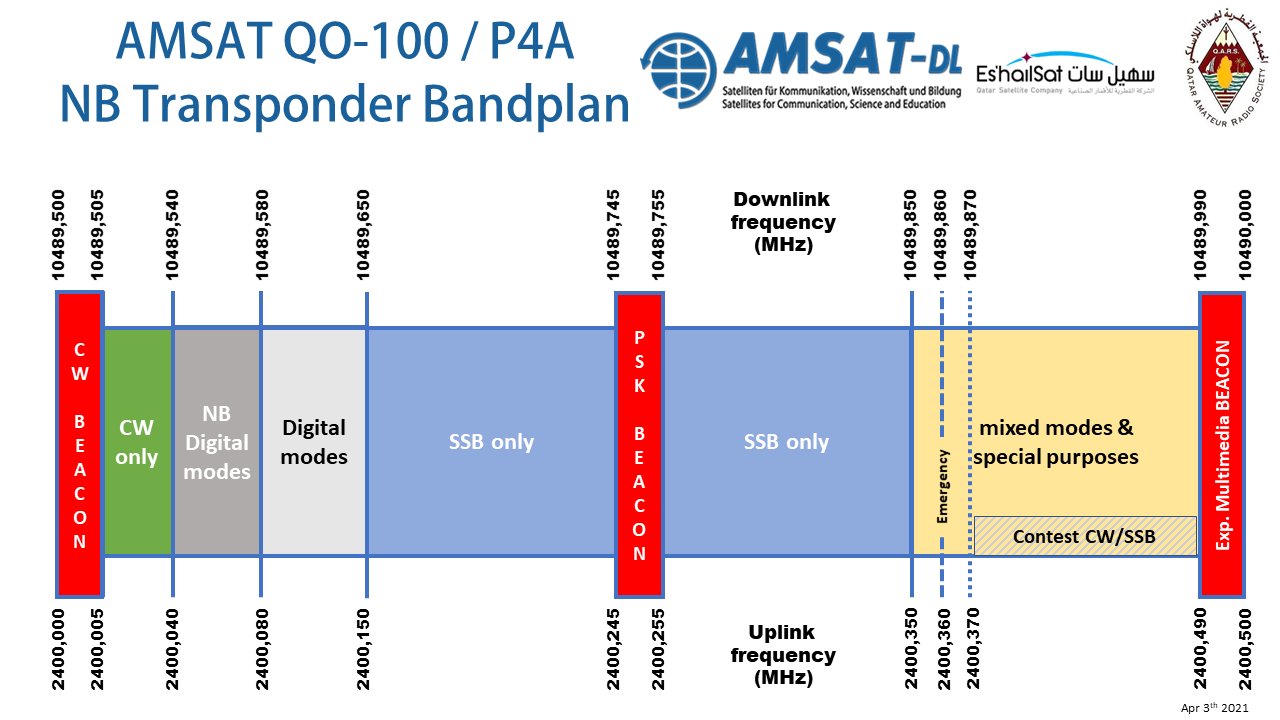
Viktiga “kom ihåg”:

  • NO FM mode is allowed on the transponder.
  • No transmission below the lower beacon and no transmission above the upper beacon.
  • The NB transponder is a bent-pipe transponder and non-inverting.
  • Uplink polarization is RHCP (right-hand circular polarization).
  • Downlink polarization for the NB transponder is V (vertical linear polarization).
  • Monitor the beacons and keep your own signal level below, otherwise you might trigger LEILA warnings.
  • Please use minimum uplink power (ERP).
  • The beacons are modulated in 400 bit / s BPSK (similar to the P3 satellites) or in CW.
  • The beacons are generated in the ground station and will Provide selected telemetry from the main satellite related to our amateur radio transponder.

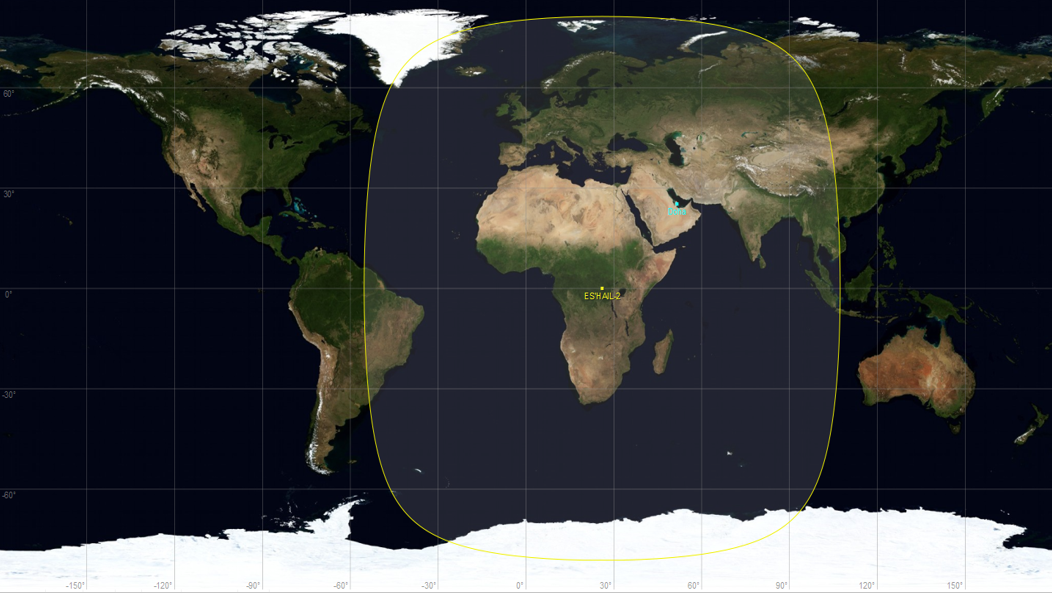
Täckningskarta

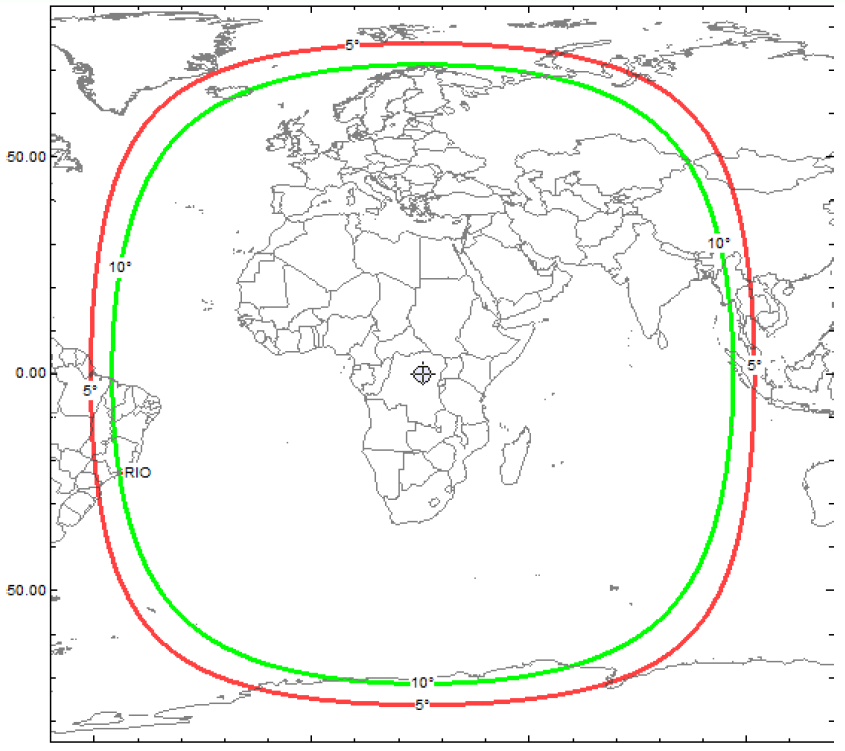
Täckningskartorna nedan är imponerande, bara att njuta och använda! Klicka för större bild.
Categories
Oscar-100

Es’hail-2 planerad uppskjutning 4:e kvartalet 2018

Nu information om att planerad uppskjutning för xx blir under 4:e kvartalet 2018. Följande info kommer från AMSAT-UK:

Es’hailSat has tweeted their geostationary satellite Es’hail-2 is expected to be launched by SpaceX in the 4th quarter of 2018.

Qatar’s Es’hail-2 satellite will provide the first amateur radio geostationary communications and is capable of linking amateurs from Brazil to Thailand.

Es’hail-2 will carry two “Phase 4” amateur radio transponders operating in the 2400 MHz and 10450 MHz bands. A 250 kHz bandwidth linear transponder intended for conventional analogue operations and an 8 MHz bandwidth transponder for experimental digital modulation schemes and DVB amateur television.

On August 2 the company tweeted the launch information in response to a question about the launch date from Eric Ralph https://twitter.com/eshailsat/status/1024898547165093890

On July 31, 2018 Michael Baylor @nextspaceflight tweeted:
A new #SpaceX Falcon 9 arriving at the Cape. The most likely scenario is that it is B1050.1 for the Es’hail mission. @13ericralph31 is reporting that B1046.2 will launch Merah Putih, making B1049.1 the most likely choice for Telstar 18V.
https://www.reddit.com/r/spacex/comments/93guev/falcon9_booster_headed_through_mount_dora_this/

AMSAT-DL Phase 4A Es’hail-2 geostationary satellite amateur radio transponder slides
https://www.amsat-dl.org/images/stories/satellites/Eshail-2/EsHail2_AMSAT-DL_July2018.pdf

AMSAT-DL Phase 4A leaflet https://www.amsat-dl.org/images/stories/satellites/Eshail-2/P4A_Leaflet.pdf

Es’hail-2 https://amsat-uk.org/satellites/geosynchronous/eshail-2/

Categories
Antennas Oscar-100

Es’hail-2 Parabol

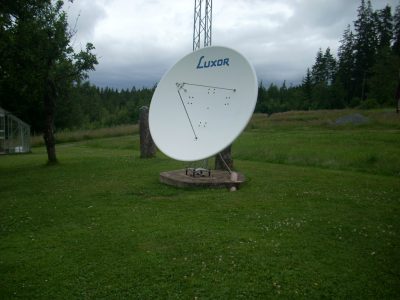
Jag har jobbat lite senaste veckan med att bygga ett varmgalvat fäste för min 180cm parabol. Parabolen skall bland annat användas för att ta in signalerna från vår kommande geostationära satellit phase 4A.

180cm

Känns rätt smidigt att montera parabolen lågt på befintlig mast.  Precis bakom parabolen är jag på gång att bygga en elektronikbod för diverse radiotekniska experiment. Som ni ser på bilden kommer det upp kulvert vid mastfoten där jag har både styrkablar och koax.  Så här långt så känns det som att jag kommer att montera en yagi eller helix för 2,4 GHz upplänken precis ovanför parabolen.

Som lite extra information så kan jag nämna att stålmasten som är 10 meter även håller på att kompletteras med en liten släde där jag skall ha 2M/70cm/23cm för tropo/Satellit.


Categories
Oscar-100

Es’hail2 tips om antenner, mottagare och sändare – Del 1

Det verkar ju som att vi kan få upp en geostationär transponder på 25,5 grader öst under kommande vinter.  Det har börjat att funderas rätt ordentligt på hur man löser nedlänken smidigast och det lutar rätt mkt åt begagnad satellit TV utrustning.
 
Enligt bifogade brev nedan så har en del planer på att använda även en satellit LNB för att sedan få ut en signal runt 739.55  MHz där man använder en SDR sticka och datorn för att lyssna.
 
Det första man kommer att tänka på är hur det blir med frekvensstabiliteten vid dom smalbandsmoder vi använder oss av?.
  
Bifogar lite text från en del tips som kommit senaste veckan.
Hi Stan (and others),

For the downlink I’m going to use an off-the-shelf dish and LNB coupled to
an SDR. The LNB should have high gain and be very frequency stable. The
Octagon Optima series LNB’s get a lot of praise and are very well suited
for this task, and they’re cheap too: I picked up one for about 15 dollars,
check ebay. The local oscillator is at 9750 MHz, so to receive the start of
the pass band at 10489.55 MHz the SDR should be tuned to 739.55 MHz, most
SDR’s should be capable of that. The pass band is a little bit below the
spec of the LNB which starts at 10700 MHz, but according to the
measurements done on the oe7forum linked below the -3 dB point of the LNB
is at 10048 MHz, so it should work just fine.

See also:
– Octagon LNB spec:
http://www.oe7forum.at/download/file.php?id=1363&mode=view
– Octagon LNB test: http://www.g4jnt.com/pll_lnb_tests.pdf
– Description of a 10 GHz ground station (in german unfortunately, but the
pictures say a lot) http://dl3jin.de/10ghz_rx.htm
– There is a lot of activity in Austria, maybe because satellite operation
with the current flock of birds is difficult when your horizon starts at 30
degrees elevation. 🙂 http://www.oe7forum.at/viewtopic.php?f=42&t=468

For the uplink it’s going to be something like a 70cm SSB-capable set, a 13
cm transverter, a PA if really necessary (but hopefully not when the
antenna gain and transverter output are high enough), all still to be
acquired.. The antenna is going to be a helical feed in the same dish as
the LNB, or maybe something like this, I’m not sure yet:
– Quad helix array (sorry, german again): http://dl3jin.de/13cm_helix.htm

73,
Rico PA3RVG

Samt en länk
http://www.prutchi.com/2012/03/11/d-i-y-combined-l-band-23-cm-helical-feed-and-ku-0-4-db-lnbf-for-120-cm-dish/
Lite mera tankar
Having posted my setup at the end of last month and
seeing that my mail program wrapped line feeds, decreasing
readibility, here again my description and perspective.

Es’hail2 will not differ from any other geostationary broadcast satellite
in a sense that it’s a ‘full duplex’ repeater with some time delay.

I reckon this time delay inhibits actual full duplex operation,
just like the TV reporter for a ‘live stand up’ in the TV news via
a satellite link having an earplug with all audio except himself (‘N-1’).

For us amateurs this means no (significant) Doppler shift,
no LSB/USB issues etc.

Just point your dish once to 25.5E like (more than) thousands of
broadcast satellite viewers do (without technical knowledge at all 😉

Downlink (10.5 GHz):
For narrow band usage frequency and stability is paramount.
For 10.5 GHz we’re helped by the BC satellite industry, offering
cheap PLL LNB’s with ‘HDTV precision’.

Imho this precision needs to be increased by injection locking
the LNB PLL with e.g. a GPSDO due to the large multiplification
factor inside the LNB (e.g. for Octagon 361.111111).

Noise figures (NF) of these LNB’s are somewhat higher on 10.5 GHz
due to (steep) wave guide cut off, but still usable, compared to
the ease and price.

Uplink (2.4 GHz):
A 10W BUC (block up converter) suffices with published specs of
the 2.4 GHz receiver above in conjunction with a ca. 75cm dish here.

I’m currenly developing a simple 2.4 GHz BUC and will use old UMTS pallets
to amplify the desired 2400 MHz output.
Picture of my UMTS pallets: http://remco.org/umts.jpg

Bear in mind, S-band power is cheap 🙂

Antenna:
One dish, the larger the better. Not for the uplink, but for improving
dynamic range at the receiver (downlink) side.

I will use a surplus Triax 88cm dish (for portable / ‘umbrella’ use ;-),
f/D is around 0.6 (like most consumer BC satellite dishes).

Feed:
From my perspective the only challenge lies in the 2.4 GHz uplink.
That is, to make an S-band feed which phase center coincides with the
10.5 GHz LNB (which has its own ‘feed’ 😉

I’ve no fear for isolation issues due to the large frequency difference.

I am told that circular polarisation (CP) is ‘mandatory’ for S-band
uplinks in general but can’t find a verification for this,
perhaps somebody else?

Anyway, we’re amateurs and creative. So when RHCP uplink is too
difficult we make a linear antenna and increase uplink power with 3 dB 😉

But, I follow the published receiver specifications . . .
Last week I made a 6 turn LHCP 2.4 GHz helix.
(Rule of thumb seems to be 1 turn per 0.1 f/D)
Phase center of such a helix is a bit ‘foggy’ but from what I read lies
somewhere between the first and second turn.

I’ve some issues with matching it due to some mechanical boundary conditions
of the helix feed point in conjunction with the mounted downlink LNB and
relative position of the helix.
There is an additional ‘transmission line’ involved and
a ‘normal’ 1/4-wave stub doesn’t give me the desired return loss.
So, this needs some fiddling, perhaps with a gamma match or so.

My approach is, the downlink LNB is mounted in the dish ‘as usual’ and
looks through the centre of the uplink helix.

Pictures of the prototype feed arrangement can be provided soon.
They are on a camera not present here at this moment of writing.

Remco PA3FYM

Det här var några klipp från veckan som gått och vi ser fram mot nya intressanta lösningar.
 
Med vänlig hälsning  Håkan
Categories
Oscar-100

Es’hail-2 med amatörradiotransponder planerad uppskjutning 2016

eshail-2__1

Från ANS kan vi nu läsa att det finns kontrakt att skjuta upp den
geostationära satelliten Es’hail-2 under senare delen av 2016. Det
speciella med denna satellit är att den kommer att ha en
amatörradiotransponder ombord.

Personligen tycker jag detta är den största händelsen inom
amatörradiosatelliter sedan Phase 3D. Vi får hoppas att det går i lås
och att flera tillverkare kommer att erbjuda paketlösningar för
mottagning av 10 GHz och sändning på 2.4 GHz.


Geosynchronous Es’hail-2 with Amateur Payload Contracted for 2016 Launch

The new satellite will be positioned at 26° East. In September 2014, a
contract with MELCO was signed to build the satellite based on the DS-2000 bus. In
December 2014, a launch contract was signed with SpaceX to launch the
satellite on a Falcon-9 v1.1 booster in late 2016.

Es’hail 2 will also provide the first Amateur Radio geostationary
communication capability linking Brazil and India. It will carry two “Phase 4” Amateur
Radio transponders. The payload will consist of a 250 kHz linear transponder
intended for conventional analogue operations in addition to another transponder
which will have an 8 MHz bandwidth. The latter transponder is intended for
experimental digital modulation schemes and DVB amateur television. The
uplinks will be in the 2.400-2.450 GHz and the downlinks in the 10.450-10.500 GHz
amateur satellite service allocations. Both transponders will have broad
beam antennas to provide full coverage over about third of the earth’s
surface. The Qatar Amateur Radio Society and Qatar Satellite Company are cooperating
on the amateur radio project. AMSAT-DL is providing technical support to the
project.

[ANS thanks Gunter Krebs for the above information]

Categories
Oscar-100

Phase 4 Transponder verklighet under 2016?


eshail-2__1

Nu har AMSAT kommit ett steg närmare en verklighet att kunna få en geostationär transponder under 2016. Det finns nu ett kontrakt att bygga TV-satelliten Es’hailSat där en payload med amatörradiotransponder är planerad. Upplänken kommer att vara mellan 2.400-2.450 GHz och nerlänken mellan 10.450-10.500 GHz. Ungefär en tredjedel av jordens yta kommer att täckas kontinuerligt.

Info från ANS:

Gunter Krebs reports on his Space Pages on the web that Es’hailSat has
signed a contract with MELCO to build the Es’hail-2 geostationary
comsat.

Es’hail 2 is a planned communication satellite operated by
Es’hailSat, the Qatar Satellite Company. It will also feature an
radio amateur payload.

The new satellite will be positioned at the 26° East hotspot
position for TV broadcasting and significantly adds to the company’s
ability to provide high quality, premium DTH television content
across the Middle East and North Africa. It will feature Ku-band and
Ka-band transponders to provide TV distribution and government
services to strategic stakeholders and commercial customers who
value broadcasting and communications independence, interference
resilience, quality of service and wide geographical coverage.
Es’hail 2 is expected to be launched at the end of 2016.

In September 2014, a contract with MELCO was signed to build the
satellite based on the DS-2000 bus.

Es’hail 2 will also provide the first Amateur Radio geostationary
communication capability linking Brazil and India. It will carry two
“Phase 4” Amateur Radio transponders. The payload will consist of a
250 kHz linear transponder intended for conventional analogue
operations in addition to another transponder which will have an
8 MHz bandwidth. The latter transponder is intended for experimental
digital modulation schemes and DVB amateur television. The uplinks
will be in the 2.400-2.450 GHz and the downlinks in the
10.450-10.500 GHz amateur satellite service allocations.
Both transponders will have broad beam antennas to provide full
coverage over about third of the earth’s surface. The Qatar Amateur
Radio Society andQatar Satellite Company are cooperating on the
amateur radio project.
AMSAT-DL is providing technical support to the project.

This story is posted at:
http://space.skyrocket.de/doc_sdat/eshail-2.htm