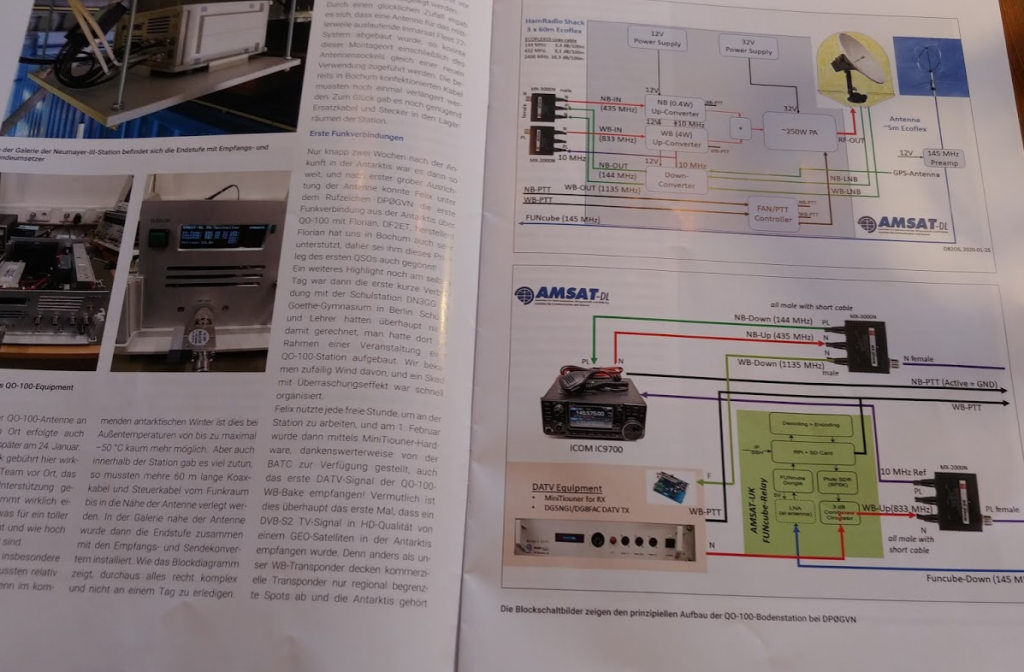
Thank you @amsatdl for latest AMSAT-DL Journal with a very nice article about the Neumayer-III QO-100 station.
 AMSAT-SM - Official Website of AMSAT-SM Sweden
Webmaster and member of the AMSAT-SM steering group.
Thank you @amsatdl for latest AMSAT-DL Journal with a very nice article about the Neumayer-III QO-100 station.
AfriCUBE update from AMSAT-SA:
http://www.amsatsa.org.za/AfriCUBE.htm
From ANS-103:
The latest version of TrustedQSL (TQSL), version 2.5.2, offers
improved Logbook of The World (LoTW) support for operations from
several locations, as well as the ability to detect uploads that
contain incorrect location data.
The primary new feature in TQSL 2.5.2 allows logging programs, in
conjunction with TQSL, to avoid incorrect contact uploads, while
adding mechanisms to allow easy uploading of logs for roving
stations. LoTW had required rovers to identify each location used
as a separate location in TQSL. The new version of TQSL allows these
operations to be handled much more smoothly by using information from
the station’s logging program.
When a log is signed by TQSL, the station details — call Sign, DXCC
entity, grid square, and other location details provided by the
selected station location (and call sign certificate) — are compared
with the details in the log. If the US state and station location in
a log do not agree, TQSL 2.5.2 will reject the contact, detecting
errors in instances when an incorrect station location has been
chosen.
This feature will necessitate changes in many logging programs,
because it requires that the log provide station details previously
not used by TQSL. Once a logging program supplies these (MY_STATE,
MY_DXCC, MY_CQ_ZONE, etc.), then TQSL will validate them against the
log. Currently, Cabrillo logs use the CALLSIGN field to verify that
the contacts are for the correct call sign.
Optionally, a station performing roaming operations (e.g., from
multiple grid squares) can choose to have TQSL assume that the log is
correct. When call sign or home station are provided with the log,
TQSL will automatically update the details on the upload. Select
“Override Station Location with QTH Details from your Log” on the
“Log Handling” preference page to enable this feature.
This release also includes an update to the most recent TQSL
configuration file.
This bird is very strong at 437.200 MHz 9k6 WFM.
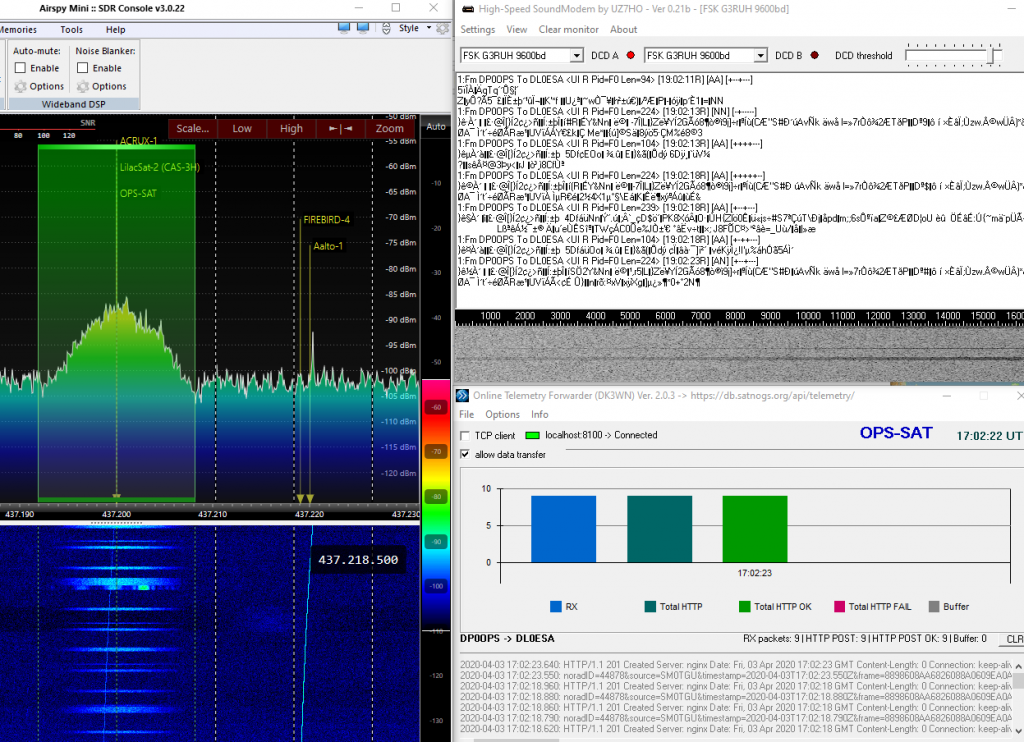
Complete pass, 13 minutes and 46 degree max elevation. 129 frames received. 2 x 6 el Yagi, LNA, #airspy mini, SDR-Console v3.
FoxTelem has been updated to version 1.08z5 and the latest version is
here:

http://amsat.us/FoxTelem/windows/
http://amsat.us/FoxTelem/linux/
http://amsat.us/FoxTelem/mac/

This is not a mandatory upgrade. It fixes some minor bugs that caused
crashes and corrects the calculation of the bit SNR for the Dot Pro-
duct BPSK detector.

If you use the Dot Product detector and you care about the measured
bit signal to noise ratio, then you want to upgrade.  Note that if you
use Find Signal in IQ mode then the bit SNR level is used to determine
if the signal is found. Because the level has changed you will need to
adjust the threshold value.  Email Chris Thompson at g0kla at arrl.net
if you need more information.

Please let me know if you see any issues, or log them on GitHub here:
https://github.com/ac2cz/FoxTelem/issues

[ANS thanks Chris Thompson, AC2CZ/G0KLA, AMSAT FoxTelem Developer for
the above information]