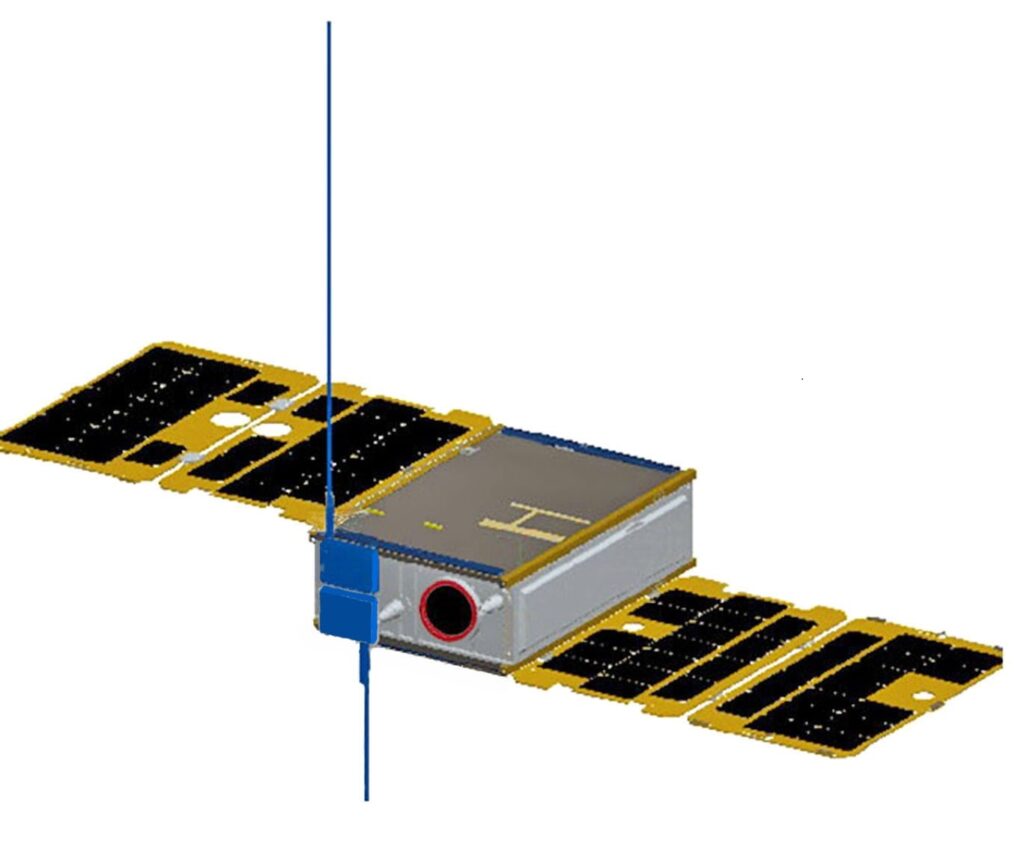
The CAS-9 XW-3 satellite was launched today 26 dec 2021. Several reports on Twitter reporting the satellite to be active on both CW, GMSK and transponder. Congratulation to the CAMSAT team! Some examples from the Twitter feed:
XW-3 Report 0425z: Thanks for rqso's: XE1MYO W3FGP K0JM KE8RJU K8DP. Heard VE5SWL(CW) Uplink calibration about +2100Hz. Keps seem very accurate as doppler was stable. Signal very weak at the end of the pass. Congratulations to the Chinese Team!
Hello OM, The CAMSAT XW-3 (CAS-9) amateur radio satellite will be launched at UTC 03:11:31 on 2021-12-26 , and will be deployed at 98.858° east longitude and 28.413° north latitude at UTC 03:35:58, location close to Western Australia.
Radio amateurs will receive CW beacon and GMSK telemetry signals approximately 38 seconds after the satellite is separated from the launch vehicle, and then the linear transponder will be put into use after approximately 49 seconds.
Attached is the launch schedule and the Two-Line Orbital Element file.
This is an example how a pass can look like over north NA and EU:
According to info from ANS-353 and BA1DU, Alan Kung, CAMSAT XW-3(CAS-9) amateur radio satellite will be launched by Chinese CZ-4C Y39 launch vehicle on December 25, 2021 from the Taiyuan Satellite Launch Center in China. XW-3(CAS-9) satellite will be piggybacked on the rocket with primary payload ZY-1(02E) satellite.
The satellite orbit is a circular sun-synchronous orbit with an altitude of 770.1 kilometers and an inclination of 98.58 degrees, the running cycle is 100.14 minutes. The functions of XW-3(CAS-9) satellite include UHF CW telemetry beacon, GMSK telemetry data transmission, V/U mode linear transponder, a visible light band space camera and an experimental thermoelectric generator for high school students. After the satellite completes the in-orbit test and works normally, the space camera photo download will be open to amateur radio enthusiasts all over the world.
When the relevant remote control command is received by the satellite, the GMSK telemetry channel will be used to downlink the photo storage information and photo data, and the telemetry data will stop sending at that time.
XW-3(CAS-9) satellite adopts a 6U CubeSat structure with a mass of about 10kg, an onorbit envelope size of 340.5×121.76x998mm with four solar array panels and a threeaxis stabilized attitude control system is used, long-term power consumption is about 15.2 Watts.
AMSAT-SM has decided to unlock all web pages for all visitors of amsat.se For many years we had have some pages only for registered members – as from now all of these pages are unlocked. For example you can now download all old issues of the newsletter AMSAT-SM Journal.
Japan’s OMOTENASHI, the world’s smallest moon lander, will have an X-band and UHF communication system, although it will not carry an amateur band transponder. OMOTENASHI is a 6U CubeSat set for launch via a NASA SLS rocket as early as February 2022. It will have a mission period of from 4 to 5 days. The name is an acronym for Outstanding Moon Exploration Technologies demonstrated by Nano Semi-Hard Impactor. Wataru Torii of the Japan Aerospace Exploration Agency (JAXA) Ham Radio Club, JQ1ZVI, said radio amateurs can play a role in gathering data from the spacecraft.
The spacecraft is made up of two separable components, both having independent communication systems — an orbiting module and a surface probe. The orbiting module will take the surface probe to the moon. It will transmit beacon or digital telemetry data on UHF (437.31 MHz). The surface probe — the moon lander — will transmit digital telemetry or three-axis acceleration analog-wave with FM modulation on UHF (437.41 MHz). Transmitter power will be 1 W in both cases.
“If we succeed in receiving the UHF signal from the surface probe, we could know the acceleration data on the impact on the moon and the success of the landing sequence,” Torii explained.
“We already have a station for uplink and downlink at Wakayama in Japan — used as an EME [moonbounce] station. However, if the satellite is invisible from Japan, we cannot receive the downlink signal. So, we need a lot of help from ham radio stations worldwide.” Torii noted that the RF system on the lander only operates on UHF.
The orbiting module beacon will transmit on 437.31 MHz using PSK31. The surface probe beacon will transmit on 437.41 MHz using FM, PSK31, and PCM-PSK/PM.