SOAR Satellite Optimized Amateur Radio by Mark Smith @smittyhalibut @HalibutElec is a radio project optimized for operating FM satellites in full duplex.
An update of GOLF-TEE project from AMSAT-NA ANS-030:
AMSAT’s GOLF-TEE CubeSat de-manifested from launch on ELaNa-46 NASA has de-manifested GOLF-TEE from the ELaNa-46 mission at the request of AMSAT. ELaNa-46 was expected to launch no earlier than 2022. COVID-related restrictions and supply chain disruptions, affecting both AMSAT’s vendors and team, have put AMSAT’s ability to meet the mission integration timeline at high risk.
AMSAT Vice-President Engineering Jerry Buxton, N0JY, described some of the reasons for this decision: • AMSAT finds itself in a similar situation to what other payloads and space-industry providers are experiencing. The worldwide pandemic and supply chain shortages are threatening everyone’s ability to properly and successfully deliver for launches. • Out of respect for NASA, the launch provider, and other payloads, it is important to withdraw now, rather than later or, even worst, missing a launch integration deadline, which has possible financial penalty implications. • GOLF-TEE and GOLF-1 have both been selected to participate in NASA’s CubeSat Launch Initiative program, and NASA will continue to look for another launch for GOLF-TEE.
AMSAT’s GOLF program plays an important role in AMSAT’s return to highly elliptical orbits. In addition to proving the maneuverability capabilities required by current and proposed orbital debris regulations, the GOLF program will work through a series of increasingly capable spacecraft to develop skills and learn systems for which we do not yet have the necessary low-risk experience. Among these are active attitude control, deployable/steerable solar panels, radiation tolerance for Commercial off the Shelf (COTS) components in higher orbits, and propulsion.
The TEE designation in GOLF-TEE stands for “Technology Exploration Environment” and reflects GOLF-TEE’s mission goal to test two critical systems needed for higher orbits. The first is an Attitude Determination and Control System (ADCS) that will allow active pointing of high gain satellite antennas, provide accurate attitude adjustments in future missions with maneuverability systems, and allow pointing the fixed solar panel array for best solar power in any given orbit type. The second is the Radiation-Tolerant Integrated Housekeeping Unit (RTIHU), which will allow AMSAT to gain initial orbit and space radiation exposure for radiation event-induced fault tolerant systems designed using COTS components. GOLF-TEE’s RTIHU includes a command transceiver, and its design is based on the Hercules line of ARM architecture-based microcontrollers.
GOLF-TEE will also evaluate a low-cost, deployable, fixed attitude, solar panel array design as part of AMSAT Engineering’s exploration of fixed panel arrays that allow for outfitting a variable number of “wings” in order to best match the power requirements of various CubeSat missions. Additionally, GOLF-TEE will carry a modified Ettus E310 commercial software-defined radio (SDR), as an experimental package, to test the high speed data downlink in the 10 GHz band and a parrot V/x mode linear transponder to provide users with an opportunity to experiment with the 10 GHz microwave downlink. GOLF-TEE will also carry a legacy V/u linear transponder.
GOLF-1 will build on technology and lessons learned from the GOLF-TEE mission; however, it will be a return to STEM-based educational missions, including hosted student radiation and imaging experiments in collaboration with AMSAT’s educational partners. GOLF-1 will require a more comprehensive de-orbiting plan and hardware that are in compliance with NASA’s NPR 8715.6 NASA Procedural Requirements for Limiting Orbital Debris in order to be manifested on an ELaNa launch to the high altitude AMSAT is seeking.
A significant amount of funding is necessary to complete the development and construction of the GOLF series of CubeSats. Please consider a donation today. Donations designated for the AMSAT GOLF program may be made at https://www.amsat.org/donations/amsat-golf-program-donations/
[ANS thanks Robert Bankston, KE4AL, President AMSAT for the above information]
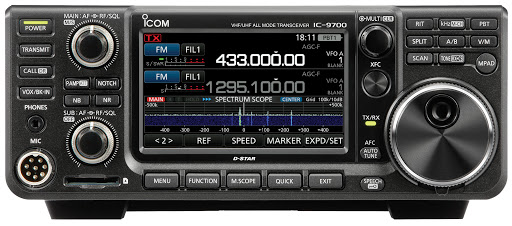
This is a guide how to work satellites with the Icom IC-9700. When trying to understand the IC-9700 I needed to write down how to use it – so this is how this post was born. Several different user scenarios are explained below.
The IC-9700 satellite memory examples and file can be found here. Please contact us if you see anything that will not work in the following user cases.
Setting up PstRotatorand OmniRig
The PstRotator manual is very good so please read it, very important is the section how to use IC-9700 with PstRotator satellite functions.
The file for OmniRig is delivered with PstRotator and is named IC-9700PST.ini. Do not forget to copy this file to the OmniRig folder.
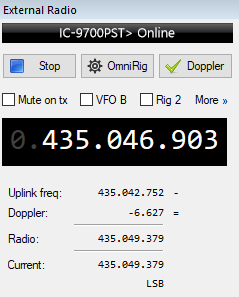
My settings for OmniRig is like this:
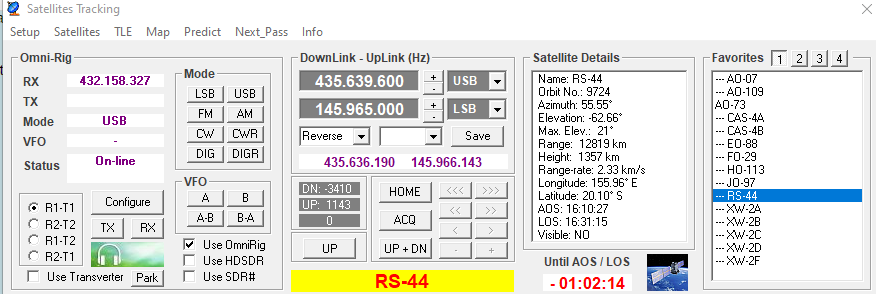
And a typical layout for PstRotator Satellites Tracking is like this:
Case 1: Using IC-9700 stand alone without computer control
Read the IC-9700 Basic Manual section 7 “Satellite communication”. It has all the information you need.
I have tested linear satellites with manual tuning (RS-44) and it worked very good. My uplink TX signal (VHF) was fixed and I tuned the downlink signal (UHF) when needed. The VFO tracking/untracking function of the IC-9700 is outstanding.
Some basic rules I learned from skilled operators:
“Tune the highest frequency”
“Always tune UHF to VHF” – the same as fix the VHF frequency and tune UHF.
Case 2: Using IC-9700 with PstRotator
Once again – first read the excellent manual of PstRotator and the section about satellites and IC-9700. Then – read it one more time!
Some operating hints:
Select the satellite from PstRotator Favorites. Correct frequency, mode and subtone (if needed, for FM) are now set to IC-9700, and the radio goes into Satellite Mode. The filter selection, for example if you have chosen FIL2 for USB, should not be changed from PstRotator.
The first time on a satellite you may need to correct the offset with the +/- and then click Save.
Press the “UP+DN” on PstRotator. Doppler is now adjusted on both RX and TX. You can use the VFO knob on the IC-9700 to tune around on the passband with full doppler control, very nice! Just transmit and you should hear yourself.
If a station you would like to receive, or your own signal, is off frequency it can be good to use the RIT on the radio to adjust RX frequency in a smooth way, without changing the PstRotator settings. Also the PBT (Pass Band Tuning of RX filter) can be good to use during RX.
Case 3: Using IC-9700 as TX with SDR-Console v3 as RX
In this case the IC-9700 is working as the transmitter with full doppler control and SDR-Console with a SDR (or panadapter for IC-9700) as receiver, also with doppler control. Be sure to set the correct band for TX to the MAIN VFO in IC-9700 and do not use the Satellite Mode. Then use the same setup as described in this post.
It is possible to use the VFO knob on IC-9700 to tune the TX frequency.
Case 4: FT4 with IC-9700 and PstRotator
Be sure to use DATA mode settings in PstRotator. Then the IC-9700 is using the filter you have selected for DATA. Then use it just like Case 2 above.
Case 5: FT4 with IC-9700 as TX and SDR-Console v3 as RX
Use the IC-9700 as transmitter and SDR-Console with SDR (or panadapter for IC-9700) as receiver. Be sure to set the correct band for TX to the MAIN VFO in IC-9700 and do not use the Satellite Mode Use the same setup as described in this post.
This is the setup I’m using when running FT4 because I think it gives better control over the QSO than using PstRotator.