Categories
Ham Satellite news

Cubesat deploys from ISS aug 2024

Re-post from ANS-245

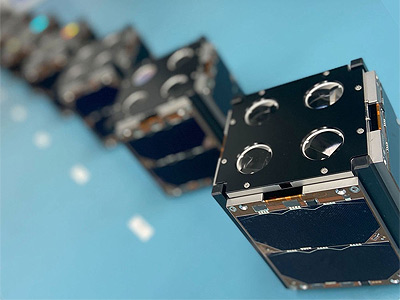
Seven CubeSats deployed from Japanese Experiment Module “Kibo” on Thursday, August 29.

According to the IARU Amateur Satellite Frequency Coordination, six of these satellites, CosmoGirl-Sat, SaganSat0, SAKURA, Binar2, Binar3 and Binar4, operate on the amateur bands. Three of them carry APRS digipeaters operating on the world-wide APRS frequency of 145.825 MHz.

CosmoGirl-Sat 145.825MHz, 437.120MHz
APRS VHF, callsign JS1YOI
CW, 4k8 GMSK UHF
A 1U cubesat built by Cosmo Girls Amateur Radio Club, a group of Japanese women established under the theme of “Getting closer to the universe.” The satellite also carries a high-resolution camera for earth imaging, as well as a short message UHF store-and-forward system.

SaganSat0 145.825MHz, 437.050MH
APRS VHF
GMSK 4k8, CW UHF
A 1U cubesat built by students at various high schools in the Saga Prefecture of Japan. The satellite also carries an infrared camera and gamma ray detector.

SAKURA 145.825MHz, 437.375MHz
APRS VHF
GMSK 4k8 UHF
A 1U cubesat built by the Chiba Institute of Technology, a university in Narashino, Japan. The satellite also carries experiments designed to monitor sunspots and solar flares, as well as to assess environmental damage on earth.

Binar-2 437.700MHz, Binar-3 437.850MHz, Binar-4 437.925MHz
CW, OQPSK 100/38.4kbps, GFSK 19.2/9.6/1.2kbps
Three cubesats built by Curtin University in Australia designed to test radiation shielding materials and modeling of re-entry data from LEO.

Info from
7 CubeSats were deployed from “Kibo” on Thursday, August 29, 2024.
https://humans-in-space.jaxa.jp/en/biz-lab/news/detail/004129.html

[ANS thanks Masa Arai, JN1GKZ, for the above information.]

Categories
Ham Satellite news

SSA remissvar om 2.4 GHz effektbegränsning

Post- och telestyrelsen har skickat ut ett förslag på nya undantags-föreskrifter på remiss. SSA har skrivit ett remissvar på detta.
Glädjande är att SSA föreslår höjning av effektgränsen på 2.4 GHz och där QO-100 pekas ut specifikt som anledning.

Läs mer här:
https://www.ssa.se/ssa-svarar-pa-pts-remiss-om-nya-undantagsforeskrifter/

Hela remissvaret:
https://www.ssa.se/wp-content/uploads/2024/08/SSA_Remiss_UFSKR_final.pdf

Del av remisssvaret:

Effektbegränsning för 2400–2450 MHz (3 kap. 185 §)

Frekvensbandet används huvudsakligen för upplänkstrafik till geostationära amatörradiosatelliter (OSCAR 100/Es’hail-2). Nuvarande effektgräns på 100 mW gör att det krävs mycket stora antenner för att
kommunicera med satelliten.

Ser man på våra grannländer så är högsta tillåtna effekt för amatörradio i bandet avsevärt högre, t.ex. tillåter Danmark 250 W1, Norge 100 W2, Finland 150 W CW, 600 W p.e.p.3 och Tyskland 75 W4

I det mycket tätbefolkade Storbritannien har man så sent som 2024 beslutat att behålla effektgränsen 400 W5

I Spanien tillåts ännu högre effekter (EIRP) med förbehållet att användningen är satellittrafik.

Vid satellittrafik används riktantenner med betydande antennvinst riktade uppåt. Risken för störningar från sådana satellitupplänkar på wifi-trafik måste bedömas vara mycket begränsad. SSA ser inte någon rimlig förklaring till vilka unika förhållanden som råder i Sverige, som gör att PTS bedömning så kraftigt avviker från kollegornas i våra grannländer.

SSA önskar
• I första hand att den högsta tillåtna tillförda effekten i delbandet 2400–2410 MHz ökas till 100 W p.e.p.
• I andra hand att den högsta tillåtna tillförda effekten för satellittrafik i delbandet 2400–2401 MHz ökas
till 10 W p.e.p.

Categories
Ham Satellite news

Tevel Re-Entry

From ANS-203:

The Tevel series of satellites is approaching re-entry, with Tevel-5 already re-entering on July 18th.

The Tevel mission consists of 8 satellites developed by the Herzliya Science Center in Israel, each carrying an FM transponder. The satellites were built by 8 schools in different parts of Israel and launched in January 2022 on the SpaceX Falcon 9 Transporter-3 mission.

A number of other satellites with amateur radio payloads are also re-entering shortly. A list of satellites approaching re-entry can be found at http://lu7aa.org/decay.asp

[ANS thanks Herzliya Science Center, AMSAT Argentina, and LU7AA for the above information]

Categories
Ham Satellite news

AMSAT-EA GENESIS-A Module

Re-post from ANS-189:

The maiden flight of the new European launcher, Ariane 6, is scheduled for July 9, 2024, with a launch window of 3:00 p.m. to 7:00 p.m. local time from the European spaceport in French Guiana (July 9 20:00h to July 10 00:00h CEST). Among many other payloads, it carries our (inside YPSAT) GENESIS-A module, attached to the second stage of the launcher. The module will transmit FT8 and live SSTV images in Robot 36 format.

FT8 transmissions are made every 16 seconds, while SSTV’s are every 5 minutes.

The working frequencies are as follows:

Downlink 144.175 MHz FT8 Mode:

– Callsign AO4ARI HO60 if the antenna has been deployed
– Callsign AO4ARI HO61 if the antenna has not been deployed

Downlink 144.550 MHz SSTV Robot 36 mode with live image and Hades text

A carrier with a frequency of 144.550 MHz (same frequency as SSTV) is left between FT8 tones.

This information is compiled in PDF in the following document on our web:
https://www.amsat-ea.org/app/download/13458580/AMSAT+EA+-+GENESIS-A+transmissions+description.pdf

The only thing ESA has given us is the trajectory over the ground while flying over Europe, but we don’t have TLEs or anything that we can semi-automate. It is available on our website:
https://www.amsat-ea.org/s/cc_images/cache_19006006.jpg?t=1720182961

It will be very difficult to receive it but we thank you all if you try and if you spread this information to have all possible operators tuned into FT-8 that day. The module will fall into the sea with the second stage after a few hours.

More information about the flight including timings here:
https://www.esa.int/Enabling_Support/Space_Transportation/Ariane/Ariane_6_launch_how_to_watch_and_what_to_look_out_for

[ANS thanks Félix Páez, EA4GQS, AMSAT EA, for the above information]

Categories
Ham Satellite news

MESAT and other satellites July 2024

Re-post from ANS-189:

Firefly Delivers New Amateur Satellites to Orbit

The Firefly Alpha FLTA005/NASA ELaNa 43 mission, nicknamed “Noise of Summer,” launched successfully at 04:04 UTC on July 4 (Wednesday evening, July 3 in the U.S.) and deployed eight new cube satellites to Low Earth Orbit (LEO). Five of these cubesats carry amateur radio equipment.

The cubesats were placed into a sun-synchronous Earth orbit, meaning that all locations on earth will see high-elevation passes roughly between 8:00 and 10:00 a.m. and between 8:00 and 10:00 p.m. local time daily, with lower elevation passes earlier and later.

Among the newly-deployed satellites, the one of greatest interest to the amateur radio community is MESAT1. Built by the University of Maine, in cooperation with AMSAT, this satellite carries a 30 kHz wide V/U Transponder plus a 1k2 BPSK telemetry downlink. Telemetry downlink 435.800 MHz with transponder downlink 435.810-435.840 MHz, and transponder uplink 145.910-145.940 MHz. Amateurs are encouraged to use AMSAT’s FoxTelem software to collect telemetry.


MESAT1 involves three missions designed by high school students in Maine. The science payloads are climate focused and include ALBEDO, IMAGER, and HAB. These will identify urban heat islands, determine concentration of phytoplankton in water bodies, and help predict harmful algal blooms. Four multispectral cameras on board will relay the data down to University of Maine’s ground station for further processing. Amateurs are encouraged to use AMSAT’s FoxTelem software to collect telemetry and assist in these science projects.

Also deployed was CatSat, a technology demonstration of an inflatable antenna for high-speed communications, built by the University of Arizona. CatSat’s deployable antenna consists of a Mylar balloon. The front half of the balloon is transparent, allowing microwaves to pass through. The back half of the balloon is aluminized, creating a reflecting antenna. After reaching low Earth orbit, CatSat’s antenna will deploy and inflate to a diameter of just over one-and-a-half feet CatSat’s demonstration will be to transmit high-definition Earth photos to 10 GHz, X-band ground stations at ~50 megabits per second.


In addition to images, data about the structure of the Earth’s ionosphere will be gathered by listening-in to thousands of beacons from ground-based ham radio stations. CatSat will relay WSPR and FT8 signals from HF. Downlinks on 437.185 MHz and 10470.00 MHz.

Other satellites with IARU-coordinated amateur frequency downlinks include:

Serenity, which uses a 4k8 FM with AX25 downlink on 437.100 MHz. Serenity was built by Teachers in Space, Inc., a 501(c)(3) nonprofit educational organization in North America that stimulates student interest in science, technology, engineering, and mathematics (STEM). They provide teachers with real space science experiences, space flight opportunities, and industry connections.

KUbeSat-1, revives small satellite research at the University of Kansas and starts a new KUbeSat program that will offer space access to student research. The main payload on KUbeSat-1 is the Primary Cosmic Ray Detector which will use a new method to measure the energy and species of primary cosmic rays hitting the Earth. The secondary payload is the High-Altitude Calibration, (HiCalK) that builds on decades of research surrounding Very High Frequency signals generated by cosmic ray interactions with the atmosphere. UHF downlink using 9k6 GMSK. A downlink on 437.085 MHz.

SOC-i (Satellite for Optimal Control and Imaging) is a technology demonstration mission of attitude control technology and a camera that serves as an instrument to demonstrate SOC-i’s pointing abilities. Developed at the University of Washington, SOC-i has a UHF downlink using 4k8 GMSK. downlink 437.125 MHz.

[ANS thanks NASA, Firefly Aerospace, and Spacflight Now for the above information]

Categories
Ham Satellite news

MESAT-1 Scheduled for June 27 2024

Re-post from ANS-175

The University of Maine’s MESAT-1 carrying a telemetry transmitter and linear transponder provided by AMSAT and experiments designed by schools in Maine will head into orbit as early as late this week as part of NASA’s ELaNa 43 launch.

The ELaNa 43 (Educational Launch of Nanosatellites 43) mission includes eight CubeSats flying on Firefly Aerospace’s Alpha rocket for its “Noise of Summer” launch from Space Launch Complex-2 at Vandenberg Space Force Base, California. The 30-minute launch window will open at 9 p.m. PDT Wednesday, June 26 (12 a.m. EDT Thursday, June 27).

Telemetry can be received using the same FoxTelem program that was used for most of AMSAT’s recent payloads. We urge readers to download the latest FoxTelem (V1.12z3) from https://www.amsat.org/tlm/leaderboard.php?id=0&db=FOXDB. This program will decode telemetry from MESAT-1 (as well as AO-91) and forward the results to AMSAT’s central server for use by AMSAT engineering as well as by Maine engineers and students.

MESAT-1 will study local temperatures across city and rural areas to determine phytoplankton concentration in bodies of water to help predict algal blooms and also contains a linear transponder for amateurs to use.  Watch ANS and other media for information about when the transponder will be activated.

For more information on this satellite, visit https://www.mainesat.org/mesat1/

MESAT-1 – Launch June 27, 2024
Uplink LSB145.910 MHzthrough145.940 MHz
Downlink USB435.810 MHzthrough435.840 MHz
AMSAT LTM-1 Transponder – 1200 bps FoxTelem BPSK beacon 435.800 MHz

[ANS thanks NASA and AMSAT Engineering for the above information]