Nu är det nära för ARISSat-1! Läs nedan.
—-
ANS-208
In this Special Bulletin:
* Deployment of ARISSat-1/KEDR Satellite Expected August 3
* ARISSat-1/KEDR Test Transmissions Planned From ISS July 30-31
SILVER SPRING, MARYLAND (AMSAT News Service) After a postponed
deployment in February from the International Space Station (ISS),
the ARISSat-1/KEDR amateur radio satellite is expected to begin its
mission on August 3, 2011. This was the word received from Energia
official, Sergey Samburov during an ARISS teleconference on July 19.
Deployment of the craft is planned during EVA-29.
NASA TV will cover the EVA live starting at 1400 GMT on August 3.
1430: Hatch Open
1446: Egress ARISSat-1 and secure to airlock ladder
1452: Remove solar panel covers
1507: Translate to deploy site, activate PWR, TIMER1 and TIMER2
switches, verify LEDs on, and deploy
(Internet streaming: http://www.nasa.gov/multimedia/nasatv/index.html)
ARISSat-1/KEDR is a satellite designed and built by amateur radio
operators to specifically interest students in scientific and tech-
nological careers. Through the use of ham radio equipment, students
and teachers should be able to access and utilize the satellite from
a classroom environment with minimal set up.
ARISSat-1/KEDR is a cooperative effort between AMSAT, ARISS (Amateur
Radio on the International Space Station,) RSC-Energia (The Russian
Space Agency) and NASA. The design, development and construction of
the satellite was done by AMSAT volunteers. Original plans called
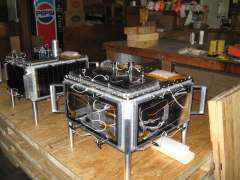
for the satellite to be housed inside an old Russian spacesuit, but
when the suit became unavailable, a spaceframe was developed to house
the radio equipment and solar panels. The new satellite was named
ARISSat-1/KEDR. Another name for the spacecraft is RadioSkaf-V. The
transmitted callsign will be RS01S.
The mission was specifically designed as an education-based satellite.
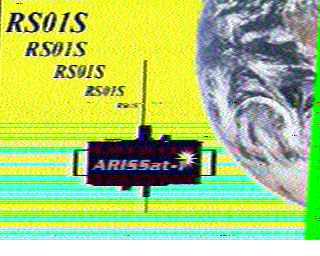
Some of its broadcast features include a voice identification, voice,
digital and morse code telemetry, stored image and on-board camera
transmissions via Slow Scan TV and digital telemetry from a Russian
science experiment that will measure vacuum in earth’s lower atmo-
sphere. Other aspects of the mission include CW (Morse code) and
voice message contests to interest students in participating along
with stored images submitted by students all over the world as part
of its payload.
ARISSat-1/KEDR Test Transmissions Planned From ISS July 30-31
Test transmissions from ARISSat-1/KEDR are scheduled to begin four
days prior to deployment at 19:15 UTC on July 30 and then continue
until 1430 UTC on July 31.
The satellite will be connected to an external antenna mounted on
the ISS during testing. During the test ARISSat-1/KEDR will be in
LOW power mode, this means that it will transmit about 40 seconds
and then shut down for 2 minutes and then transmit for again for
40 seconds.
To listen for ARISSat-1/KEDR signals, FM receivers should be tuned
to 145.950 MHz. Even though the satellite will only have an output
of 250 mW on 2 meters, a standard FM handy talkie equipped with a
quarter-wave whip antenna should be able to receive the voice ID,
voice telemetry and greeting messages as the craft passes overhead.
SSTV transmissions may also be demodulated and viewed using a free
downloadable program such as MMSSTV that is available at:
http://mmhamsoft.amateur-radio.ca/pages/mmsstv.php.
For Mac users, Multiscan2 is available at:
http://web.me.com/kd6cji/MacSSTV/MultiScan.html.
Those planning to monitor voice broadcasts from ARISSat-1/KEDR
during the July 30 – 31 test are requested to make note of the
telemetry battery voltage values and UTC time, and then submit
their records by e-mail to: julytest@arissat1.org.
Digital telemetry will be sent at 145.920 MHz. Given the low duty
cycle of the spacecraft, those planning to receive the digital
telemetry are encouraged to record the entire signal band using
the FunCube dongle or SDR-IQ receivers. Software for demodulating
the BPSK-1000 telemetry is available at http://www.arissattlm.org;
the software Quick Start Guide is available on the link on the
http://www.amsat.org front page.
After it is deployed from the International Space Station,
ARISSat-1/KEDR is expected to be in orbit for a period of up to
six months.
More information on the transmission schedule and overall mission
of ARISSat-1/KEDR can be found at:
ARISSat-1/KEDR Web site: http://www.arissat1.org
AMSAT Web site: http://www.amsat.org
ARISS Web site: http://www.ariss.org
ARISS Facebook Page: Amateur Radio on the ISS (ARISS)
ARISS Twitter site: @ARISS_status
The Radio Amateur Satellite Corporation (AMSAT) is a non-profit,
volunteer organization which designs, builds and operates experi-
mental amateur radio satellites and promotes space education. We
work in partnership with government, industry, educational insti-
tutions and fellow amateur radio societies. We encourage technical
and scientific innovation, and promote the training and development
of skilled satellite and ground system designers and operators. Our
vision is to deploy satellite systems with the goal of providing
wide area and continuous coverage for amateur radio operators world-
wide. AMSAT is also an active participant in human space missions
and supports satellites developed in cooperation with the educational
community and other amateur satellite groups.
Amateur Radio on the International Space Station (ARISS) is a volun-
teer program which inspires students, worldwide, to pursue careers
in science, technology, engineering and math through amateur radio
communications opportunities with the International Space Station
on-orbit crew. Students learn about life on board the ISS and explore
Earth from space through science and math activities. ARISS provides
opportunities for the school community (students, teachers, families
and local residents) to become more aware of the substantial benefits
of human space flight and the exploration and discovery that occur on
space flight journeys along with learning about technology and amateur
radio.
[ANS thanks the ARISSat-1/KEDR Team for the above information]
ANS-208
In this Special Bulletin:

* Deployment of ARISSat-1/KEDR Satellite Expected August 3
* ARISSat-1/KEDR Test Transmissions Planned From ISS July 30-31

SILVER SPRING, MARYLAND (AMSAT News Service) After a postponed
deployment in February from the International Space Station (ISS),
the ARISSat-1/KEDR amateur radio satellite is expected to begin its
mission on August 3, 2011. This was the word received from Energia
official, Sergey Samburov during an ARISS teleconference on July 19.
Deployment of the craft is planned during EVA-29.

NASA TV will cover the EVA live starting at 1400 GMT on August 3.
1430: Hatch Open
1446: Egress ARISSat-1 and secure to airlock ladder
1452: Remove solar panel covers
1507: Translate to deploy site, activate PWR, TIMER1 and TIMER2
      switches, verify LEDs on, and deploy
(Internet streaming: http://www.nasa.gov/multimedia/nasatv/index.html)

ARISSat-1/KEDR is a satellite designed and built by amateur radio
operators to specifically interest students in scientific and tech-
nological careers. Through the use of ham radio equipment, students
and teachers should be able to access and utilize the satellite from
a classroom environment with minimal set up.

ARISSat-1/KEDR is a cooperative effort between AMSAT, ARISS (Amateur
Radio on the International Space Station,) RSC-Energia (The Russian
Space Agency) and NASA. The design, development and construction of
the satellite was done by AMSAT volunteers. Original plans called
for the satellite to be housed inside an old Russian spacesuit, but
when the suit became unavailable, a spaceframe was developed to house
the radio equipment and solar panels. The new satellite was named
ARISSat-1/KEDR. Another name for the spacecraft is RadioSkaf-V. The
transmitted callsign will be RS01S.

The mission was specifically designed as an education-based satellite.
Some of its broadcast features include a voice identification, voice,
digital and morse code telemetry, stored image and on-board camera
transmissions via Slow Scan TV and digital telemetry from a Russian
science experiment that will measure vacuum in earth's lower atmo-
sphere. Other aspects of the mission include CW (Morse code) and
voice message contests to interest students in participating along
with stored images submitted by students all over the world as part
of its payload.

ARISSat-1/KEDR Test Transmissions Planned From ISS July 30-31

Test transmissions from ARISSat-1/KEDR are scheduled to begin four
days prior to deployment at 19:15 UTC on July 30 and then continue
until 1430 UTC on July 31.

The satellite will be connected to an external antenna mounted on
the ISS during testing. During the test ARISSat-1/KEDR will be in
LOW power mode, this means that it will transmit about 40 seconds
and then shut down for 2 minutes and then transmit for again for
40 seconds.

To listen for ARISSat-1/KEDR signals, FM receivers should be tuned
to 145.950 MHz.  Even though the satellite will only have an output
of 250 mW on 2 meters, a standard FM handy talkie equipped with a
quarter-wave whip antenna should be able to receive the voice ID,
voice telemetry and greeting messages as the craft passes overhead.

SSTV transmissions may also be demodulated and viewed using a free
downloadable program such as MMSSTV that is available at:
http://mmhamsoft.amateur-radio.ca/pages/mmsstv.php.
For Mac users, Multiscan2 is available at:
http://web.me.com/kd6cji/MacSSTV/MultiScan.html.

Those planning to monitor voice broadcasts from ARISSat-1/KEDR
during the July 30 - 31 test are requested to make note of the
telemetry battery voltage values and UTC time, and then submit
their records by e-mail to: julytest@arissat1.org.

Digital telemetry will be sent at 145.920 MHz. Given the low duty
cycle of the spacecraft, those planning to receive the digital
telemetry are encouraged to record the entire signal band using
the FunCube dongle or SDR-IQ receivers. Software for demodulating
the BPSK-1000 telemetry is available at http://www.arissattlm.org;
the software Quick Start Guide is available on the link on the
http://www.amsat.org front page.

After it is deployed from the International Space Station,
ARISSat-1/KEDR is expected to be in orbit for a period of up to
six months.

More information on the transmission schedule and overall mission
of ARISSat-1/KEDR can be found at:

ARISSat-1/KEDR Web site: http://www.arissat1.org
AMSAT Web site:          http://www.amsat.org
ARISS  Web site:         http://www.ariss.org
ARISS Facebook Page:     Amateur Radio on the ISS (ARISS)
ARISS Twitter site:      @ARISS_status

The Radio Amateur Satellite Corporation (AMSAT) is a non-profit,
volunteer organization which designs, builds and operates experi-
mental amateur radio satellites and promotes space education. We
work in partnership with government, industry, educational insti-
tutions and fellow amateur radio societies. We encourage technical
and scientific innovation, and promote the training and development
of skilled satellite and ground system designers and operators. Our
vision is to deploy satellite systems with the goal of providing
wide area and continuous coverage for amateur radio operators world-
wide. AMSAT is also an active participant in human space missions
and supports satellites developed in cooperation with the educational
community and other amateur satellite groups.

Amateur Radio on the International Space Station (ARISS) is a volun-
teer program which inspires students, worldwide, to pursue careers
in science, technology, engineering and math through amateur radio
communications opportunities with the International Space Station
on-orbit crew. Students learn about life on board the ISS and explore
Earth from space through science and math activities. ARISS provides
opportunities for the school community (students, teachers, families
and local residents) to become more aware of the substantial benefits
of human space flight and the exploration and discovery that occur on
space flight journeys along with learning about technology and amateur
radio.

[ANS thanks the ARISSat-1/KEDR Team for the above information]