Categories
Ham Satellite news

ASRTU-1 Launched November 4 2024

Re-post from ANS-315

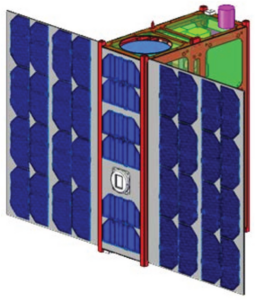
On November 4, 2024 at 23:18 UTC, a Soyuz rocket launched from Vostochny with at least 17 satellites using amateur satellite service frequencies. Among those launched was ASRTU-1, a 12U CubeSat designed by Russian and Chinese students and developed by the Harbin Institute of Technology in Harbin, China, for education and amateur radio.

The satellite contains an FM transponder, which is currently operational, with an uplink of 145.850 MHz (67 Hz CTCSS tone required) and a downlink of 435.400 MHz. After the repeater detects the end of uplink, it will wait for 0.5s. If no new uplink in 0.5s, telemetry will be sent. So make fast QSOs so the telemetry is less like to interrupt you.

The satellite also contains two cameras with an SSDV downlink for low resolution images on 436.210 MHz, and a high speed downlink on 10460.00 MHz for high resolution images.

On November 7, 2024, the camera system was tested for the first time. N6RFM uplinked the command and the image was downloaded by Chinese stations using the UHF SSDV downlink.

Windows software for decoding telemetry is available at https://drive.google.com/file/d/1W8nm-P0_h0J1Bd1eif74mLo-EuRdWcjH

A Live ISO Linux image is also available for telemetry at https://drive.google.com/drive/folders/1T6GMNnDNEEavckoe4oPXPIU_SPFXLDd4

A Telegram group has been created for discussing the satellite: https://t.me/+I5NTtX7eAJA4ZDVl

Latest TLEs:

ASRTU-1_20241108D
1 99130U 24313.98869213 .00036395 00000-0 15511-2 0 00005
2 99130 097.3830 178.7387 0016365 224.8894 196.6964 15.22873038000014

ASRTU-1
 Uplink FM
(67 Hz CTCSS)
Downlink FMComments
ASRTU-1145.850 MHz435.400 MHzIn orbit, commissioning
Also downlinks on 436.210 MHz, 10460.00 MHz. Download Live CD for telemetry decoding.

[ANS thanks BG2BHC, the IARU, and AMSAT-F for the above information]

Categories
Ham Satellite news

AO-7 50 Year Anniversary

Re-post from ANS-315

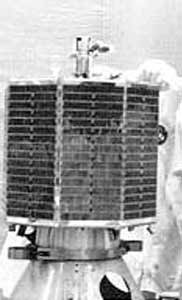
As AO-7, launched on November 15, 1974, approaches is 50th Anniversary and setting a record as the longest operating satellite, we look back at a few of its noteworthy accomplishments.

The downlink spectrum of AO-7’s UHF/VHF transponder overlapped with AO-6’s VHF-to-HF transponder. The overlap of the two was approximately 50 kHz wide. The two orbits were the same – almost. AO-7’s mean motion was slightly higher than that of AO-6, which means, once every year of so, AO-6 will “lap” its younger sibling in space. During the time when the two spacecraft are in closer proximity, it was already known to be theoretically possible (if AO-7 has its UHF/VHF transponder on) for one user to communicate through two spacecraft in succession, with the downlink of AO-7’s transponder being relayed through AO-6’s VHF/HF transponder uplink, and then, with the doubly relayed signal arriving on 29.5 MHz to another user on the ground. This could be done, in certain geometries, in both directions, making a two-way double-hop communications possible.

The first successful Earth-Space-Space-Earth relay of this type took place on January 6, 1975. This happened early in AO-7’s  “first” lifetime and during the first occasion when AO-6 approached AO-7, in their very similar orbits. The two stations were both located in the state of Texas – one in Dallas and one in Richardson. This method of communications was also conducted and reported by 55 other user stations from 12 countries during 1975. These events were documented in the IEEE Proceedings in October of 1975.

See another AO-7 50 Year Anniversary highlight in next week’s ANS Weekly Bulletin.

Categories
Ham Satellite news

SONATE-2 AX.25 Digipeater

SONATE-2 from Space Technology Uni Würzburg is now operating as an AX.25 simplex Digipeater on 145.825 MHz.

To work this satellite you can use Greencube Terminal from OZ9AAR and the normal Soundmodem for AX.25 1200 bd.

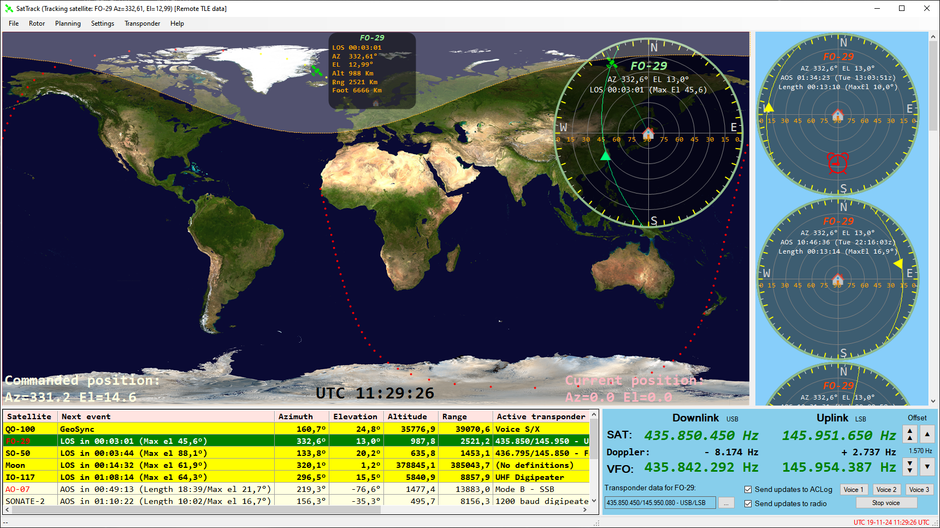
I find it hard to get in to the satellite but as you see in the featured image in this post it is possible.

Anyway – nice to have one more amateur radio satellite.
More info at:
https://www.informatik.uni-wuerzburg.de/en/space-technology/projects/active/sonate-2/information-for-radio-amateurs/#c1137755

Categories
Ham Satellite news Members news

Föredrag DL4-möte 2024-10-05

Lördagen den 5:e oktober 2024 hade jag förmånen att hålla ett föredrag under DL4-mötet i Mora. Föredraget gick igenom följande:

  • Historik – vad är AMSAT och när började det?
  • Olika typer av satelliter som finns idag
  • Satellitbanor (LEO, MEO, GEO)
  • Vad behöver jag? – Radio och antenner
  • Lite tips för att genomföra ett QSO
  • Telemetri och SatNOGS – satellitnätverk
  • Demo – PstRotator satellitspårning och radiokontroll

Tack till alla som var med och lyssnade!
Föredraget finns att ladda ner som PDF här.

73 Lars SM0TGU

Categories
Ham Satellite news

MESAT1 Designated MESAT1-OSCAR 122 (MO-122)

Re-post from ANS-276

On July 4, 2024 at 04:04 UTC, the MESAT1 satellite was launched on a Firefly Alpha launch vehicle from Vandenberg Space Force Base in California. Developed by the University of Maine, the satellite carries an earth imaging experiment and an AMSAT-provided LTM-1 linear transponder to provide services to amateur radio enthusiasts around the world. The satellite has been commissioned and the transponder is currently active. 

At the request of University of Maine, AMSAT hereby designates MESAT1 as MESAT1-OSCAR 122 (MO-122). We congratulate the University of Maine, thank them for their contribution to the amateur satellite community, and wish them continued success on this and future projects.

73, Drew Glasbrenner, KO4MA
AMSAT VP Operations / OSCAR Number Administrator

Categories
Ham Satellite news

AMSAT-UK Jovian-1 project

AMSAT-UK is delighted to have been able to accept an opportunity to provide a FUNcube Lite payload, with a mode U/V FM transponder, for the exciting Jovian-1 satellite.  

This 6U CubeSat is being designed and built by Space South Central  which is the largest regional space cluster in the UK. 

This is a partnership between industry and academia, designed to accelerate space business growth, grow the reputation of the south central region of the UK and foster an environment of innovation. 

A collaboration between the universities of Surrey, Portsmouth and Southampton, JUPITER – the Joint Universities Programme for In-Orbit Training, Education and Research – will equip participants with invaluable hands-on space industry experience and training for their future careers.

The FUNcube Lite payload from AMSAT-UK will collect and send telemetry from Jovian-1 sub-systems for educational outreach to schools and colleges, using the tried and tested FUNcube data format. 

Telemetry will include data from the payload’s own radiation sensor, along with GPS information gathered from the satellite’s CAN bus.  

These data can be used to map radiation throughout the orbit, identifying planetary radiation ‘hotspots’ such as the polar regions and the South Atlantic Anomaly. It will also give an accurate measure of how much radiation reaches the sensitive electronics within the satellite. 

While Jovian-1 and its ground station at Surrey University will use commercial S and X band for primary communication, FUNcube Lite will use frequencies in the amateur UHF and VHF spectrum. 

When not sending telemetry, the payload can be configured as a mode U/V FM voice transponder for amateurs to use for international communications.

More information will be provided at the AMSAT-UK Colloquium taking place during the weekend  of October 12/13th https://amsat-uk.org/colloquium/

Links:

Space South Central: https://www.spacesouthcentral.com/

Surrey University: https://www.surrey.ac.uk/

Portsmouth University: https://www.port.ac.uk/

Southampton University: https://www.southampton.ac.uk/