
Categories
Ham Satellite news Hamradio from ISS

Nu är det nära för ARISSat-1

Nu är det nära för ARISSat-1! Läs nedan.

—-
ANS-208
In this Special Bulletin:

* Deployment of ARISSat-1/KEDR Satellite Expected August 3
* ARISSat-1/KEDR Test Transmissions Planned From ISS July 30-31

SILVER SPRING, MARYLAND (AMSAT News Service) After a postponed
deployment in February from the International Space Station (ISS),
the ARISSat-1/KEDR amateur radio satellite is expected to begin its
mission on August 3, 2011. This was the word received from Energia
official, Sergey Samburov during an ARISS teleconference on July 19.
Deployment of the craft is planned during EVA-29.

NASA TV will cover the EVA live starting at 1400 GMT on August 3.
1430: Hatch Open
1446: Egress ARISSat-1 and secure to airlock ladder
1452: Remove solar panel covers
1507: Translate to deploy site, activate PWR, TIMER1 and TIMER2
switches, verify LEDs on, and deploy
(Internet streaming: http://www.nasa.gov/multimedia/nasatv/index.html)

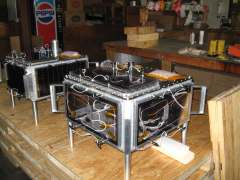
ARISSat-1/KEDR is a satellite designed and built by amateur radio
operators to specifically interest students in scientific and tech-
nological careers. Through the use of ham radio equipment, students
and teachers should be able to access and utilize the satellite from
a classroom environment with minimal set up.

ARISSat-1/KEDR is a cooperative effort between AMSAT, ARISS (Amateur
Radio on the International Space Station,) RSC-Energia (The Russian
Space Agency) and NASA. The design, development and construction of
the satellite was done by AMSAT volunteers. Original plans called
for the satellite to be housed inside an old Russian spacesuit, but
when the suit became unavailable, a spaceframe was developed to house
the radio equipment and solar panels. The new satellite was named
ARISSat-1/KEDR. Another name for the spacecraft is RadioSkaf-V. The
transmitted callsign will be RS01S.

The mission was specifically designed as an education-based satellite.
Some of its broadcast features include a voice identification, voice,
digital and morse code telemetry, stored image and on-board camera
transmissions via Slow Scan TV and digital telemetry from a Russian
science experiment that will measure vacuum in earth’s lower atmo-
sphere. Other aspects of the mission include CW (Morse code) and
voice message contests to interest students in participating along
with stored images submitted by students all over the world as part
of its payload.

ARISSat-1/KEDR Test Transmissions Planned From ISS July 30-31

Test transmissions from ARISSat-1/KEDR are scheduled to begin four
days prior to deployment at 19:15 UTC on July 30 and then continue
until 1430 UTC on July 31.

The satellite will be connected to an external antenna mounted on
the ISS during testing. During the test ARISSat-1/KEDR will be in
LOW power mode, this means that it will transmit about 40 seconds
and then shut down for 2 minutes and then transmit for again for
40 seconds.

To listen for ARISSat-1/KEDR signals, FM receivers should be tuned
to 145.950 MHz.  Even though the satellite will only have an output
of 250 mW on 2 meters, a standard FM handy talkie equipped with a
quarter-wave whip antenna should be able to receive the voice ID,
voice telemetry and greeting messages as the craft passes overhead.

SSTV transmissions may also be demodulated and viewed using a free
downloadable program such as MMSSTV that is available at:
http://mmhamsoft.amateur-radio.ca/pages/mmsstv.php.
For Mac users, Multiscan2 is available at:
http://web.me.com/kd6cji/MacSSTV/MultiScan.html.

Those planning to monitor voice broadcasts from ARISSat-1/KEDR
during the July 30 – 31 test are requested to make note of the
telemetry battery voltage values and UTC time, and then submit
their records by e-mail to: julytest@arissat1.org.

Digital telemetry will be sent at 145.920 MHz. Given the low duty
cycle of the spacecraft, those planning to receive the digital
telemetry are encouraged to record the entire signal band using
the FunCube dongle or SDR-IQ receivers. Software for demodulating
the BPSK-1000 telemetry is available at http://www.arissattlm.org;
the software Quick Start Guide is available on the link on the
http://www.amsat.org front page.

After it is deployed from the International Space Station,
ARISSat-1/KEDR is expected to be in orbit for a period of up to
six months.

More information on the transmission schedule and overall mission
of ARISSat-1/KEDR can be found at:

ARISSat-1/KEDR Web site: http://www.arissat1.org
AMSAT Web site:          http://www.amsat.org
ARISS  Web site:         http://www.ariss.org
ARISS Facebook Page:     Amateur Radio on the ISS (ARISS)
ARISS Twitter site:      @ARISS_status

The Radio Amateur Satellite Corporation (AMSAT) is a non-profit,
volunteer organization which designs, builds and operates experi-
mental amateur radio satellites and promotes space education. We
work in partnership with government, industry, educational insti-
tutions and fellow amateur radio societies. We encourage technical
and scientific innovation, and promote the training and development
of skilled satellite and ground system designers and operators. Our
vision is to deploy satellite systems with the goal of providing
wide area and continuous coverage for amateur radio operators world-
wide. AMSAT is also an active participant in human space missions
and supports satellites developed in cooperation with the educational
community and other amateur satellite groups.

Amateur Radio on the International Space Station (ARISS) is a volun-
teer program which inspires students, worldwide, to pursue careers
in science, technology, engineering and math through amateur radio
communications opportunities with the International Space Station
on-orbit crew. Students learn about life on board the ISS and explore
Earth from space through science and math activities. ARISS provides
opportunities for the school community (students, teachers, families
and local residents) to become more aware of the substantial benefits
of human space flight and the exploration and discovery that occur on
space flight journeys along with learning about technology and amateur
radio.

[ANS thanks the ARISSat-1/KEDR Team for the above information]
ANS-208
In this Special Bulletin:

* Deployment of ARISSat-1/KEDR Satellite Expected August 3
* ARISSat-1/KEDR Test Transmissions Planned From ISS July 30-31

SILVER SPRING, MARYLAND (AMSAT News Service) After a postponed 
deployment in February from the International Space Station (ISS), 
the ARISSat-1/KEDR amateur radio satellite is expected to begin its 
mission on August 3, 2011. This was the word received from Energia 
official, Sergey Samburov during an ARISS teleconference on July 19. 
Deployment of the craft is planned during EVA-29. 

NASA TV will cover the EVA live starting at 1400 GMT on August 3.
1430: Hatch Open
1446: Egress ARISSat-1 and secure to airlock ladder
1452: Remove solar panel covers
1507: Translate to deploy site, activate PWR, TIMER1 and TIMER2 
      switches, verify LEDs on, and deploy
(Internet streaming: http://www.nasa.gov/multimedia/nasatv/index.html)

ARISSat-1/KEDR is a satellite designed and built by amateur radio 
operators to specifically interest students in scientific and tech-
nological careers. Through the use of ham radio equipment, students 
and teachers should be able to access and utilize the satellite from 
a classroom environment with minimal set up. 

ARISSat-1/KEDR is a cooperative effort between AMSAT, ARISS (Amateur 
Radio on the International Space Station,) RSC-Energia (The Russian 
Space Agency) and NASA. The design, development and construction of 
the satellite was done by AMSAT volunteers. Original plans called 
for the satellite to be housed inside an old Russian spacesuit, but 
when the suit became unavailable, a spaceframe was developed to house 
the radio equipment and solar panels. The new satellite was named 
ARISSat-1/KEDR. Another name for the spacecraft is RadioSkaf-V. The 
transmitted callsign will be RS01S.

The mission was specifically designed as an education-based satellite. 
Some of its broadcast features include a voice identification, voice, 
digital and morse code telemetry, stored image and on-board camera 
transmissions via Slow Scan TV and digital telemetry from a Russian 
science experiment that will measure vacuum in earth's lower atmo-
sphere. Other aspects of the mission include CW (Morse code) and 
voice message contests to interest students in participating along 
with stored images submitted by students all over the world as part 
of its payload. 

ARISSat-1/KEDR Test Transmissions Planned From ISS July 30-31

Test transmissions from ARISSat-1/KEDR are scheduled to begin four 
days prior to deployment at 19:15 UTC on July 30 and then continue 
until 1430 UTC on July 31. 

The satellite will be connected to an external antenna mounted on 
the ISS during testing. During the test ARISSat-1/KEDR will be in
LOW power mode, this means that it will transmit about 40 seconds 
and then shut down for 2 minutes and then transmit for again for 
40 seconds. 

To listen for ARISSat-1/KEDR signals, FM receivers should be tuned 
to 145.950 MHz.  Even though the satellite will only have an output 
of 250 mW on 2 meters, a standard FM handy talkie equipped with a 
quarter-wave whip antenna should be able to receive the voice ID, 
voice telemetry and greeting messages as the craft passes overhead. 

SSTV transmissions may also be demodulated and viewed using a free 
downloadable program such as MMSSTV that is available at:  
http://mmhamsoft.amateur-radio.ca/pages/mmsstv.php. 
For Mac users, Multiscan2 is available at: 
http://web.me.com/kd6cji/MacSSTV/MultiScan.html.

Those planning to monitor voice broadcasts from ARISSat-1/KEDR 
during the July 30 - 31 test are requested to make note of the 
telemetry battery voltage values and UTC time, and then submit 
their records by e-mail to: julytest@arissat1.org. 

Digital telemetry will be sent at 145.920 MHz. Given the low duty 
cycle of the spacecraft, those planning to receive the digital 
telemetry are encouraged to record the entire signal band using 
the FunCube dongle or SDR-IQ receivers. Software for demodulating 
the BPSK-1000 telemetry is available at http://www.arissattlm.org; 
the software Quick Start Guide is available on the link on the 
http://www.amsat.org front page. 

After it is deployed from the International Space Station, 
ARISSat-1/KEDR is expected to be in orbit for a period of up to 
six months.

More information on the transmission schedule and overall mission 
of ARISSat-1/KEDR can be found at:

ARISSat-1/KEDR Web site: http://www.arissat1.org 
AMSAT Web site:          http://www.amsat.org 
ARISS  Web site:         http://www.ariss.org 
ARISS Facebook Page:     Amateur Radio on the ISS (ARISS)
ARISS Twitter site:      @ARISS_status

The Radio Amateur Satellite Corporation (AMSAT) is a non-profit, 
volunteer organization which designs, builds and operates experi-
mental amateur radio satellites and promotes space education. We 
work in partnership with government, industry, educational insti-
tutions and fellow amateur radio societies. We encourage technical 
and scientific innovation, and promote the training and development 
of skilled satellite and ground system designers and operators. Our 
vision is to deploy satellite systems with the goal of providing 
wide area and continuous coverage for amateur radio operators world-
wide. AMSAT is also an active participant in human space missions 
and supports satellites developed in cooperation with the educational 
community and other amateur satellite groups.

Amateur Radio on the International Space Station (ARISS) is a volun-
teer program which inspires students, worldwide, to pursue careers 
in science, technology, engineering and math through amateur radio 
communications opportunities with the International Space Station 
on-orbit crew. Students learn about life on board the ISS and explore 
Earth from space through science and math activities. ARISS provides 
opportunities for the school community (students, teachers, families 
and local residents) to become more aware of the substantial benefits 
of human space flight and the exploration and discovery that occur on 
space flight journeys along with learning about technology and amateur 
radio.

[ANS thanks the ARISSat-1/KEDR Team for the above information]
Categories
Hamradio from ISS

Snart dags för ARISSat-1

Nu börjar det närma sig för aktiviteter från ARISSat-1. I juli är planerat att den ska släppas ut från ISS. Finns mycket information nedan!

AMSAT News Service Bulletin 170.03
>From AMSAT HQ SILVER SPRING, MD.
June 19, 2011
To All RADIO AMATEURS
BID: $ANS-170.03

A few weeks remain before the planned July deployment of ARISSat-1
from the ISS. The AMSAT News Service will bring you more details
in the coming weeks. Here are some reminders to help you get your
station ready for ARISSat-1 operation.

145.950 MHz FM Downlink:
————————
FM transmissions will cycle between a voice ID as RS01S, select tele-
metry values, 24 international greeting messages in 15 languages and
SSTV images. One of the messages will be a conversation between Yuri
Gagarin and ground control. See the next news item for pointers to get
your station ready to receive the SSTV images.

435 MHz – 145 MHz Linear Transponder:
————————————-
The linear transponder will operate in Mode U/V (70 cm Up, 2m Down).
It is an 16 KHz wide inverting passband and the convention will be to
TX LSB on the 435 MHz uplink and RX USB on the 145 MHz downlink. This
mode is designed to work with low power transmitters and omni antenna.

145.919 MHz/145.939 MHz CW Beacon:
———————————-
The CW transmissions will be callsign ID RS01S, select telemetry, and
callsigns of people actively involved with the ARISS program.

145.920 MHz SSB BPSK-1000 Telemetry:
————————————
The BPSK transmissions will feature a new 1kBPSK protocol developed
by Phil Karn, KA9Q to be readable in low signal level conditions.
The BPSK data will transmit satellite telemetry.

The ARISSat-1 BPSK-1000 downlink is transmitted in SSB mode on
145.920 MHz. When the CW2 beacon on 145.919 MHz is active this
indicates that the BPSK-1000 format is being transmitted. If the
CW1 beacon on 145.939 MHz is active this indicates the backup of
BPSK-400 format is being transmitted.

Transmitting at 100 mW, both BPSK rates include Forward Error
Correction (FEC) and it is expected that modest quarter-wave
antennas with low-loss coaxial cable will provide sufficient
signal strength for decoding and display by the ARISSatTLM
software.

An audio feed from an SSB receiver to the computer’s soundcard
input is needed. An initial “Receive Only” configuration is easily
done consisting of an audio patch cable between your radio and
the soundcard. Take the speaker or headphone output from the radio
and run it into the line (or mic) input on your PC sound card.

BPSK-1000 sounds like a “shusssch” with a higher pitch than the
400 bps growl. It is difficult to tune by ear. The CW2 beacon is
used as a tuning signal for BPSK-1000. The PC and Mac ARISSatTLM
software display contains a dotted line that you use to tune your
receiver until the CW signal bumps lines up with the dotted line
on your PC screen. This will allow you to decode the BPSK-1000
signal and you will also be able to copy the CW2 beacon.

Download the Windows ARISSatTLM free ground station soundcard
demodulator and display software:
http://www.arissattlm.org/download/ARISSatTLM_050_Setup.exe

Download the Mac ARISSatTLM software:
http://www.arissattlm.org/download/ARISSATTLM.zip

The ARISSatTLM software user guide is available:
http://tinyurl.com/42uhtyf (amsat.org)

Get your color ARISSat-1 Frequency Guide:
http://tinyurl.com/4t497t2 (amsat.org)

ARISSat-1 Presentation Slides (~1MB)
http://tinyurl.com/4n4pzkm (amsat.org)

—————–

ARRISat-1 Team Pointers to Get Ready for SSTV Reception

AMSAT News Service Bulletin 170.04
>From AMSAT HQ SILVER SPRING, MD.
June 19, 2011
To All RADIO AMATEURS
BID: $ANS-170.04

The ARISSat-1 FM downlink on 145.950 MHz includes live SSTV
images as part of the cycling voice ID, select spoken telemetry
values, and the international greeting messages. Here are some
pointers to help you get your station ready to receive and dis-
the SSTV pictures transmitted by ARISSat-1.

One fun feature is that there are four SSTV cameras mounted on
the spacecraft. On photos of ARISSat-1 you may have noticed black
brackets on the outside of the spacecraft. These hold the mirrors
that reflect the light onto the lens of the cameras. The software-
defined-transponder will use the image data from the cameras to
generate the SSTV downlink.

ARISSat’s software will sequentially select a new or stored image
from one the four cameras. There are two pre-recorded images as
part of the sequence. The camera that took the the picture can be
identified by the color of the call sign in the upper left of the
SSTV image. The SSTV image will be sent down as FM audio SSTV in
Robot 36 format on 145.950 MHz about every 140 seconds.

The RF downlink power on the 145.950 MHz FM downlink will be 250mW
which is predicted to provide a link margin around 6 dB on an HT
with a ‘big whip’ when the satellite is at 15 degrees elevation. This
should be sufficient to receive SSTV pictures although you may need
to orient the whip to line up the antenna polarization.

ARISSat-1 is not stabilized so the antenna orientation is unpredict-
able and a certain amount of fading will happen. The receiving link
margin may be improved with a handheld beam such as an “Arrow”, “Elk”,
or “Cheap Yagi” antenna.
(See: http://www.wa5vjb.com/references/Cheap%20Antennas-LEOs.pdf)

General Overview Radio-to-Soundcard Interface
———————————————
To view the SSTV downlink from ARISSat-1 you’ll need a computer
running SSTV software for your soundcard and an audio connection
between your radio and the computer.

If you are already on the air with other amateur radio soundcard
applications chances are you are ready to receive ARISSat’s SSTV
downlink with little or no modification to your setup.

The audio from the radio to the computer is the key link. An initial
“Receive Only” configuration is easily done consisting of an audio
patch cable between your radio and the soundcard. Take the speaker
or headphone output from the radio and run it into the line (or mic)
input on your PC sound card.

Setting the level is simple also as the MMSSTV software has a bar
indicator. Just adjust the sound card gain slider and/or radio volume
control so that the SSTV signal is within the center part of the bar.
MMSSTV will give you an “overflow” indication if the volume is too
high.

If your rig has a ‘Line Out’ connection this can be run to the
soundcard ‘Line In’. Using the radio ‘Line Out’ you won’t have to
deal with the interaction of the radio’s volume control with the
soundcard levels. But you will still need to use the soundcard
‘Volume Control’ to set the ‘Line In’ levels.

SSTV Software Download Sites
—————————-
There are many amateur radio SSTV software decoding applications
available. One of the easiest to use on Windows computers is the
MMSSTV program. This can be downloaded from:
http://mmhamsoft.amateur-radio.ca/pages/mmsstv.php

The Ham Radio Deluxe software package also includes SSTV operation.

SSTV software for the Mac is available at:
http://web.me.com/kd6cji/MacSSTV/MultiScan.html

[ANS thanks the ARISSat-1 Team for the above information]

Categories
Hamradio from ISS

ARISSat-1 mottagningstävling

I juli är det dags för ARISSat-1 och då anordnas en mottagningstävling. Se nedan:

ARISSat-1 is scheduled for deployment from the ISS in July. It has a
composite VHF downlink that will easily fit into the FUNcube Dongle
receive spectrum. The telemetry is 1000 bps BPSK and can, of course,
also be received with a normal SSB 2 metre receiver.

The expected signal levels from ARISSat should be similar to those we
expect from FUNcube itself (and also eventually from UKube) and the
team are keen to discover what will be the minimum and best type of
antennas for schools to use with a FCD. Therefore user experience with
the ARISSat signals will be very valuable in making this determination.

To encourage everyone to receive ARISSat signals we are offering a FUN
reward for listeners!

There are a number of categories for this challenge including:

1. The first FCD user, from each continent, who can post a spectrum
recording of the received signal together with evidence of decoding
the data using the ARISSat software and of sending it to the ARISSat
data warehouse.

2. The first non-FCD user, from each continent, who can provide evidence
of having decoded the signals and of sending it to the ARISSat data
warehouse.

3. The listener, using a FCD or not, who can demonstrate satisfactory
reception of the telemetry in the same ways as described above,
using the “smallest” possible receive antenna. The actual closing date for
this part of the challenge will be announced later.

4. All other entrants who can demonstrate that they have been having
FUN!

Please submit your “entries”, including your location, station details
(including FCD serial number where applicable), postal address and
reportsto g0auk<at>amsat.org.

[ANS thanks AMSAT-UK and the Southgate ARC News Site for the above
information]

ARISSat-1 Reception Challenge

ARISSat-1 is scheduled for deployment from the ISS in July. It has a
composite VHF downlink that will easily fit into the FUNcube Dongle
receive spectrum. The telemetry is 1000 bps BPSK and can, of course,
also be received with a normal SSB 2 metre receiver.

The expected signal levels from ARISSat should be similar to those we
expect from FUNcube itself (and also eventually from UKube) and the
team are keen to discover what will be the minimum and best type of
antennas for schools to use with a FCD. Therefore user experience with
the ARISSat signals will be very valuable in making this determination.

To encourage everyone to receive ARISSat signals we are offering a FUN
reward for listeners!

There are a number of categories for this challenge including:

1. The first FCD user, from each continent, who can post a spectrum
    recording of the received signal together with evidence of decoding
    the data using the ARISSat software and of sending it to the ARISSat
    data warehouse.

2. The first non-FCD user, from each continent, who can provide evidence
    of having decoded the signals and of sending it to the ARISSat data
    warehouse.

3. The listener, using a FCD or not, who can demonstrate satisfactory
    reception of the telemetry in the same ways as described above,
using
    the "smallest" possible receive antenna. The actual closing date for
    this part of the challenge will be announced later.

4. All other entrants who can demonstrate that they have been having
FUN!

Please submit your "entries", including your location, station details
(including FCD serial number where applicable), postal address and
reports
to g0auk<at>amsat.org.

[ANS thanks AMSAT-UK and the Southgate ARC News Site for the above
  information]
Categories
Ham Satellite news Hamradio from ISS

ARISSat-1

Det har nu rapporterats att Satelliten är på väg till ISS med övrig utrustning och proviant. Enligt uppgift ska satelliten skickas ut i rymden under en kommande  rymdpromenad.

Satelliten har förutom en transponder med upplänk på 70 cm och nedlänk 2 meter även en röstbeacon. Det finns även möjlighet att sända SSTV bilder.  Programvara för att avkoda telemetri kommer säkerligen att dyka upp.

Frekvensplan.  Länk

Satellitdetaljer.  Länk

Categories
Hamradio from ISS

Mera information om ARISSat-1

Nu finns mera information om ARISSat-1 hos AMSAT-NA:

Thanks to the ARISSat-1 team for providing a copy of their Symposium presentation materials. Links to the following have been posted at http://www.amsat.org.

1. ARISSat-1 color frequency guide
2. PDF copy of ARISSat-1 Overview presentation slides (~1MB)

Lots more information will be published in the AMSAT Journal.

ARISSat-1 will have these features …

Transponder
. Mode U/V (70 cm Up, 2m Down)
. Linear
. Inverting (Tx LSB, Rx USB)
. 16 kHz bandwidth
. Can be worked with QRP transmitter and omni antennas

Digital Beacon
. BPSK-1000 w/FEC by Phil Karn KA9Q
. Legacy mode 400 BPSK (P3 type)
. Telemetry Data
. Experiment Data
. PC/Mac demodulator & decoder software will be available

CW Beacon
. Call sign = RS01S
. CW Telemetry (subset)
. Call signs or names of developers
. CW1 or CW2 identifies BPSK mode

FM Audio
. Call sign = RS01S
. Voice Telemetry (subset)
. SSTV in Robot-36 format
. Voice Greetings

Voice Greetings
. 24 different greetings
. Mostly children
. Special one from Yuri Gagarin
. Secret word
. 15 different languages
English Spanish Russian French
Italian Dutch Swedish Japanese
Chinese Catalan Bengali Portuguese
Hebrew Nepalese German

Categories
Hamradio from ISS

ARRISSat-1 Update

AMSAT News Service Bulletin 234.01
From AMSAT HQ SILVER SPRING, MD.
August 22, 2010
To All RADIO AMATEURS
BID: $ANS-234.01

Just another nag that the AMSAT election for members of the Board of Directors is in progress.  The end of the summer, and the start of school is upon us.  Still, if you haven’t gotten around to it, take a few minutes to vote.  The deadline will be here in a month.  Obviously it is important as a member to vote, but it is also important for Board members to receive your input in this way.

73s,

Alan Biddle
WA4SCA
AMSAT Corporate Secretary