
Categories
Hamradio from ISS

SSTV från ISS 27/8 2014

Det planeras ISS-sändningar från ISS onsdagen den 27/8 (2014). Frekvensen kommer att vara 145.800 MHz FM. Mer info:

Dmitry Pashkov R4UAB reports that the Slow Scan Television (SSTV)
experiment MAI-75 on the International Space Station (ISS) may be
active on Wednesday, August 27 using the call sign RS0ISS on 145.800
MHz FM.

A Google English translation of the work plan says “On Gagarin from
Space”. Open gear with ISS RS by amateur radio link to ground
receiving stations amateurs around the world images of photographs
devoted to the life and work of the first cosmonaut Yuri Gagarin.

It is unclear how long the SSTV transmissions will continue for but
the plan shows the Kenwood TM D-700 transceiver being used for a
school contact in the Ruzaevo district on Saturday, August 30.

All you need to do to receive the SSTV pictures from the space
station is to connected the audio output of a scanner or amateur rig
via a simple interface to the soundcard on a Windows PC or an Apple
iOS device, and tune in to 145.800 MHz FM. You can even receive
pictures by holding an iPhone next to the radio’s loudspeaker.

The ISS puts out a strong signal on 145.800 MHz FM and a 2m handheld
with a 1/4 wave antenna will be enough to receive it. The FM
transmission uses 5 kHz deviation which is standard in much of the
world.

Many FM rigs in the UK can be switched been wide and narrow
deviation FM filters so select the wider deviation. Handhelds all
seem to have a single wide filter fitted as standard.

On Windows PC’s the free application MMSSTV can be used to decode
the signal, on Apple iOS devices you can use the SSTV app. The ISS
Fan Club website will show you when the space station is in range.

Listen for the ISS SSTV transmissions online using the SUWS WebSDR,
further details at
http://amsat-uk.org/2014/08/15/suws-websdr-moves-to-new-site/

For more on Slow Scan Television SSTV, see this article SSTV – The
Basics
http://www.essexham.co.uk/sstv-the-basics

How to be successful with the ISS Slow Scan Television (SSTV)
imaging system
http://www.marexmg.org/fileshtml/howtoisssstv.html

Information on the MAI-75 SSTV experiment
http://www.energia.ru/eng/iss/researches/education-26.html

Free MMSSTV software
http://hamsoft.ca/pages/mmsstv.php

iOS SSTV App
https://itunes.apple.com/gb/app/sstv/id387910013

IZ8BLY Vox Recoder, enables you to record the signals from the ISS
on 145.800 MHz while you’re away at work
http://antoninoporcino.xoom.it/VoxRecorder/

ARISS Slow Scan TV (SSTV) Blog and Gallery
http://ariss-sstv.blogspot.co.uk/

For real-time tracking and the latest status of amateur radio
activity on the space station see the ISS Fan Club
http://www.issfanclub.com/

Dmitry Pashkov R4UAB
http://r4uab.ru/?p=7237

ISS Work Plan
http://www.mcc.rsa.ru/plan.htm

[ANS thanks AMSAT-UK for the above information]
Categories
Hamradio from ISS

Uppdatering HAM TV från ISS

Här är senaste nytt om HAM TV från ISS:

HamTV Bulletin #13
April 14, 2014

Ham Video Commissioning completed


The final Ham Video Commissioning Pass was performed flawlessly Sunday April 13 at 18.23 UTC.
ISS Commander Koichi Wakata operated OR4ISS while ground stations G4KLB, F6DZP, IK1SLD and KI (Livorno) received the signals and streamed the video over the BATC server. The DATV signal was received for about 6 minutes.
Commander Wakata congratulated ARISS for this achievement and answered a series of questions, prepared in the manner of a school contact. He also proceeded to a microgravity experiment.
The recorded video of this historical transmission is available at:

http://www.vivadatv.org/viewtopic.php?f=66&t=317

and also on YouTube

http://youtu.be/EpFzbKvK1pk

Congratulations to the Ham Video team for this outstanding performance.

Next step should be a video enhanced ARISS school contact.
We will keep you informed on any progress.

73,
Gaston Bertels, ON4WF
ARISS Europe chairman

Categories
Hamradio from ISS

HAM TV från ISS 6/3 2014

Nu börjar det att röra sig med TV sändninarna från rymdstationen.
73 Håkan SM7WSJ (via AMSAT-SM mailinglista)

Ham Video Commissioning now scheduled

The Ham Video transmitter, which is stored in the Columbus module of
the International Space Station, will be installed March 6, 2014. The
transmitter will be powered on briefly, just the time needed to check
that the connection cables to the antenna, to the power supply and to
the camera are installed properly. All control LEDs nominal, the
transmitter will be considered ready for Commissioning and will be
unpowered.

The first Commissioning step is planned March 8. Michael S. Hopkins
KF5LJG will power on the Ham Video transmitter in configuration 1:
ARISS antenna 41 Frequency 2.422 GHz Symbol rate 1.3 Ms/s The
transmission will start shortly before the pass of the ISS over the
Matera ground station in south Italy at approximately 13.29 UTC.

The ground station will stream the video over the BATC server
http://www.batc.tv/ .Please select Member Streams and ISS.
During the pass, different configurations will be tested with ARISS
antenna 41.

After the pass, the Ham Video transmitter will stay powered on in
configuration 1 till the following Commissioning step, which is
planned Sunday March 9, 2014 at approximately 12.40 UTC.

For about 24 hours, the DATV signal will be transmitted permanently,
but the camera will be powered off. The reason is, that the camera is
battery powered and no provisions are made for frequent battery
replacement. This mode is called “blank” transmission.

During Commissioning step 2, different configurations will again be
tested, this time with ARISS antenna 43. The Matera ground station
will stream the video over the BATC server.

Possibly, blank transmissions will occur in the period between
Commissioning step 2 and the following step, which is not yet
planned.
We will circulate Ham TV Bulletins to inform on blank transmissions.

Reports on reception of blank transmissions are very welcome.
Reports can be filed via this webpage:
http://www.spaceflightsoftware.com/ARISS_FSTV/submit.php

Participants using the Tutioune receiving software, developed by
Jean Pierre Courjaud F6DZP, can record as well as stream detailed
parameters of the received signal. Please see:
http://www.vivadatv.org/
Thank you for your participation

Categories
Hamradio from ISS

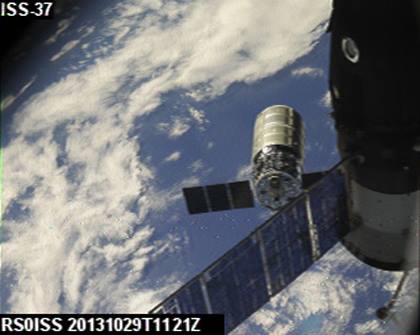
SSTV aktiv från ISS 29/10 2013

SSTV från ISS mottagen av UB4UAD

Den 28 och 29 oktober (2013) skickades några SSTV-bilder från ISS. Dmitry Pashkov UB4UAD (bilden ovan) är en av dom som lyckades ta emot en bild.

Mera info finns att läsa från följande:
AMSAT-UK: http://amsat-uk.org/2013/10/28/iss-slow-scan-tv-active/

ARISS SSTV Blog: http://ariss-sstv.blogspot.co.uk/

Categories
Hamradio from ISS

Video från Thunmanskolans kontakt med Christer Fuglesang

Här är videon från Thunmanskolans kontakt med Christer Fuglesang som var ombord på den internationella rymdstationen år 2006. Kontakten genomfördes via amatörradio inom programmet för skolkontakter till ISS. Stort tack till Bram Bottema, SM0FLY, som filmat och till Eskil van Loosdrecht, SM5SRR, som var projektledare för kontakten.

Categories
Hamradio from ISS

ISS Ham Video installeras snart

Snart är det dags för amatörradio-video (Ham Video) att installeras och börja användas från ISS:

The ARISS DATV transmitter, dubbed “Ham Video”, already onboard the
International Space Station, will soon be installed in the Columbus module and
commissioned.

Commissioning will be done in several steps, each during a full pass of the
ISS over the Matera ground station (see Bulletin 2). It is not yet known if
these passes will be chosen in close succession, or if they will cover several
weeks. ARISS proposes ESA to operate so called “blank” transmissions during the
commissioning period. If this is accepted, it means that Ham Video will
transmit permanently without camera. The camera will not be used because it is
fed on batteries and servicing it would need prohibitive crew time.
Transmitting recordings is part of a future project, but not available
presently.

Although ground stations will receive a black image without audio, “blank”
transmissions contain all information needed for the setting up and the fine
tuning of the station. Moreover, collected data will be used for a performance
study of the ARISS L/S-band antennas as well as for an evaluation of the global
system.

For this launch campaign, ARISS addresses a call for collaboration to the
amateur radio community, especially to the operators interested in space
communications. Several satellite operators have shown interest.

Ham Video technical characteristics are available at www.ariss-eu.org  .
Suggestions and useful addresses for the setting up of a Ham Video ground
station are also provided.

Among the components of  a satellite ground station, the antenna system is the
most expensive. High gain antennas are needed, moved by azimuth and elevation
motors and driven by an appropriate computer program. For Ham Video reception,
a 1.2m dish with precision tracking is recommended. A station compliant with
the recommendations provided in the aforementioned reference text should be
capable of 3 to 4 minutes of DATV reception during a pass of the ISS. AO-40
operators who still have an S-band dish can now use it for Ham Video.

On the other hand, interesting data can be gathered by stations with a much
simpler setup. A dish with a self made helix feed could be used without motors.
This antenna could be positioned in a fixed direction, determined before a pass
of the ISS, pointing to the position of the ISS at closest approach, which
corresponds to the maximum elevation of the space station during the pass. With
the setup as described hereunder, 1 to 2 minutes of solid reception of the Ham
Video signal should be possible.

Call for participation to the Ham Video launch campaign

ARISS addresses a call to amateur radio experimenters who would like to
participate to the Ham Video launch campaign.

Data gathering during the initial “blank” transmissions is important and the
help of volunteering operators will be most appreciated.
More details to follow.

It is to be noted that builders of the hereunder proposed “Simple Station”
could later update their equipment and add tracking motors. Chained stations
will be needed for ARISS Ham TV school contacts. Video and audio from the ISS
will be web streamed to the schools over the Internet.

We will keep you informed of these developments. For the time being, as a
starter, let us concentrate on receiving “blank” transmissions.

All Ham TV Bulletins are available at www.ariss-eu.org

[ANS thanks Gaston Bertels, ON4WF, and AMSAT-UK, for the above information]