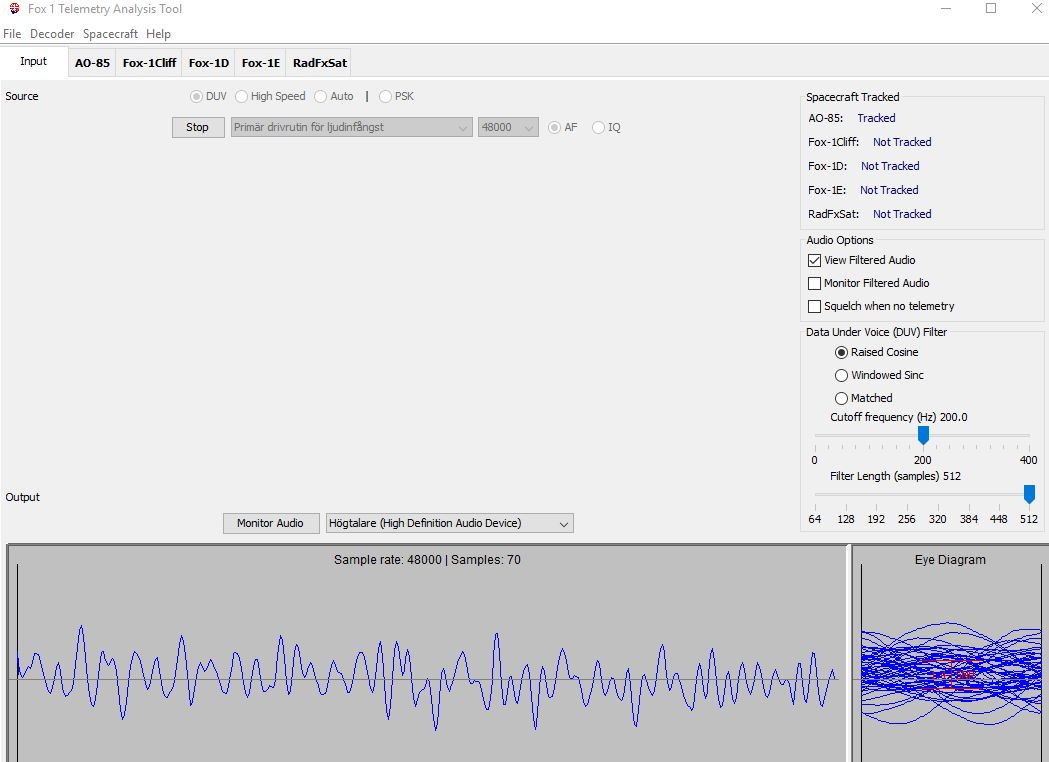
Senaste programvaran för telemetrimottagning av Fox-satelliterna finns nu tillgänglig:
 AMSAT-SM - Official Website of AMSAT-SM Sweden
Webmaster and member of the AMSAT-SM steering group.
Senaste programvaran för telemetrimottagning av Fox-satelliterna finns nu tillgänglig:
Viktig information runt uppskjutningen av RadFxSat/Fox-1B den 10:e november 2017:
AMSAT Vice-President Engineering, Jerry Buxton, NØJY wrote what to
initially expect when the AMSAT RadFxSat/Fox-1B cubesat is launched
as a passenger on NASA’s ELaNa XIV mission on Friday, Nov. 10, from
Vandenberg Air Force Base, California.
Liftoff will be aboard a United Launch Alliance Delta II rocket from
Space Launch Complex 2 and is targeted for 1:47 a.m. PT (4:47 a.m. ET,
9:47 am UTC) at the opening of a 65-second launch window. Launch cov-
erage will begin on NASA Television and the agency’s website at
1:15 a.m. PT.
RadFxSat/Fox-1B will automatically come up in Beacon Mode, transmitting
a beacon and voice ID (Veronica saying “RadFxSat Safe Mode”) every two
minutes, starting about 50 minutes after deployment. The AMSAT command
stations will want to see voltage and current data to determine that
it’s healthy and conduct various tests before opening it up for general
use.
Telemetry makes the engineering and operations teams very happy,
starting ASAP after startup (~55 minutes after deployment) and for
the next 72-96 hours at least as we look for successful startup, watch
the general health and function as the satellite begins to acclimate
to space, and perform the on orbit checkout. Ground stations are also
invited to continue uploading received telemetry for the life of the
satellite.
If you are capturing telemetry with FoxTelem please be sure that “Upload
to Server” is checked in your settings, and your Ground Station Params
are filled in as well. You can help AMSAT and everyone waiting to get
on the air with RadFxSat tremendously, by capturing RadFxSat telemetry.
In the initial Beacon Mode, the transmitter is limited to 10 seconds on
time then does the two minutes off cycle as Paul pointed out. For those
of you capturing telemetry, that means that you will only see Current
frames and no High or Low frames because the High and Low are truncated
as it takes just over 10 seconds to send two frames. Veronica may also
be cut off before she gets to say her whole ID string. If Veronica is
speaking, “RadFxSat Fox-1B Safe Mode” which is the full ID, if it’s cut
off then we’re still in Beacon Mode. If we are seeing good data from
user telemetry data, it is likely when it comes over the U.S. for the
first good pass we will command it from Beacon Mode to normal Safe Mode,
which then puts RadFxSat in full (still Safe Mode though) operation and
transmits a full two frames of telemetry which is one Current frame
followed by, and alternating each ID cycle, a High or a Low frame.
Veronica now has time to make the whole ID announcement, in Safe Mode.
YOUR HELP IS NEEDED!
——————–
Jerry, NØJY commented further …
Help your friends and all of our satellite ham friends get on the air
and have fun sooner by being polite and patient!
The on orbit checkout procedure is similar to Fox-1A/AO-85 and could
be completed in as little as a few days if we have the cooperation of
the users. It is very important, not to mention just plain good Amateur
Operating Practice, to refrain from using the transponder uplink so we
can do the on orbit tests, including when we turn on transponder mode
for testing. I can’t stress enough, the importance of this cooperation
not just for us but for all users, simply having a little patience so
we can conduct the tests as quickly and accurately as possible.
AMSAT will make it broadly known when the tests are complete and the
transponder is available for all to use. If you hear someone on the
transponder, please don’t assume that it is open for general use –
check the AMSAT website, Facebook, Twitter, to be sure you’re not
accidentally jumping in with and unwittingly interfering with the
commissioning process.
Lots of hams put thousands of volunteer hours of their time into making
RadFxSat happen. Just like any ham radio project you might undertake,
we build satellites. We do it because we like to, and when we’re done
we freely share our project with hams everywhere as is the spirit of
amateur radio.
I am asking all satellite hams to contribute just a little bit of your
time to the fun now, by being patient and just gathering telemetry,
not using the transponder uplink, and helping us complete the last few
days of getting RadFxSat in orbit and operating for all of you.
Thank you very much, see you on the bird!
Nu finns en sammanfattning av projektet på Hamnews.se
Ny är det äntligen dags för Räddningsgymnasiet i Sandö att köra sin ARISS-kontakt. Enligt Håkan SM7WSJ kommer passagen vara hörbar i delar av Sverige. Kontakten kommer även att streamas på internet, se länkar nedan:
Nedan är information från ARISS:
An International Space Station ARISS contact has been planned for astronaut Paolo Nespoli IZ0JPA with Tallaght Community School, Dublin, Ireland
and Gymnasium Räddningsgymnasiet Sando, Sandöverken, Sweden.
The event is scheduled Thursday October 19, 2017 at approximately 12.49 UTC, which is 14.49 CEST.
This direct radio contact will be operated by EI1ISS.
The signals will be relayed from Ireland to Sweden by telebridge.
Downlink signals will be audible in parts of Europe on 145.800 MHz narrowband FM.
School Information:
Tallaght Community School is located in Dublin city in Ireland. The school was chosen for the event as it is in a disadvantaged area and the school
works hard to prepare and encourage students to pursue some form of further education. The school has 900 students aged 12 to 18 years and all
will take part in the event. All students have studied about the ISS and were given an opportunity to submit questions to be selected.
Sandö is located about 400 Km to the North of Stockholm. The participating schools are Räddningsgymnasiet Sandö, Minerva school Ånge and the NTI
Gymnasium Sundsvall. Together they count 550 students ranging from ages 12 to 19. Sandö Räddningsgymnasium is close to nature and overlooks a beautiful
fjord. Besides teaching science programs, the gymnasium offers courses in civil crisis management, firefighting as well as search and rescue. Students
are prepared for a career as teachers, nurses, psychologist, firemen, fire engineers and policemen. Together with the Folke Bernadotte academy
as well as other governmental organisations, they create an understanding of and a preparedness for international assignments. Part of the education
is that the students travel around the world to learn from existing fire and rescue situations. Amateur Radio is also included in the student’s
graduate projects.
The NTI Gymnasium Sundsvall or the Northern Technical institute, established 1968 offers courses in digital techniques, internet technology and
other forms of digital communication. The institute has about 250 students. Minerva school Ånge teaches younger students from age 12 to 15 and
has of about 200 students enrolled.
Participants will ask as many of the following questions as time allows:
Odd numbered questions are from Tallaght, Ireland
Even numbered questions are from Sando, Sweden
1. Amy (14): What is your favourite view from the ISS?
2. Medina (16): Do you ever think children will be allowed to travel into space with astronauts?
3. Dean (14): If you had the chance would you change or add anything to the design of the ISS?
4. Anton (18): Is this job the most challenging job you have ever done?
5. Eimintas (16): What is the longest time you have spent on a spacewalk and what did you do?
6. Linna (15): Does the ISS have a black box like an aircraft?
7. Emma (12): Who inspired you to become an astronaut?
8. Valentina (17): Have space experiments resulted in something useful which is used on earth?
9. James (17): What training did you do to prepare for space walks?
10. Emil (14) Have you ever encountered an anomaly that has baffled you?
11. Trudy(15): This is your third trip to space, did it take your body more time to adjust to earth’s gravity the second time you landed?
12. Erik (18): What education in physics and engineering is required to become an astronaut?
13. Abbie (15): When your mission is over what will you miss the most and least about life on the ISS?
14. Sofia:(17: )Does your view of life change after seeing earth from another perspective?
15. Jack (12): Can you tell us about some of the interesting experiments you are conducting on the ISS?
16. Sanna (17): Are you allowed to bring along private things like photos?
17. Levente (15): Is the ISS ever affected by Solar radiation surges from the sun?
18. Felicia (19): Do you use “private” communication channels when talking with your family?
19. Lee (12): Have you had any fun or exhilarating experiences so far on your mission?
20. Jenna (16): How does it feel to see earth from such a distance for the first time?
ARISS is an international educational outreach program partnering the volunteer support and leadership from AMSAT and IARU societies around the
world with the ISS space agencies partners: NASA, Russian Space Agency, ESA, JAXA, and CSA.
ARISS offers an opportunity for students to experience the excitement of Amateur Radio by talking directly with crewmembers on board the International
Space Station. Teachers, parents and communities see, first hand, how Amateur Radio and crewmembers on ISS can energize youngsters’ interest in
science, technology, and learning.
73,
Gaston Bertels – ON4WF
ARISS Europe
På PE1ITR hemsida finns en presentation från AMSAT-DL årsmöte med en del intressanta bilder och information om Es’Hailsat. Använd Google translate om du inte kan holländska 🙂
Just nu pågår ett projekt för att skicka ny amatörradio-utrustning till ISS. Detta projekt kräver mycket pengar vilket du kan läsa om här.
Med denna undersökning vill vi i AMSAT-SM veta om Du tycker att vi ska donera pengar till projektet.