PSAT2 was successfully Launched at 0630Z on June 25, 2019 on the
Falcon Heavy STP-2 mission into a 28 degree elliptical orbit with
apogee at 860 km and perigee at 300 km. The 28 degree inclination
makes it difficult to work it over most of Europe but the
significant difference in apogee and perigee can make a 15 degree or
so elevation difference on the horizon. When apogee circulates to
be over the northern hemisphere,then more northern stations can
work it. When Perigee is over the
northern hemisphere, it can only be seen in Spain and Italy latitudes
in Europe, and only mid latitudes in the USA.
This changing apogee dynamic will move earlier each day and two weeks
later, will have reversed, and so forth on a monthly cycle or so.
Another interesting thing about the orbit is that it is almost time
synchronous; meaning that a pass will occur almost the same time
every day (though five minutes earlier). But then an earlier orbit
will appear an hour and a half earlier every other day. This makes
it very easy to do mobile/portable operations without any computer
once you hear one pass.
Lightsail-2 Scheduled for Launch June 24 – Beacon on 437.025 MHz
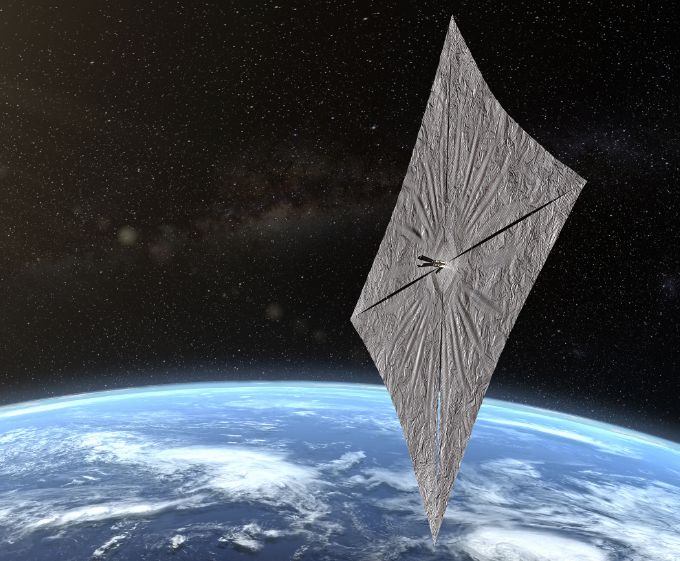
LightSail is a citizen-funded project from The Planetary Society. This cubesat will be propelled solely by sunlight, to Earth orbit. LightSail 2 is scheduled to launch aboard a SpaceX Falcon Heavy on June 24, 2019, and we will attempt the first, controlled solar sail flight in Earth orbit.
LightSail 2 will ride to space aboard the Department of Defense Space Test Program-2 (STP-2) mission which will send 24 spacecraft to 3 different orbits. LightSail 2 itself will be enclosed within Prox-1, a Georgia Tech-designed spacecraft originally built to demon- strate close-encounter operations with other spacecraft. Prox-1 will deploy LightSail 2 seven days after launch.
After a few days of health and status checks, LightSail 2’s four dual-sided solar panels will swing open. Roughly a day later, four metallic booms will unfurl four triangular Mylar sa
ils from storage. The sails, which have a combined area of 32 square meters [344 square feet], will turn towards the sun for half of each orbit, giving the spacecraft a tiny push no stronger than the weight of a paperclip. For about a month after sail deployment, this continual thrust should raise LightSail 2’s orbit by a measurable amount.
LightSail 2 will fly in a 24-degree inclination, 720 km, circular orbit. At latitudes of 42 degrees north it will reach a maximum elevation of 10 degrees above the horizon.
Lightsail-2 has been issued an experimental radio license WM9XPA and transmit on 437.025 MHz. A morse beacon will transmit the callsign every 45 seconds. A packet beacon will transmit AX.25, FSK 9K6 bps data.
[ANS thanks the Planetary Society for the above information]
———————————————————————
NASA Lightsail-2 PR and TV Coverage
NASA Television coverage is scheduled for an upcoming prelaunch activity and first nighttime launch of a SpaceX Falcon Heavy rocket, which will be carrying four agency technology missions to help improve future spacecraft design and performance.
The launch window for the Falcon Heavy opens at 11:30 p.m. EDT Monday, June 24, from historic Launch Complex 39A at NASA’s Kennedy Space Center in Florida. The launch, as well as a live technology show, will air NASA Television and the agency’s website.
SpaceX and the U.S. Department of Defense will launch two dozen sat- ellites to space, including four NASA payloads that are par
t of the Space Test Program-2, managed by the U.S. Air Force Space and Missile Systems Center. The four payloads include two NASA technology demon- strations to improve how spacecraft propel and navigate, as well as two NASA science missions to help us better understand the nature of space and how it impacts technology on spacecraft and the ground.
Full NASA TV coverage is as follows: (all times EDT)
Sunday, June 23 . Noon – NASA prelaunch technology TV show from Kennedy. Subject matter experts will explain each NASA mission and answer questions.
Monday, June 24 . 9:30 p.m. – Live NASA TV coverage begins of the return to Earth of NASA astronaut Anne McClain and two other International Space Station residents, with landing scheduled at 10:48 p.m. (Public Channel) . 11 p.m. – NASA TV launch com
mentary begins ahead of the targeted 11:30 p.m. launch. NASA TV will simulcast the SpaceX STP-2 webcast starting about 15 minutes before liftoff. (Media Channel)
From ANS-153: LightSail is a citizen-funded project from The Planetary Society. This cubesat will be propelled solely by sunlight, to Earth orbit. LightSail 2 is scheduled to launch aboard a SpaceX Falcon Heavy on June 22, 2019, and we will attempt the first, controlled solar sail flight in Earth orbit.
LightSail 2 will ride to space aboard the Department of Defense Space Test Program-2 (STP-2) mission which will send 24 spacecraft to 3 different orbits. LightSail 2 itself will be enclosed within Prox-1, a Georgia Tech-designed spacecraft originally built to demon- strate close-encounter operations with other spacecraft. Prox-1 will deploy LightSail 2 seven days after launch.
After a few days of health and status checks, LightSail 2’s four dual-sided solar panels will swing open. Roughly a day later, four metallic booms will unfurl four triangular Mylar sails from storage. The sails, which have a combined area of 32 square meters [344 square feet], will turn towards the sun for half of each orbit, giving the spacecraft a tiny push no stronger than the weight of a paperclip. For about a month after sail deployment, this continual thrust should raise LightSail 2’s orbit by a measurable amount.
LightSail 2 will fly in a 24-degree inclination, 720 km, circular orbit. At latitudes of 42 degrees north it will reach a maximum elevation of 10 degrees above the horizon.
Lightsail-2 has been issued an experimental radio license WM9XPA and transmit on 437.025 MHz. A morse beacon will transmit the callsign every 45 seconds. A packet beacon will transmit AX.25, FSK 9K6 bps data. Beacon information is available at: http://tinyurl.com/ANS-153-Lightsail-Morse-Beacon Documentation of the downlink telemetry data structure is posted at: http://tinyurl.com/ANS-153-Lightsail-Telemetry