BRICSAT2 and PSAT2 Designated Navy-OSCAR 103 (NO-103) and Navy- OSCAR 104 (NO-104)
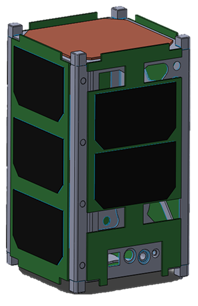
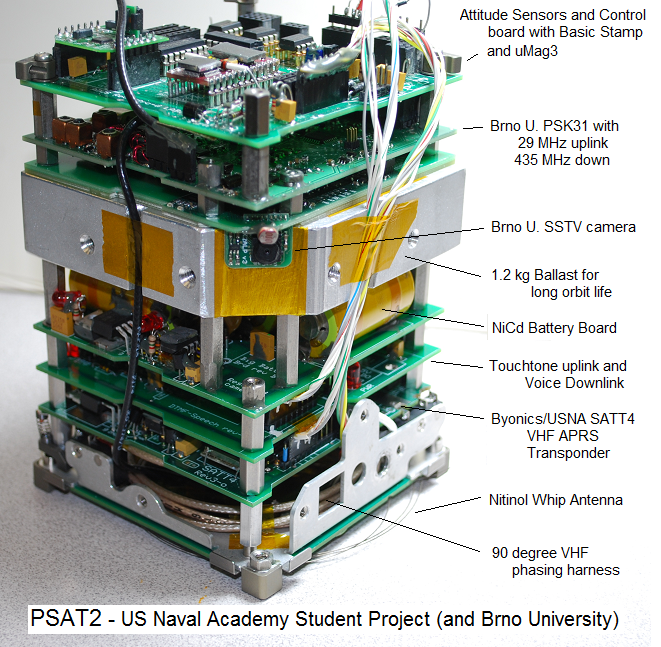
On June 25, 2019, the United States Naval Academy PSAT2 and BRICSAT2
cubesats were launched on a Falcon Heavy launch vehicle from the
Kennedy Space Center in Florida. PSAT2 and BRICSAT2 were developed by
Naval Academy students in the USNA Satellite Lab and operated in
cooperation with the USNA Amateur Radio Club. PSAT2 carries a PSK31
transponder, digipeater, SSTV-downlinked camera images, and a DTMF to
voice/APRS system. BRICSAT2 carries a digipeater and thruster
experiment. Both satellites are currently active.
At the request of the Naval Academy Amateur Radio Club, AMSAT hereby
designates BRICSAT2 as Navy-OSCAR 103 (NO-103), and PSAT2 as Navy-
OSCAR 104 (NO-104). We congratulate the owners and operators, thank
them for their contribution to the amateur satellite community, and
wish them a long mission and continued success on this and future
projects.
73,
Drew Glasbrenner, KO4MA
AMSAT VP Operations / OSCAR Number Administrator
[ANS thanks AMSAT VP Operations / OSCAR Number Administrator Drew
Glasbrenner, KO4MA, for the above information.]
“Analog transmitters of Fuji No. 3 (FO-29) have been suspended since
July 9, 2019. Currently, we are doing situation grasp and information
gathering, but we will inform you as soon as the situation is
understood.
If you have telemetry data after July 8th (UTC), please send it to the
following address.
[Transmission destination of telemetry data] oper (at) jarl.org
Thank you for your cooperation in collecting information on “Fuji No.
3″ of many users.
JARL Secretariat Member Section Fuji 3 Telemetry Section”
The Radio Amateur Society of Thailand (RAST) has announced that
JAISAT-1 is scheduled for launch on July 5, 2019 by a Soyuz 2.1
rocket at 05:41 UTC. JAISAT-1 will ride with a Meteor-M N2-2
meteorology satellite along with a total of 34 satellites from
twelve countries.
The telemetry downlink is 435.325 MHz and the telemetry format is
4k8 GMSK Mobitex (CMX990 Mobitex format). The telemetry format is
detailed at https://tinyurl.com/ANS-181-JAISAT-telfmt.
Signals in the same format can be found with the D-STAR ONE Sparrow
and D-STAR ONE iSAT satellites. Information on these satellites and
the decoding software download can be found at
http://dk3wn.info/blog/satelliten/d-star-one/
https://www.youtube.com/watch?v=UAjPOJDbHdA
https://www.youtube.com/watch?v=Rm_NS3Prz9U
http://uz7.ho.ua/packetradio.htm
http://www.dk3wn.info/files/dstar_one.zip
All Amateur Radio operators receiving signals from JAISAT-1 are asked
to email data to jaisatonetele@gmail.com. The Radio Amateur Society
of Thailand will have a SWL card to confirm reception.
Also of interest are videos of the satellites’ installation to the
Soyuz fairing at
https://www.roscosmos.ru/26486/
https://www.roscosmos.ru/26491/
https://www.youtube.com/watch?v=klXEGKKTlFs) and
https://www.youtube.com/watch?v=xcUhJMU4mHA&t=10s
[ANS thanks Tanan Rangseeprom, HS1JAN, JAISAT-1 Project Manager for
the above information.]
PSAT2 was successfully Launched at 0630Z on June 25, 2019 on the
Falcon Heavy STP-2 mission into a 28 degree elliptical orbit with
apogee at 860 km and perigee at 300 km. The 28 degree inclination
makes it difficult to work it over most of Europe but the
significant difference in apogee and perigee can make a 15 degree or
so elevation difference on the horizon. When apogee circulates to
be over the northern hemisphere,then more northern stations can
work it. When Perigee is over the
northern hemisphere, it can only be seen in Spain and Italy latitudes
in Europe, and only mid latitudes in the USA.
This changing apogee dynamic will move earlier each day and two weeks
later, will have reversed, and so forth on a monthly cycle or so.
Another interesting thing about the orbit is that it is almost time
synchronous; meaning that a pass will occur almost the same time
every day (though five minutes earlier). But then an earlier orbit
will appear an hour and a half earlier every other day. This makes
it very easy to do mobile/portable operations without any computer
once you hear one pass.
Lightsail-2 Scheduled for Launch June 24 – Beacon on 437.025 MHz
LightSail is a citizen-funded project from The Planetary Society. This cubesat will be propelled solely by sunlight, to Earth orbit. LightSail 2 is scheduled to launch aboard a SpaceX Falcon Heavy on June 24, 2019, and we will attempt the first, controlled solar sail flight in Earth orbit.
LightSail 2 will ride to space aboard the Department of Defense Space Test Program-2 (STP-2) mission which will send 24 spacecraft to 3 different orbits. LightSail 2 itself will be enclosed within Prox-1, a Georgia Tech-designed spacecraft originally built to demon- strate close-encounter operations with other spacecraft. Prox-1 will deploy LightSail 2 seven days after launch.
After a few days of health and status checks, LightSail 2’s four dual-sided solar panels will swing open. Roughly a day later, four metallic booms will unfurl four triangular Mylar sa
ils from storage. The sails, which have a combined area of 32 square meters [344 square feet], will turn towards the sun for half of each orbit, giving the spacecraft a tiny push no stronger than the weight of a paperclip. For about a month after sail deployment, this continual thrust should raise LightSail 2’s orbit by a measurable amount.
LightSail 2 will fly in a 24-degree inclination, 720 km, circular orbit. At latitudes of 42 degrees north it will reach a maximum elevation of 10 degrees above the horizon.
Lightsail-2 has been issued an experimental radio license WM9XPA and transmit on 437.025 MHz. A morse beacon will transmit the callsign every 45 seconds. A packet beacon will transmit AX.25, FSK 9K6 bps data.
[ANS thanks the Planetary Society for the above information]
———————————————————————
NASA Lightsail-2 PR and TV Coverage
NASA Television coverage is scheduled for an upcoming prelaunch activity and first nighttime launch of a SpaceX Falcon Heavy rocket, which will be carrying four agency technology missions to help improve future spacecraft design and performance.
The launch window for the Falcon Heavy opens at 11:30 p.m. EDT Monday, June 24, from historic Launch Complex 39A at NASA’s Kennedy Space Center in Florida. The launch, as well as a live technology show, will air NASA Television and the agency’s website.
SpaceX and the U.S. Department of Defense will launch two dozen sat- ellites to space, including four NASA payloads that are par
t of the Space Test Program-2, managed by the U.S. Air Force Space and Missile Systems Center. The four payloads include two NASA technology demon- strations to improve how spacecraft propel and navigate, as well as two NASA science missions to help us better understand the nature of space and how it impacts technology on spacecraft and the ground.
Full NASA TV coverage is as follows: (all times EDT)
Sunday, June 23 . Noon – NASA prelaunch technology TV show from Kennedy. Subject matter experts will explain each NASA mission and answer questions.
Monday, June 24 . 9:30 p.m. – Live NASA TV coverage begins of the return to Earth of NASA astronaut Anne McClain and two other International Space Station residents, with landing scheduled at 10:48 p.m. (Public Channel) . 11 p.m. – NASA TV launch com
mentary begins ahead of the targeted 11:30 p.m. launch. NASA TV will simulcast the SpaceX STP-2 webcast starting about 15 minutes before liftoff. (Media Channel)