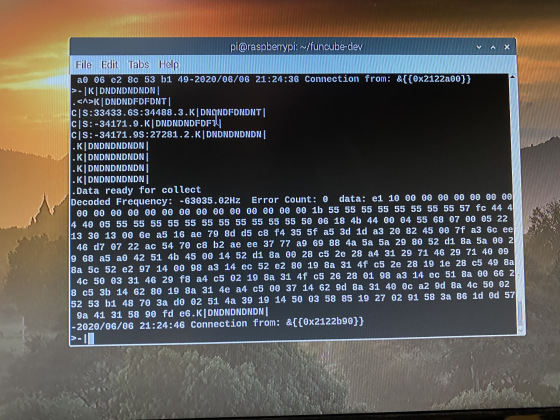
According to info from G3VZV/FUNcube website the FUNcube decoder now can be used with Raspberry PI, but only if you are using FUNcube dongle SDR.
 AMSAT-SM - Official Website of AMSAT-SM Sweden
Webmaster and member of the AMSAT-SM steering group.
According to info from G3VZV/FUNcube website the FUNcube decoder now can be used with Raspberry PI, but only if you are using FUNcube dongle SDR.

This is same pass from AO-92 at 20 degree elevation, decoded by my SatNOGS station and my “big” setup with tracking yagis. Good to see that the yagis makes a huge difference. Note: I’m not sure about the difference in data frames between the programs.

A V-dipole for NOAA weather satellites on 137 MHz has been published by 9A4QV and it seems to get very good results. I decided to build one for UHF 436 MHz satellite band and also add reflectors to get the antenna pattern higher up.
I followed the instructions by 9A4QV but adjusted to 436 MHz. All SWR measurements are done with a NanoVNA. Please see the pictures below for some ideas how to build one of you own. You can also see test results below.
I have used the following materials:
Some pictures from building


Test results
When listening to local repeaters a got good readings, but when trying to receive satellites I did not get the result I think this type of antenna should deliver. I think it is a better antenna for the high power NOAA satellites on 137 MHz. But, it´s very simple to build!
Some results:

Olle Enstam SM0DY har avlidit i en ålder av 90 år. Olle var under många år aktiv i AMSAT-SM både som styrelsemedlem och ordförande. Han var även aktiv på satelliterna och en flitig skribent i medlemstidningen AMSAT-SM Journal.
Jag hade förmånen att vara medlem i styrelsen en tid under Olles ordförandeskap. Trots stor åldersskillnad mellan oss fick jag alltid förtroende av Olle vilket hans stora erfarenhet av styrelseuppdrag då lyste igenom.
I Svenska Dagbladet den 8 juni 2020 finns en minnestext som sammanfattar hans yrkesliv.
/Lars Thunberg SM0TGU
RX CW decoding with fldigi.

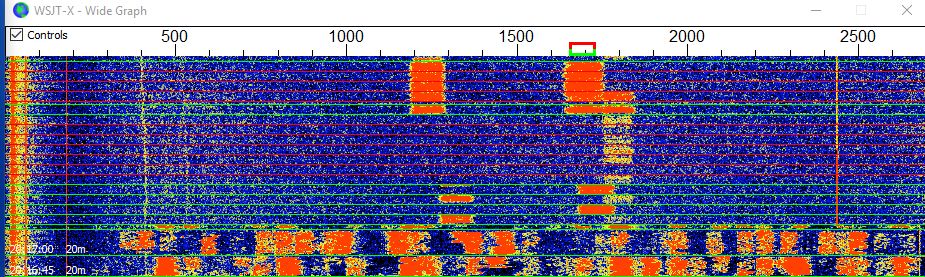
Interesting tests with FT8 and FT4 via linear transponders. I hope we will see more of this in the future, for hams not interested in SSB or/and CW.
Digital Mode Experiments Conducted on Linear Satellites
From ANS-152
[EDITOR’S NOTE: Be aware that the experiments described below utilize
very narrow AFSK modulation with fairly advanced computer control for
Doppler correction and frequency stabilization. They do NOT involve
use of narrowband FM signals such as those used for terrestrial APRS or
dedicated APRS satellites. So please, NEVER transmit FM on the uplink
to a linear satellite. ALSO, in should be emphasized that power levels
must be kept very low, as all the WSJT modes are 100% duty cycle.]
Recently a group of regular satellite-using amateurs conducted experi-
ments with FT-8 and FT-4 on a variety of linear satellites. Alan
(WA6DNR), Carlos (W7QL), Dave (W0DHB) and Ron (W5RKN) were involved and
made many satisfactory QSOs. The primary results and observations from
these tests are:
• Digital modes can successfully be employed on the linear birds
while not interfering with concurrent users by operating close to
the bottom end of the passband, using the lowest power practicable
and using very narrow signals.
• We avoided the satellites known to be power-sensitive, FO-29 and
AO-7. Testing was conducted with CAS-4A, CAS-4B, RS-44, XW-2A, XW-2B,
XW-2C and XW-2F.
• FT-4 was the most robust signal format, compared to FT-8. Other
of Joe Taylor’s digital signal modes should be investigated.
• The rate of change of Doppler just before and after TCA is high on
the lower-orbit satellites and must have compensation. 200 Milli-
second Doppler updates allowed 100% copy of FT-4 transmissions
throughout several passes of different linear satellites. This can be
accomplished in SatPC32 by setting the “SSB/CW Interval” in the CAT
menu to zero and checking the 5X box. Note that this setting is not
retained when SatPC32 is shut down.
• Very little power is needed for QSOs throughout the duration of the
pass, from AOS to LOS. W7QL set IC-9700 power to “zero” (roughly 500
milli-Watts, with over 3 dB cable/connector loss to a Leo-Pack anten-
na pair) and copied every packet on several satellites.
• FT-4 is very tolerant of voice signals which might drop on top of
an ongoing FT-4 QSO. However, an FT-4 signal dropping in the middle
of an SSB QSO would be quite annoying to the SSB operators.
• According to Joe Taylor, the occupied bandwidth of an FT-4 signal
is 90 Hz. So theoretically over 200 such signals could be present on
a 20 KHz channel. Obviously that will not, and should not happen. But
a dozen closely spaced FT-4 QSOs at the bottom of the band, each run-
ning very low power should hardly be noticeable to current voice and
CW traffic.
We invite other Satellite operators to join us in this expanded utili-
zation of the linear satellite resources available to us. We recommend
using FT-4 AT VERY LOW POWER, in the bottom few KHz of the downlink
frequency range, with appropriate Doppler compensation, as described
above. We hope to have a digital QSO with you sometime soon on the
linear birds.
[ANS thanks Carlos Cardon, W7QL, for the above information]