
Re-port ANS-235:
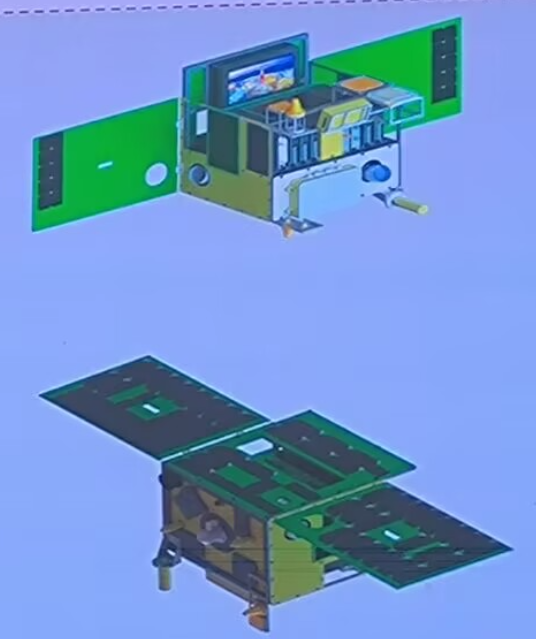
Two Chinese science-education satellites carrying amateur radio communications systems are scheduled for launch from the Taiyuan Satellite Launch Center on August 25 aboard a Long March 6C rocket.
The first, known as Jing’an Dream Star and carrying the JAMX01 amateur radio payload, is the result of a multi-year education project involving students in Shanghai’s Jing’an District. The project began in 2019 as an effort to give students hands-on experience with satellite development, radio communications, tracking, and spacecraft operations. Students and teachers are traveling to Taiyuan to participate in tracking and control activities associated with the mission.
According to the IARU Amateur Satellite Frequency Coordination database, JAMX01 was developed by students from Jing’an District together with amateur radio participants, with support from the Youngster Activity Center of Jing’an District, Shanghai. The approximately 50-kilogram microsatellite will support telemetry, digital image transmissions, and an FM digipeater. It also carries navigation lights and a kaleidoscope experiment intended for science-education activities.
The following frequencies have been coordinated for JAMX01:
145.950 MHz – FM digipeater uplink
435.075 MHz – beacon and SSTV downlink
435.175 MHz – FM digipeater downlink
435.500 MHz – telemetry downlink
IARU frequency coordination for JAMX01 was completed on January 6, 2025.
Shanghai officials say the spacecraft is expected to operate at approximately 500 kilometers altitude. Project organizers also describe several unusual educational experiments aboard the satellite, including a system designed to make the spacecraft visible as a flashing point of light, a kaleidoscope payload, and recorded youth voices for use in space-based broadcasts.
A second educational microsatellite, BY70-4, also known as 8104, BY-04, and Harbin MicroSat, is expected to fly on the same launch. The spacecraft was developed by the LilacSat Team at Harbin Institute of Technology and has a mass of approximately 18.7 kilograms. SatNOGS lists a high-definition camera, miniature camera, polarization camera, educational display, and short-message transponder among its payloads. The miniature camera is capable of JPEG and SSDV image transmission.
SatNOGS currently lists a UHF telemetry downlink for BY70-4 on 437.443 MHz using 9600 bps BPSK, with a format compatible with ASRTU-1. The spacecraft team has said in the Libre Space Community that BY70-4 is intended to share the frequency coordination previously used by BY70-3, which has reentered. The public IARU coordination database, however, presently shows the 437.443 MHz coordination under BY70-3 and does not contain a separate BY70-4 record. Operators should therefore watch for any additional coordination or operating information issued before or after launch.
Information on JAMX01 is available from the IARU Amateur Satellite Frequency Coordination database at:
https://iaru.amsat-uk.org/formal_detail.php?serialnum=1009
The Shanghai Jing’an District announcement is available at:
https://www.jingan.gov.cn/sy/004009/004009010/004009010001/20260813/f8989d84-fce0-46e6-afba-c4e654267a9d.html
SatNOGS information for BY70-4 is available at:
https://db.satnogs.org/satellite/EMBU-7314-7883-5821-1365/
Launch discussion and spacecraft-team information are available from the Libre Space Community at:
https://community.libre.space/t/cz-6c-launches-jamx01-2026-08-25-03-30utc/15173
[ANS thanks the Shanghai Jing’an District Government, the IARU Amateur Satellite Frequency Coordination service, SatNOGS, and members of the Libre Space Community for the above information]