
Repost: ANS-074
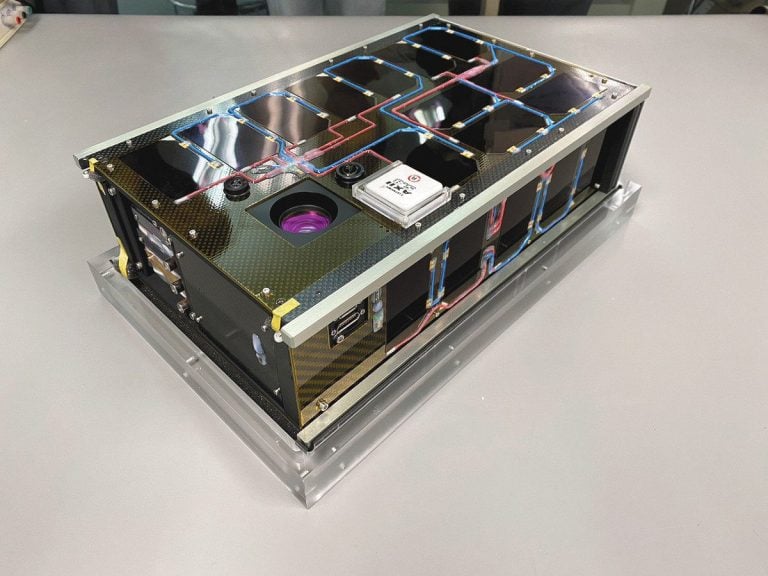
The 6U CubeSat Ten-Koh 2 (also written as Tenkoh-2 or てんこう2) from Japan’s Nihon University was successfully deployed into orbit on March 11, 2026, at approximately 09:34 UTC. The satellite was released from JAXA’s new HTV-X1 cargo spacecraft using the HTV-X Small Satellite Orbital Deployer (H-SSOD) after the vehicle departed the International Space Station (ISS) on March 6 and raised its altitude to around 500 km. This marks the first use of the H-SSOD mechanism for satellite deployment from HTV-X.
Developed by the Okuyama Laboratory in the Department of Aerospace Engineering at Nihon University’s College of Science and Technology, Ten-Koh 2 builds on the legacy of its predecessor, Ten-Koh (launched in 2018). The mission focuses on low-Earth orbit environmental observations to gather data for future space development, alongside in-orbit demonstrations of next-generation communication technologies. Key goals include evaluating high-speed data transmission and enabling global access for amateur radio operators to collect telemetry and experiment with the payloads.
The satellite carries an amateur radio payload coordinated by the International Amateur Radio Union (IARU) and supported by JAMSAT (Japan Amateur Satellite Association):
- V/U Linear Transponder (inverting, 40 kHz bandwidth):
- Uplink (LSB): 145.895–145.935 MHz
- Downlink (USB): 435.875–435.915 MHz
- Additional Downlinks/Experiments:
- CW beacon, Digitalker, AFSK 1.2 kbps, GMSK up to 19.2 kbps on 435.860 MHz
- High-speed experiments (GMSK 4.8–19.2 kbps, 4FSK 38.4 kbps) and photo/picture downlinks on 435.895 MHz
- 5.839 GHz CW beacon for microwave-band communication demos (SHF experimenters take note—this provides a great target for testing dishes, feeds, and LNAs)
The transponder is expected to operate on a scheduled basis (initially two days per week, with details forthcoming from the team). Operations began shortly after deployment, with the university’s ground station confirming reception of the CW beacon for basic telemetry (voltage, temperature, etc.).
Post-deployment updates from the Okuyama Lab indicate the signal level is currently weaker than anticipated, prompting ongoing monitoring and appeals for reception reports via networks like SatNOGS to aid diagnostics and performance assessment. Early passes over Japan and other regions have yielded mixed results, with some operators reporting no signals yet, while preliminary TLEs (e.g., temporary NORAD 98542) are circulating for tracking.
[ANS thanks the Okuyama Laboratory at Nihon University for the above information]