Categories
Ham Satellite news

Cubesats förlorade i rakethaveri

Problem vid senaste förnödenhetsleveransen till ISS.  Det försvann tyvärr en hel del satelliter men inga personskador.

 https://www.orbital.com/NewsInfo/release.asp?prid=1918


The GOMX-2 and RACE CubeSats were among more than 2 dozen satellites that were lost after an unmanned Orbital Space Sciences (OSC) Antares 130 vehicle exploded spectacularly shortly after launch at 2222 UTC on Tuesday, October 28, from the Mid-Atlantic Regional Spaceport on Wallops Island on Virginia’s Eastern Shore. Both satellite packages carried payloads that operated on Amateur Radio frequencies. The Antares is a new medium-class launch vehicle developed by OSC.

The rocket exploded about 6 seconds after launch, sending a huge ball of fire hurtling toward the ground, which set a massive fire at the NASA launchsite.

The 2U GMX-2 CubeSat was intended to test a de-orbit system designed by Aalborg University in Denmark. Karl Klaus Laursen, OZ2KK, is listed as the“responsible operator” on International Amateur Radio Union frequency coordination documents. The Amateur Radio payload proposed using a 9.6 k MSK data downlink on 437.250 MHz. Also on board was an optical communications experiment from the National University of Singapore. The mission also hoped to flight qualify a new high-speed UHF transceiver and SDR receiver built by an Aalborg University team.

The Radiometer Atmospheric Cubesat Experiment (RACE) CubeSat was a joint project between The Texas Spacecraft Laboratory (TSL) at the University of Texas-Austin and NASA’s Jet Propulsion Laboratory (JPL). It carried a 183 GHz radiometer, a new science instrument designed by JPL. The primary objective of the RACE mission was to collect atmospheric water vapor measurements. The spacecraft was equipped to transmit using GMSK at 38.4 k and CW telemetry on a downlink frequency of 437.525MHz, as coordinated with the IARU. TSL’s Edgar Glenn Lightsey, KE5DDG, was listed in the IARU coordination documents as the responsible operator.

The Antares 130 launcher was on a resupply mission, carrying some 5000 pounds of cargo to the International Space Station. GOMX-2 and the other satellites onboard the rocket were to be launched into orbit from the International Space Station.

The Antares 130 also was carrying the Flock-1d array of 26 satellites as well as Arkyd-3, Cygnus CRS-3, and the RACE CubeSat
Med vänlig hälsning  Håkan SM7WSJ
Categories
Ham Satellite news

LituanicaSAT-2 Announced

Teamet bakom Lituanica har nu meddelat att nästa satellit, LituanicaSAT-2, är på gång. LituanicaSAT-2 kommer att vara mer avancerad än LituanicaSAT-1 med bla. möjlighet att aktivt ändra bana med hjälp av hjälpmotorer/raketer. Därför beräknas den kunna vara i bana under ca. 18 månader. Läs mer:

The LituanicaSAT team has announced on Facebook that the
LituanicaSAT-2 CubeSat will be coming soon.

It is hoped the CubeSat will be among 50 satellites launched in the
1st quarter of 2016 on the Ukrainian Cyclone 4 launcher from the
Alcantara launch site built by Ukraine and Brazil. The new launch
site is located near the Atlantic coast of Brazil just 2.3 degrees
south of the equator.

LituanicaSAT-2 will be more complex than the first and will test a
new propulsion system which will enable it to change orbit.
Currently CubeSats deployed in very low Earth orbit may only last 3
months before burning up in  the Earth’s atmosphere, the propulsion
system could extend that up to 18 months.

Read the 15min.lt article about LituanicaSAT-2 in Google English at
http://tinyurl.com/LituanicaSAT-2-15min

Facebook
https://www.facebook.com/Lituanicasat1

You can watch a presentation by Gintautas Sulskus on the first
LituanicaSAT CubeSat at
http://amsat-uk.org/colloquium/colloquium-2014/presentation-videos/

LituanicaSAT-1
http://amsat-uk.org/2014/02/27/lituanicasat-1-cubesat/

QB50 to use Alcantara launch site
http://amsat-uk.org/2014/01/28/qb50-cubesat-launch-contract-signed/

[ANS thanks AMSAT-UK for the above information]

Categories
Ham Satellite news

Den kinesiska månsonden

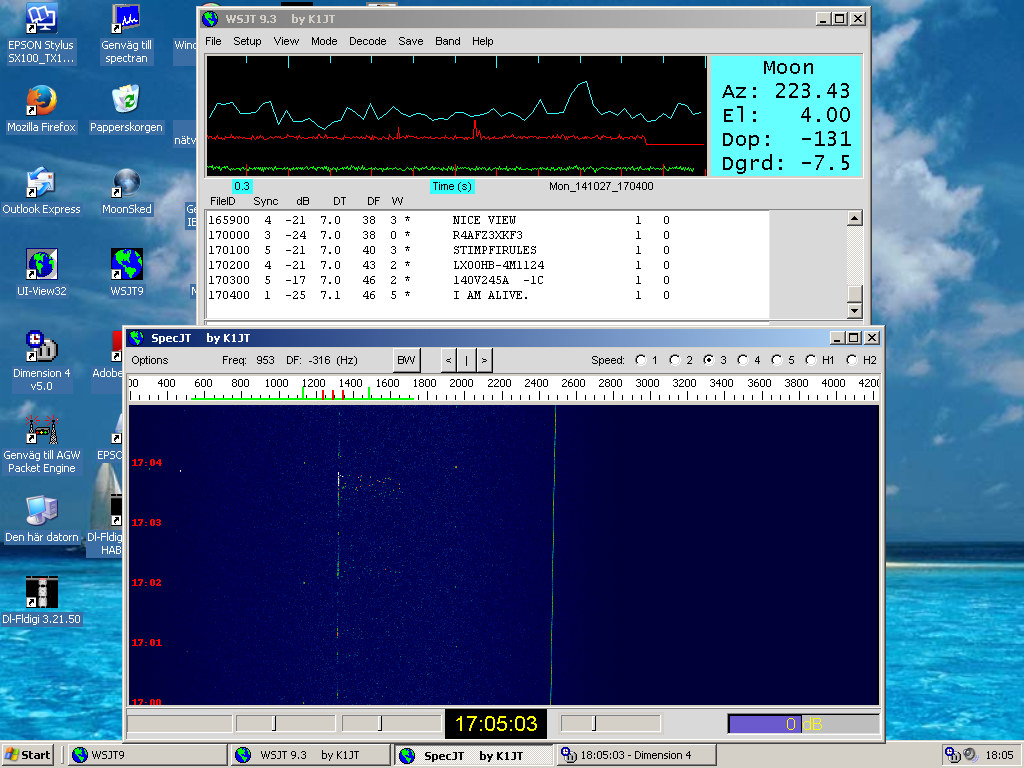
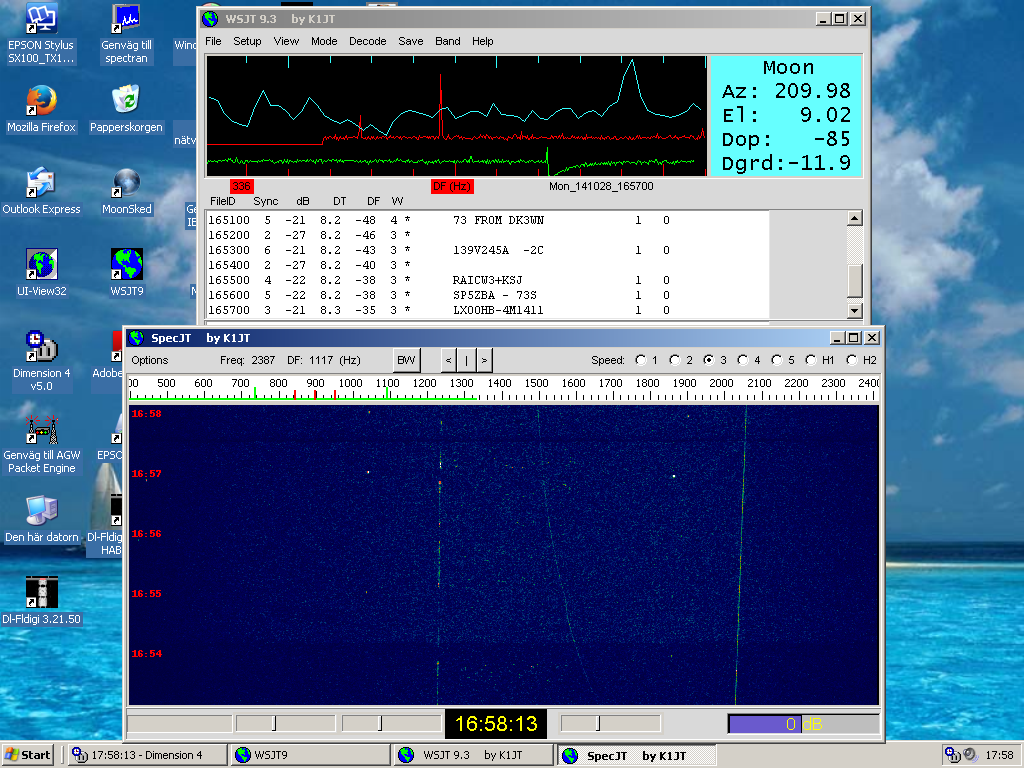
Nu har den Kinesiska  månsonden kommit fram och befinner sig på ett avstånd av 390 000 km från jorden.  Den lilla VHF sändaren som genererar 1W hörs förvånande väl.  Mottagningsutrustning här är en 16EL horisontell yagi med mastmonterad lågbrusig antennförstärkare.

Mer information finns på     http://moon.luxspace.lu/        Ni kan även på den länken klicka på partners för att se vilka som ligger bakom själva sonden som sitter fäst på den Kinesiska raketen.

390000 km


Uppdatering nu när raketen har rundat månen och är på väg tillbaka. Det ser bra ut så här långt.

396000 km retur


Categories
Ham Satellite news

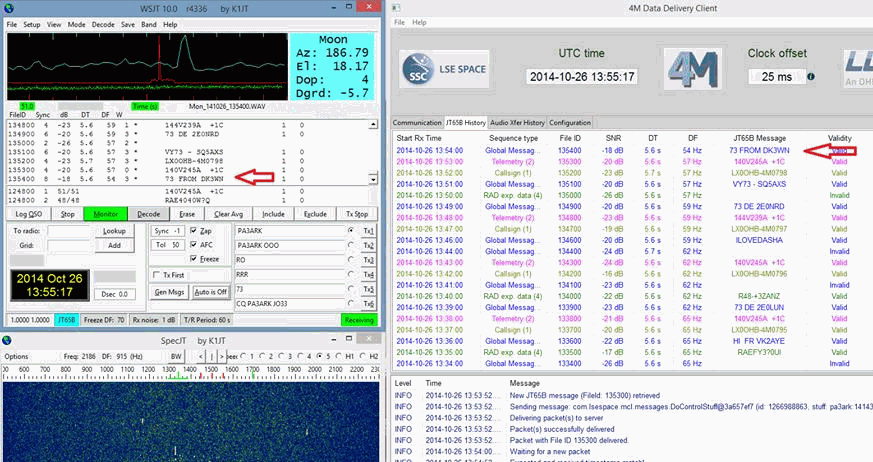
4M moon mission med amatörradio

4M telemetry: From DK3WN website

4M moon mission är en satellit med destination månen och som även har amatörradio ombord. Den sänder runt 145.8795 MHz och använder WSJT. I Sverige har bla. SM7WSJ Håkan hört den. Mer information finns på följande sidor:

http://moon.luxspace.lu/

http://moon.luxspace.lu/flyby/#comments

DK3WN Satblog har mycket info:

http://www.dk3wn.info/p/?cat=227

Categories
Ham Satellite news

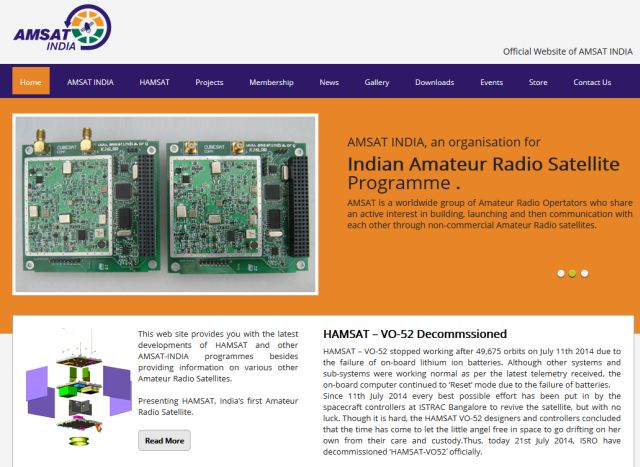
AMSAT India new website


amsat_india_new_website

AMSAT India har lanserat en ny webbsida. Finns på:
http://amsatindia.org/

Categories
Ham Satellite news

HAMTV från ISS

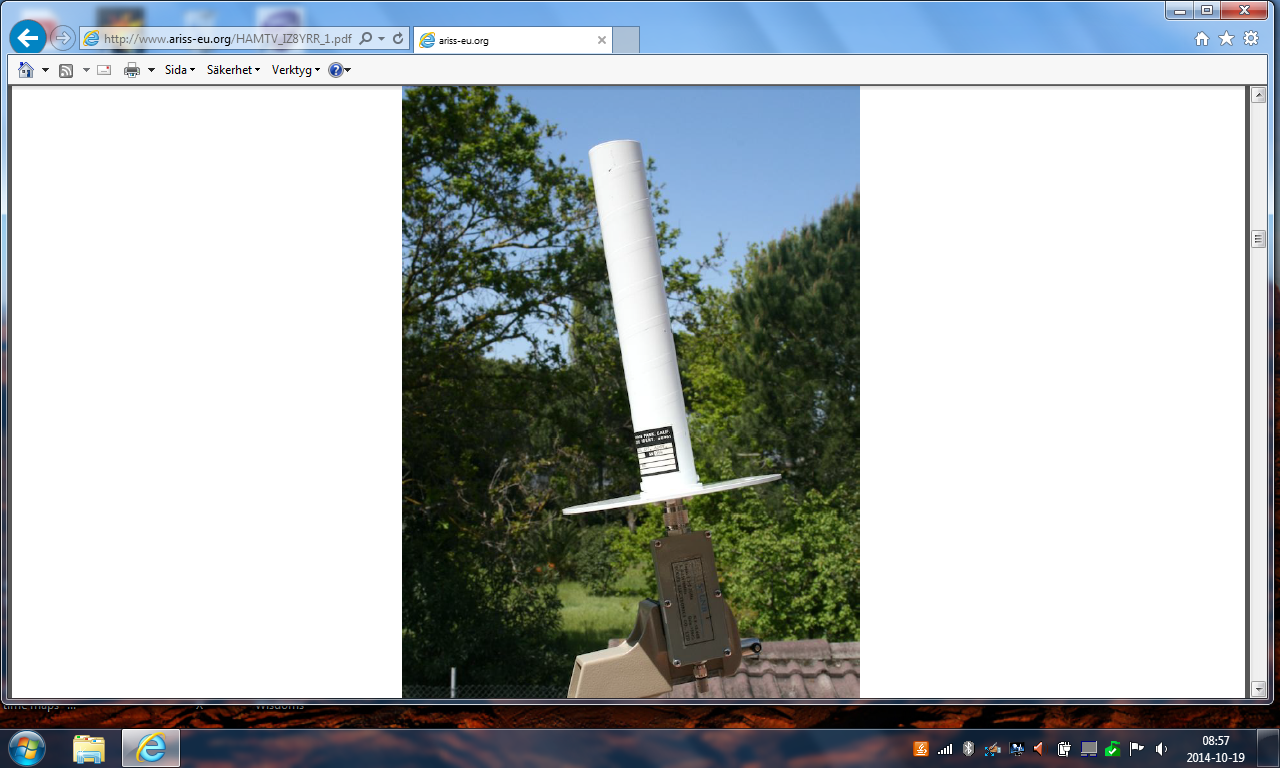
Det har kommit ut en  ny artikel om mottagning av TV signalerna från rymdstationen med en mindre antenn än rekommenderat.      http://www.ariss-eu.org/


HAMTV