
Categories
Ham Satellite news

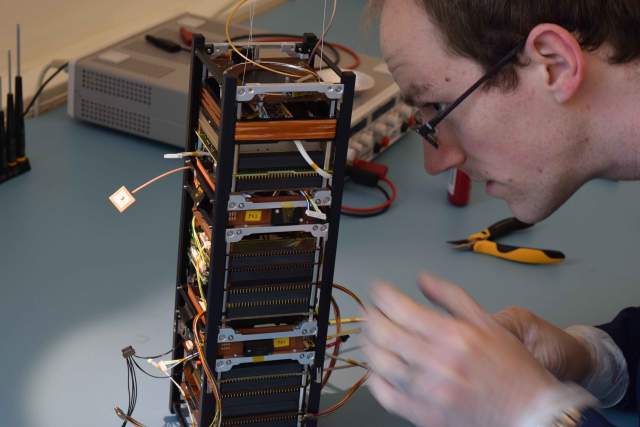
Nya QB50 cubesats planeras från ISS

Från ANS-256 kan vi läsa följande nyhet om nya cubesats av modellen QB50:

It has been announced that the fifty CubeSat QB50 constellation should be
shipped to the International Space Station (ISS) in July 2016 for subsequent
deployment. It had been planned for them to be launched by Alcantara Cyclone
Space, a joint venture between the governments of Ukraine and Brazil, but that
option is not longer available.

The AlbertaSat website reports on the 9th QB50 Workshop, held September 8, 2015
in Liège, Belgium. The CubeSats are now planned to be deployed from the ISS
using the Japanese Experiment Module (JEM) and the Nanoracks CubeSat Deployers.

Eight NanoRacks deployers are installed on the Multi-Purpose Experiment Platform
(MPEP). Each deployer has a capacity of 6U and so can hold up to six 1U, three
2U or two 3U CubeSats. They are carried by Japanese Experiment Module-Remote
Manipulator System (JEM-RMS).

AlbertaSat provide an update on the QB50 precursor CubeSats P1/P2 which were
launched in 2014. The first payload is working, and while it has been resetting,
no damage appears to have occurred. It is possible that the second payload is
damaged, but it is still functioning.

Representatives from QB50 also took the time to clearly define their goals and
specify the details of the project. The project aims to probe probe thermosphere
with about 40 sensors which study atmospheric science. These sensors include the
Langmuir Probes that will be on Ex Alta-1. 40 CubeSats will be fitted with one
of these sensors. The other 10 CubeSats will have in-orbit demonstrations.

QB50 project https://www.qb50.eu/

[ANS thanks AMSAT-UK for the above information]
Categories
Ham Satellite news

Nyheter från AMSAT OZ / journal no. 206

Följande information kommer från AMSAT-OZ:

Hej alle,

Der har været lidt stille fra AMSAT OZ det sidste halve års tid. Det
skyldes til dels at vi har været “offline” mens det fysiske netværk på
DTU Diplom (tidligere IHK) skulle udskiftes, men nu er vi ved at komme
op at køre igen.

Der er allerede kommet et par nye artikler på vores hjemmeside og jeg
håber vi får mere tid til at skrive om hvad der sker indenfor
amatørradiosatellitter verden over.

Videooptagelser fra AMSAT-UK Space Colloquium:
https://www.amsat.dk/nyheder/videooptagelser-fra-amsat-uk-space-colloquium

Kinesiske amatørradiosatellitter er klare til opsendelse i september:
https://www.amsat.dk/nyheder/kinesiske-amatorradiosatellitter-er-klare-til-opsendelse-i-september

ARISS School Contacts – Call for Candidate Schools:
https://www.amsat.dk/nyheder/ariss-school-contacts-call-for-candidate-schools

Satellitstatus for september 2015:
https://www.amsat.dk/nyheder/satellitstatus-2015-09

Ny mulighed for opsendelse af Phase 3E:
https://www.amsat.dk/nyheder/ny-mulighed-for-opsendelse-af-phase-3e
73
Alex OZ9AEC

Categories
Ham Satellite news

SM0IFP antenner för satellit

SM0IFP Jan-Olof har skickat en video på sina antenner och elevationsrotor. Enligt Jan-Olof, som köpt antennerna begagnat, är det troligtvis ett Vårgårda-system. Se även mer på http://hem.bredband.net/sm0ifp/sida2.html


Categories
Ham Satellite news

Nytt QSO avståndsrekord via FO-29

Följande nyhet kom bla. via Twitter och AMSAT-UK. Nytt avståndsrekord för QSO via FO-29. Se även videon längre ner!

Satellite friends and colleagues,

I’m happy to announce that at 1732UTC on August 27th, 2015, A QSO was
made between myself, KG5CCI, and F4CQA on Satellite FO-29. This was not
a scheduled contact, I simply answered Christophe’s CQ call. I knew it
was a good contact at the time, but as I was portable up on Arkansas’
Shinnall Mountain, I did not have the resources available to calculate
distances. After returning to my office I began to log the contacts I
had made, and noticed the “general” distance between EM34 and JN17 was
in excess of 7500km. About the same time I came to this realization, my
email chirped with a message from Christophe, who had came to the same
conclusion.

After some quick exchanges, and verifying 10 digit locators, we have
settled on an official distance of 7599.959km between my grid of
EM34ST11TL and Christophe’s grid of JN17EA22OT, using the
http://no.nonsense.ee/qth/map.html website for calculations.

To the best of our knowledge, referencing data found on Amsat-UK’s
website ( at http://amsat-uk.org/2015/05/06/uk-texas-extreme-dx-contact/
) this breaks the previous distance records of 7537.799km between W5CBF
and G4DOL, and the 7538.685km contact between K4FEG and DK1TB.

I had my camera setup to record the pass as well, and you can view a raw
clip of the contact here:

If anyone has any questions about the contact, I’ll be happy to answer
them. Special thanks and a solid *GOOD-DX* to Christophe  for the
contact, and here’s to many more.

73!

-Dave, KG5CCI

Categories
Ham Satellite news

Nya satelliter till ISS

Foto: Nasa
GOMX-3. Foto: Nasa

Dags för fler satelliter att släppas ut från ISS:

Japan Aerospace Exploration Agency’s (JAXA) launch of its H-II Transport
Vehicle (HTV)-5 to the International Space Station on Wednesday, Aug. 19
included two cubesats. These satellites will then be deployed together into
space in the first half of September, with the involvement of Danish ESA
astronaut Andreas Mogensen. Both CubeSats originated from Denmark.

GOMX-3 is a 3U Cubesat. The mission and its payloads will be used for story
telling and teaching. It will include an ADS-B receiver, magnetometer data,
solar cells and green energy and radio operation. An experimental X Band
transmitter plus an SDR receiver will also be carried.

GOMX-3 downlink: 437.250 MHz with 1k2-9k6 GMSK data from a NanoCom AX100
using CSP protocol.

AAUSAT-5 is a 1 unit cubesat. The primary mission is to receive AIS beacons
from ships with a new design based on AAUSAT-3. In addition to that a
educational payload for high school outreach was designed by engineering
students. The AIS receiver payload is based on SDR principles. Once deployed
from the ISS it is expected to remain in orbit for approx 6 months.

AAUSAT-5 downlink:  437.425 MHz, GMSK telemetry.

Danish Ministry of Science and Education, House of Natural Sciences
http://nvhus.dk/house-of-natural-sceinces.aspx

ESA Cubesat launch announcement:
http://tinyurl.com/ESA-Gomx

SpaceRef.com article about AAUSAT-5:
http://tinyurl.com/AAUSAT-Article


Categories
Ham Satellite news

RadFXSat/Fox-1B Launch Opportunity Announcement november 2016

Nu finns det en bokad uppskjutning för amatörradio-satelliten Fox-1B, men det är inte förrän november 2016 så det är över ett år kvar. Läs mer:

AMSAT has been notified by Scott Higginbotham, Mission Manager for ELaNa-12
(Fox-1A launch) and ELaNa-14 (RadFxSat/Fox-1B launch) in NASA’s Launch
Services Program at Kennedy Space Center, “The ELaNa-14 CubeSat complement
is scheduled to fly along with NOAA’s JPSS-1 spacecraft on a Delta II that
will be launching from VAFB on November 15, 2016. Due to a number of
CubeSats recently dropping off of the manifest for this flight, a door has
been opened, and it is my pleasure to inform you that your respective
CubeSats (RadFXSat, GoldenEagle-1, EagleSat, and MiRaTA) have all been
officially added to the manifest.”

AMSAT will begin working with Tyvak, the CubeSat Dispenser and Dispenser
Integration Contractor for this flight. Additional news regarding the
schedule milestones toward meeting launch requirements will be released as
more information becomes available.

In a message sent to AMSAT Vice President Engineering, Jerry Buxton, N0JY,
Higginbotham concluded, “Congratulations and welcome aboard!”

Planned Frequencies for the Fox-1 FM Series Cubesats
————————————————————–
Uplink FM (67 Hz tone) Downlink FM
—————————- ———–
Fox-1A 435.180 MHz 145.980 MHz
RadFxSat/Fox-1B * 435.250 MHz 145.960 MHz
Fox-1C* 435.300 MHz/1267.300 MHz ** 145.920 MHz
Fox-1D* 435.350 MHz/1267.350 MHz ** 145.880 MHz

* Pending IARU Coordination, Changes will be announced
** Switchable by command station, not operational simultaneously

Download the Fox-1A Operating Guide from the AMSAT Station and
Operating Hints page: http://www.amsat.org/?page_id=2144

[ANS thanks NASA and Jerry Buxton, N0JY, AMSAT Vice President Engineering
for the above information]