Categories
Ham Satellite news

RadFxSat-2 / Fox-1E uppskjutning 19 december 2020

Den sista satelliten i AMSAT-NAs FOX-serie, RadFxSat-2 / Fox-1E, har fått ett uppskjutningsfönster som börjar den 19 december (2020). Till skillnad mot de andra FOX-satelliterna, som har haft FM-transponder, har Fox-1E en linjär inverterande transponder för SSB och CW-trafik.

Dessutom har telemetrilänken flyttat till 70cm på 435.750 MHz och kan tas emot med den senaste versionen av FoxTelem.

Läs hela nyheten här:

Launch Window for AMSAT’s RadFxSat-2 / Fox-1E Opens December 19th

Virgin Orbit has announced that the launch window for their
LauncherOne Launch Demo 2 mission opens on December 19th. This launch
will carry AMSAT’s RadFxSat-2 / Fox-1E to orbit.

RadFxSat-2, like RadFxSat / Fox-1B, now AMSAT-OSCAR 91, is a
partnership opportunity between Vanderbilt University and AMSAT and
will carry a similar radiation effects experiment, studying new FinFET
technology.

RadFxSat-2 is the fifth and final Fox-1 satellite built by AMSAT. The
RadFxSat-2 spacecraft bus is built on the Fox-1 series but features a
linear transponder “upgrade” to replace the standard FM transponder in
Fox-1A through D. In addition, the uplink and downlink bands are
reversed from the previous Fox satellites in a Mode V/u (J)
configuration using a 2 meter uplink and 70 cm downlink. The downlink
features a 1200 bps BPSK telemetry channel to carry the Vanderbilt
science data in addition to a 30 kHz wide transponder for amateur
radio use. Telemetry and experiment data can be decoded using FoxTelem
version 1.09 or later. FoxTelem is available at
https://www.amsat.org/foxtelem-software-for-windows-mac-linux/.

Participation in telemetry collection by as many stations in as many
parts of the world as possible is essential as AMSAT Engineering looks
for successful startup and indications of the general health and
function of the satellite as it begins to acclimate to space. AMSAT
will send a commemorative 3D printed QSL card to the first station
capturing telemetry from RadFxSat-2.

RadFxSat-2 / Fox-1E Frequencies:

Telemetry Downlink – 435.750 MHz
Inverting Linear Transponder Uplink – 145.860 MHz – 145.890 MHz
Inverting Linear Transponder Downlink – 435.760 MHz – 435.790 MHz

[ANS thanks AMSAT for the above information]
Categories
Ham Satellite news

IARU Coordinates Frequencies for Six Satellites in October

During the month of October the IARU coordinated frequencies for six
upcoming Amateur Radio satellites:

  • OreSat0 (Portland State Aerospace Society at Portland State
    University is a 1U CubeSat. The mission is to provide flight heritage
    to the “OreSat bus”, an open source card-cage based system that is
    ideally suited for education CubeSat projects involving
    interdisciplinary teams of students. Downlinks on UHF using CW
    beacon, 9k6 G3RUH AX25/APRS packet beacon and a 96k GMSK
    engineering downlink. Also downlink on S Band using amateur 802.11b
    DPSK with 11M chip/sec spread and 1 Mbps data rate for bulk mission
    data. Downlinks on 436.500 MHz and 2425.00 MHz have been
    coordinated. Planning a launch with Momentus Space from Cape
    Canaveral in February 2021 into a 450 km polar orbit. More info at:
    http://oresat.org/ and https://github.com/oresat.
  • TartanArtibeus-1 (Carnegie Mellon University) is a 1P PocketQube.
    The
    Amateur Radio community globally will be provided with a delay
    ping-back service, allowing Amateurs to send messages, with replies
    from the satellite transmitted later. A UHF downlink using 3kbps FSK
    compatible with RadioHead library. A downlink on 437.170 MHz has
    been coordinated. Planning a SpaceX launch from KSC in December 2020
    into a 550km SSO.
  • SATLLA-2 (Ariel University) is a 2P picosat that will take
    low-resolution photos and will broadcast the photos over the Amateur
    Radio with its position in orbit and data from its sensors. UHF and S
    Band downlinks using LORA from 476bps to 9k6 bps. Downlinks on
    437.250 MHz and 2401.000 MHz have been coordinated.Planning a SpaceX
    launch into a 410 km 52 degree orbit in December 2020.
  • CSIROSat-1 (University of South Australia & CSIRO) is a 3U CubeSat
    mission that will perform hyperspectral infrared imaging of the earth
    for scientific research purposes. An experimental two-way link for
    Amateur Radio operators to exchange short messages through a
    ‘ping-pong’ arrangement of data exchange is among the several
    communications experiments. Proposing a 9k6 FSK downlink. A downlink
    on 437.315 MHz has been coordinated. Planning a launch from Cape
    Canaveral in March 2021 into an ISS orbit.
  • PyCubed-1 (Carnegie Mellon University) is a 1P PocketQube that will
    test a novel 3-axis attitude control system based on magnetic torque
    coils. In addition, it will test new low- power LoRa radios in
    low-Earth orbit which will be of interest to many other Amateur Radio
    small satellite operators. Proposing a 3kbps UHF downlink. A downlink
    on 437.290 MHz has been coordinated. Packets are standard LoRa format
    and are compatible with the RadioHead library. Planning a SpaceX
    launch from KSC into a 550 km SSO in December 2020.
  • Grizu-263A (Zonguldak Bülent Ecevit University) is a pocketcube
    satellite with a digipeater mode that will allow forwarding of
    received messages back to earth to support communication between
    Amateur Radio operators. Proposing a UHF downlink using 4k8 FSK. A
    downlink on 437.190 MHz has been coordinated. Planning a SpaceX
    launch from Vandenberg into a 500 600 km SSO in December 2020.

Information on these and other upcoming satellites can be found at:
http://www.amsat.org.uk/iaru/.

[ANS thanks the IARU for the above information.]

Categories
Ham Satellite news

AMSAT Virtual Symposium Replay Available on YouTube

The 2020 AMSAT Space Symposium and Annual General Meeting was held via a Zoom Webinar on October 17, 2020 with over 200 AMSAT members in
attendance. If you were not able to attend, a complete replay is
available on the AMSAT YouTube channel:

The YouTube video is divided into chapters to make it easy to find the
specific presentation you are looking for:

0:00:00 Welcome
0:02:07 AMSAT GOLF-TEE System Overview and Development Status
0:43:02 GOLF IHU Coordination
1:19:10 GOLF Downlink Coordination
1:50:15 FUNcube Next
2:13:50 LunART – Luna Amateur Radio Transponder
2:45:35 CatSat HF Experiment Overview
3:13:30 Neutron-1 CubeSat
3:39:58 Progress and Development of Open Source Electric Propulsion
for Nanosats and Picosats
4:15:00 AMSAT Education
5:14:00 ARISS (Amateur Radio on the International Space Station) /
AREx (Amateur Radio Exploration)
6:14:00 AMSAT Engineering
7:21:16 AMSAT Annual General Meeting

AMSAT members may download the 2020 Symposium Proceedings at
https://launch.amsat.org/Proceedings.

The 2021 AMSAT Space Symposium and Annual General Meeting is expected to be held in the Minneapolis area in October 2021.

[ANS thanks the 2020 AMSAT Symposium Team for the above information]

Categories
Ham Satellite news

AMSAT Board of Directors Elects Robert Bankston, KE4AL, President

ANS-292.02 AMSAT News Service Special Bulletin

At its annual meeting, the AMSAT Board of Directors elected Robert
Bankston, KE4AL, of Dothan, AL, President, succeeding Clayton Coleman,
W5PFG. Bankston is a Life Member of AMSAT and has previously served
as Treasurer and Vice-President User Services, as well as volunteering
in several other capacities for AMSAT, including the development and
launch of AMSAT’s online member portal and chairing the 2018 AMSAT
Space Symposium held at the U.S. Space and Rocket Center, in
Huntsville, Alabama. He also is an ARRL Life Member and holds an
Extra Class license.

Immediate Past President Clayton Coleman, W5PFG, said “It has been
both a joy and privilege to serve as President of AMSAT in 2020. In
what has been a rather difficult year for many individuals in amateur
radio, AMSAT, through its many supportive members, volunteers, and
donors, has continued course on our vision of Keeping Amateur Radio in
Space. With our initiatives such as modernizing the AMSAT office with
a self-service member portal and the Linear Transponder Module, the
organization has moved forward. With the talented and capable
individuals sitting on AMSAT’s new Board and its Officers, I am
confident in a bright future ahead for AMSAT and the amateur radio
satellite service.“

Other officers elected by the Board were:

• Paul Stoetzer, N8HM, of Washington, DC, as Executive Vice President
• Jerry Buxton, N0JY, of Granbury, TX, as Vice-President – Engineering
• Drew Glasbrenner, KO4MA, of Brooksville, FL, as Vice President –
Operations
• Jeff Davis, KE9V, of Muncie, IN, as Secretary
• Steve Belter, N9IP, of West Lafayette, IN, as Treasurer
• Martha Saragovitz, of Silver Spring, MD, as Manager
• Alan Johnston, KU2Y, of Philadelphia, PA, as Vice President –
Educational Relations
• Frank Karnauskas, N1UW, of Burnsville, MN, as Vice President –
Development

[ANS thanks the AMSAT Board of Directors for the above information]

Categories
Ham Satellite news

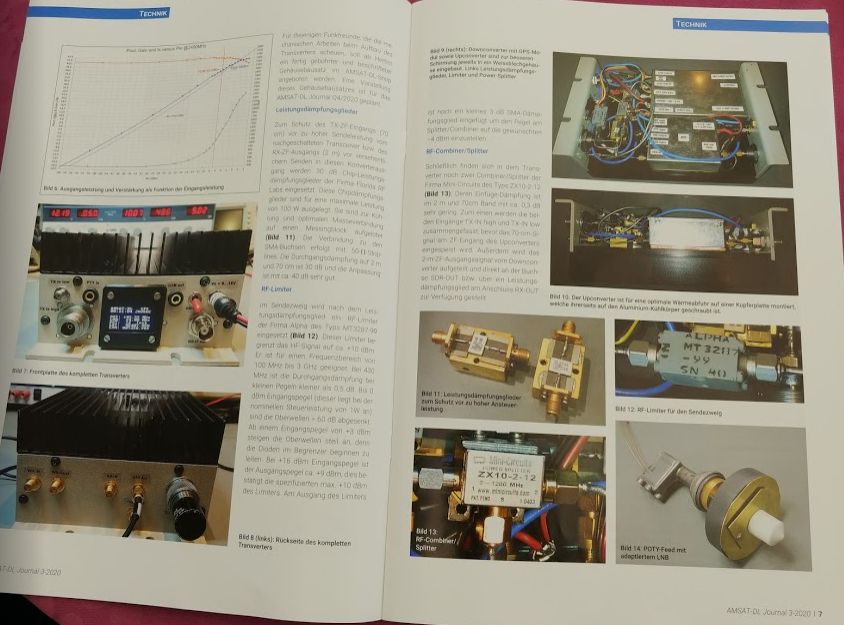
AMSAT-DL Journal Nr. 3 – 47

This number with some excellent articles about portable QO-100 setup, Free-DV on QO-100 and several more articles with QO-100 focus.

Categories
Ham Satellite news

AMSAT-DL AMSAT-UK Virtual Satellite Symposium

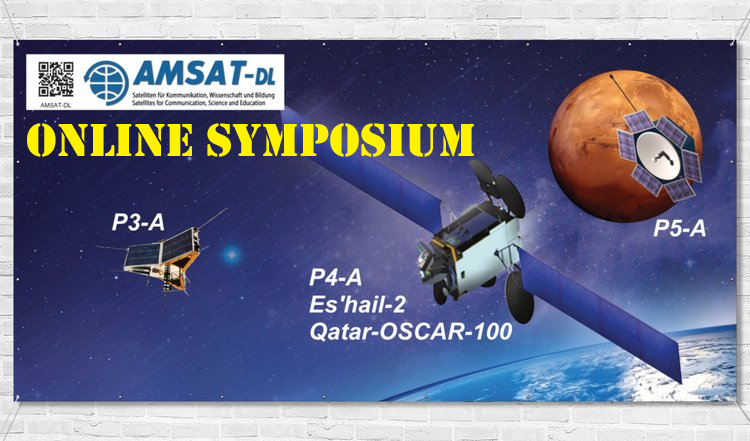
AMSAT-DL Online Satellite Symposium on September 26, 2020

Both AMSAT-DL and AMSAT-UK announces Virtual Satellite Symposium for 2020.

AMSAT-DL:

Unfortunately, the AMSAT-DL Symposium planned for September 26 and 27, 2020 cannot take place this year in the usual manner.
Since the health of all of us is very important to us and the legal framework currently leaves no other option, we have decided not to hold a meeting on site in Bochum this year. We regret this very much, but the premises only allow an occupancy of less than 20 people.
Unfortunately, a “social” meeting with a dinner together is not possible, nor is a flea market and other activities, such as the QO-100 User Meeting, which will be held for the first time during the HAM Radio Fair in Friedrichshafen in 2019.
Instead, we will broadcast the symposium as an “online” meeting in DATV via the broadband transponder of QO-100 and on the Internet on the YouTube channel of AMSAT-DL (https://www.youtube.com/user/amsatdl) radiate.

AMSAT-UK:

AMSAT-UK Announces Colloquium 2020 October 11, 2020
There will not be an in-person AMSAT-UK International Space
Colloquium this year instead they will be holding an Online Event on
Sunday, October 11, 2020. This is the day after the RSGB’s Radio
Convention which is also an on-line event.
The AMSAT-UK Convention will run from 11:00am to approximately
5:00pm, with a break for lunch and several short breaks during the
day. (Times are British Summer Time, or UTC/GMT + 1.) Membership in
AMSAT-UK is not required to attend and the event is free of charge.
The event will be in the form of a Zoom Webinar. Register at
http://tinyurl.com/amsatukreg2020 and follow the instructions which
will arrive by email. No special software is installed since a
browser plug in is used by Zoom.
Those who are registered before the start of the Colloquium will be
entered for a number of free raffles which will take place during the
event. The event will be hosted by Graham Shirville, G3VZV and
Jim Heck, G3WGM and formally opened by our Chairman, Martin Sweeting,
G3YJO. For those registered it will be possible to pose questions to
the speakers during Q and A sessions. Informal on-line discussions
after the official close of the Colloquium, are also planned.
The Colloquium will be live streamed to the AMSAT-UK YouTube channel
at https://www.youtube.com/user/AMSATUK.
Complete information is available at https://amsat-uk.org/colloquium/.