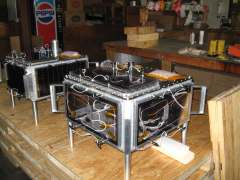
Troll Station Supports first Antarctic contact with FASTRAC student-built satellites
Av SM4TUV
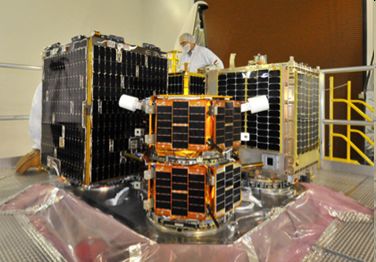
The FASTRAC satellites (foreground) ready for launch in November 2010 at the Kodiak Launch Complex, Alaska
At 4:53 AM on Monday, February 14th, Lars Berglund (3Y8XSA=SM4TUV) of the Norwegian Polar Institute and graduate student Jamin Greenbaum (KF5IBB) successfully tracked two satellites built by students at the University of Texas at Austin and launched into orbit on November 19th, 2010 with three other satellites from the U.S. Air Force and NASA. The early morning contact with the two satellites, affectionately named Sara Lily and Emma after the daughters of two team members, was the first ever from Antarctica. Several more contacts were made later in the morning demonstrating a strong and robust link between Norway’s Troll Station (72° 1’ S & 2° 32’ E) and the satellite pair orbiting at an altitude of 650 km and an inclination of 72 degrees.
The FASTRAC mission, sponsored by the U.S. Air Force Research Laboratory, has two primary purposes. The first is to demonstrate enabling technologies for formation flying of small satellites. As the cost to launch space vehicles remains high but electronics continue to improve in performance and decrease in size, smaller and smarter satellites and shared launch opportunities are the gateway to orbit for organizations previously unable to get there, such as Universities. To do this, the FASTRAC mission is composed of two, nearly identical satellites launched while attached to one another. Once the current checkout period is complete, the two satellites will be commanded to separate from each other as they share a UHF/VHF crosslink (437.345 MHz and 145.825 MHz) including their positions computed using onboard GPS receivers. Each satellite uses the information from the other to compute their relative position and velocity. At the same time, both satellites are using a novel technique to compute their orientation in space using only their GPS antennas and a tiny, 3-axis magnetometer. Onboard, real-time orientation determination and GPS relative navigation have never been demonstrated in space before.
The second purpose of the FASTRAC mission is to train the next generation of scientists and engineers in designing, fabricating, operating, and managing novel space missions. Since the project began in 2003, over 150 students have contributed to the project and many have gone on to careers and further graduate study in the government and civilian space sectors as well as Earth and Planetary sciences.
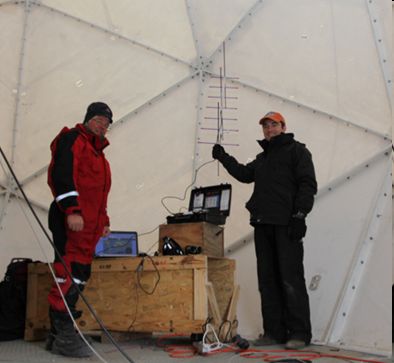
Lars Berglund and Jamin Greenbaum pose next to FASTRAC’s furthest south ground station within a radome Norway’s Troll Station, Antarctic
References:
General: http://en.wikipedia.org/wiki/FASTRAC
Homepage: http://fastrac.ae.utexas.edu/
Animation of flight vehicles:
http://www.engr.utexas.edu/fastracanimation