Categories
Ham Satellite news

AMSAT-SM HF-nätet 11/12 2011

Hej!

Dagens nät blev det inte så mycket med då vi endast var två deltagare.

SM4EFW
SM7WSJ

*OZ till Månen
http://www.euroluna.dk/

*ESA skickar upp nio cubesats början 2012

http://www.esa.int/SPECIALS/Education/SEM3N03MDAF_0.html

*Satellitstatus

Bra aktivitet på följande analoga satelliter

AO-7 Mode A och B
AO-27
SO-50
VO-52

*Övrigt
Jag ser under året som gått att vi varit ungefär samma deltagare. Vi har
inte många övriga inhopp med frågor eller intresse så tanken börjar väckas
att det kanske är dags att ta en paus med kortvågstrafiken.

73 Håkan SM7WSJ

Categories
Ham Satellite news

AMSAT-SM HF-nätet 4/12 2011

Hej!

Dagens nät på 3740 klockan 10.00

Deltagare
SM4EFW
SM5HL
SM7WSJ

Punkter

*AO-51 har nu gett upp på batterisidan.

Satelliten har åtminstone gett mig många roliga kontakter från bilen på
väg/från jobbet samt lätt körd både portabel och fast station.
Enda problemet har varit dess popularitet och höga användarantel.

*SO-50

Nu verkar den här FM satelliten öka i användandet

Frekvenser

145.850 upp
436.795 ned
På upplänk skall 67 Hz CTCSS användas hela tiden. Skulle satelliten inte
vara aktiverad när den kommer norrifrån så sänder man 74,4 Hz CTCSS ton i ca
10 sekunder för att starta den. Söderifrån lär den alltid vara aktiverad.

*FOX-1

Nu blir det lite mer bråttom med efterföljaren och den är betydligt smartare
än föregångaren. Det samlas in donationer på
http://www.amsat.org/amsat-new/fox/ Man kan även där läsa presentationen
på satelliten.

Om man tittar på donationslistan så ligger Drew på första plats och andra
platsen skulle vara rätt lätt att lägga in AMSAT SM om vi gör gemensam sak.

“Given the sad news on AO-51,” AMSAT President Barry Baines, WD4ASW, said,
“we
highlighted at the recent 2011 Symposium that AMSAT is actively developing
Fox-1, a new spacecraft that is designed to
replace AO-51. Fox-1 development now
takes on a great sense of urgency.”

AMSAT Vice-President of Engineering, Tony Monteiro, AA2TX says, “Fox-1 will
advance single-channel FM repeater satellite operation beyond the experience
of
AO-51. It will advance AMSAT to the next
generation of AO-51 class satellites.”

Fox-1 is designed for longer operational life with these features:

+ Fox-1 is designed to operate in sunlight without batteries once
the battery system fails. This applies lessons learned from AO-51
and ARISSat-1 operations.

+ In case of IHU failure Fox-1 will continue to operate its FM
repeater in a basic, ‘zombie sat’ mode, so that the repeater
remains on-the-air.

+ Fox-1 is designed as the immediate replacement for AO-51. Its U/V
(Mode B) transponder will make it even easier to work with modest
equipment.

+ From the ground user’s perspective, the same FM amateur radio
equipment used for AO-51 may be used for Fox-1.

+ Extending the design, Fox-2 will benefit from the development work
of Fox-1 by adding more sophisticated power management and Software
Defined Transponder (SDX) communications systems.

Barry concluded, “AMSAT’s ability to provide a
replacement spacecraft and get it
launched is dependent upon the active support of donors who wish to see
Fox-1
fly.”

Several opportunities to make your donation include:

+ Call Martha at the AMSAT Office +1-888-FB AMSAT (1-888-322-6728)
+ Paypal donation widget on the main page at: http://www.amsat.org
+ Paypal donation widget for Project Fox at:
http://www.amsat.org/amsat-new/fox/
+ The AMSAT Store: http://www.amsat-na.com/store/categories.php

The Powerpoint presentations from the 2011 AMSAT Space Symposium on the
Project
Fox web site provide a good overview of the technical progress:
http://www.amsat.org/amsat-new/fox/

+ Fox-1 Project Overview
+ Fox-1 Mechanical Design
+ Fox-1 Thermal Design
+ Fox-1 Radiation Environment

73 de Håkan SM7WSJ

Categories
Ham Satellite news

FASTRAC klar för digipeat

December 4, 2011
To All RADIO AMATEURS
BID: $ANS-338.01

The FASTRAC satellites have been in operation for more than a year and the team
has been able to get a lot of data from them, in great part due to the amazing
support from the amateur radio community.

Over the last month the team noticed that one of FASTRAC-1’s on board
microcontrollers which controls one of the experiments has not been booting up
correctly. The team has done everything possible to correct this issue apart
from turning it off which can only happen if the batteries fall below an
specific charge level. Since the satellites have been power positive throughout
this whole year the only way this can happen is if the satellites transmit more
often. Given that one of FASTRAC goals has always been to eventually provide a
platform for amateur radio enthusiasts to use after the primary mission was
over, the team has decided to open up FASTRAC-1 to the amateur radio community
with the hope as more people use it to digipeat through the satellite, the
battery levels will diminish and cause a hard reset of the microcontrollers on
board.

The satellite will be configured so that amateur radio operators can use it
beginning on Friday Dec 2 at 1600 UTC. Starting on this date people will be able
to digipeat through the satellites. The call sign and frequencies of the
satellite are summarized below and an example of digipeating through the
satellite is also shown in below. To increase the chances of causing a hard
reset, it is requested that as many amateur radio enthusiasts try to digipeat
through the satellite on the weekend of Dec 10. If you are successful at
digipeating through the satellites or have any problems doing so please let us
know at fastracsats@gmail.com, through our Facebook page
(www.facebook.com/fastracsats) or through the forums on our website
(http://fastrac.ae.utexas.edu/for_radio_operators/users/phpBB3/index.php).

*Frequency Information for FASTRAC-1*

– FASTRAC-1 “Sara Lily” Downlink Frequency: 437.345 MHz
– FASTRAC-1 “Sara Lily” Uplink Frequency (1200 or 9600 baud): 145.825MHz
– FASTRAC-1 “Sara Lily” Satellite Call Sign: FAST1

*Example of Digipeating through FAST1 *

– cmd: c CALLSIGN via fast1
– cmd: KE5DTW>CALLSIGN,FAST1/1: <<C>>:
– CALLSIGN>KE5DTW,FAST1*/1: <UA>:
– *** CONNECTED to CALLSIGN VIA FAST1

Here the example shows KE5DTW (UT Austin Ground Station) digipeating through
FAST1 to connect to CALLSIGN. CALLSIGN represents an arbitrary callsign and
should be replaced with the callsign of the station with whom a connection is
being attempted. The above example is based on a Kantronics KPC9612+ TNC.

For a PDF version of the announcement please go to the following link:
http://fastrac.ae.utexas.edu/FASTRAC_Digipeating_Announcement.pdf

[ANS thanks Sebastin, KE5FKV, for the above information]

SB SAT @ AMSAT $ANS-338.01
FASTRAC-1 Opened for Digipeating

AMSAT News Service Bulletin 338.01
From AMSAT HQ SILVER SPRING, MD.
December 4, 2011
To All RADIO AMATEURS
BID: $ANS-338.01

The FASTRAC satellites have been in operation for more than a year and the team
has been able to get a lot of data from them, in great part due to the amazing
support from the amateur radio community.

Over the last month the team noticed that one of FASTRAC-1’s on board
microcontrollers which controls one of the experiments has not been booting up
correctly. The team has done everything possible to correct this issue apart
from turning it off which can only happen if the batteries fall below an
specific charge level. Since the satellites have been power positive throughout
this whole year the only way this can happen is if the satellites transmit more
often. Given that one of FASTRAC goals has always been to eventually provide a
platform for amateur radio enthusiasts to use after the primary mission was
over, the team has decided to open up FASTRAC-1 to the amateur radio community
with the hope as more people use it to digipeat through the satellite, the
battery levels will diminish and cause a hard reset of the microcontrollers on
board.

The satellite will be configured so that amateur radio operators can use it
beginning on Friday Dec 2 at 1600 UTC. Starting on this date people will be able
to digipeat through the satellites. The call sign and frequencies of the
satellite are summarized below and an example of digipeating through the
satellite is also shown in below. To increase the chances of causing a hard
reset, it is requested that as many amateur radio enthusiasts try to digipeat
through the satellite on the weekend of Dec 10. If you are successful at
digipeating through the satellites or have any problems doing so please let us
know at fastracsats@gmail.com, through our Facebook page
(www.facebook.com/fastracsats) or through the forums on our website
(http://fastrac.ae.utexas.edu/for_radio_operators/users/phpBB3/index.php).

*Frequency Information for FASTRAC-1*

– FASTRAC-1 “Sara Lily” Downlink Frequency: 437.345 MHz
– FASTRAC-1 “Sara Lily” Uplink Frequency (1200 or 9600 baud): 145.825MHz
– FASTRAC-1 “Sara Lily” Satellite Call Sign: FAST1

*Example of Digipeating through FAST1 *

– cmd: c CALLSIGN via fast1
– cmd: KE5DTW>CALLSIGN,FAST1/1: <<C>>:
– CALLSIGN>KE5DTW,FAST1*/1: <UA>:
– *** CONNECTED to CALLSIGN VIA FAST1

Here the example shows KE5DTW (UT Austin Ground Station) digipeating through
FAST1 to connect to CALLSIGN. CALLSIGN represents an arbitrary callsign and
should be replaced with the callsign of the station with whom a connection is
being attempted. The above example is based on a Kantronics KPC9612+ TNC.

For a PDF version of the announcement please go to the following link:
http://fastrac.ae.utexas.edu/FASTRAC_Digipeating_Announcement.pdf

[ANS thanks Sebastin, KE5FKV, for the above information]

Categories
Ham Satellite news

Tillbakablick (och framåt?)

Hej!

Det har gått många år sedan den första amatörsatelliten sändes upp i rymden. Något som jag reflekterar över är att många gånger använder radioamatörer Rymden och ISS som positiva argument för att lyfta fram sin hobby.

Det känns då väldigt konstigt att man ibland kan se framstående radioamatörer i bland annat SMpropagera för en inskränkning i satellitsegmentet 435-438 Mhz till förmån för repeaternät.

I det senaste tilltaget på SSA forumet skriver en medlem att det kan kallas hamspirit då mn kan använda satellitfrekvenserna som en del i repeaternät då dom annars är tysta och man annars riskerar att förlora dom frekvenserna. Enligt mitt sätt och se på saken så tror jag att dom som sysslar med frekvensplanering är väl införstådda med dom låga signalstyrkor vi arbetar med inom amatörsatellit-servicen och behöver ha dom frekvenserna världsomspännande välkordinerade och fria från störning från markbunden
trafik.

http://www.itu.int/en/ITU-R/space/AmateurDoc/AmateurSatServiceFreq.pdf

En vanlig repeateranvändare som rattar över satellitdelen klarar inte höra en avlägsen satellitsignal. Däremot hör satelliten repeateranvändaren som sänder inom satellitsegmentet.

Något som inte många oinvigda beaktar är att Amatörsatelliterna är det enda som idag får universitetens intresse och därmed statliga pengar till förfogande till sina experiment. Att det då ibland etablerade radioamatörer
inte finns nog med förståelse för att vi behöver ha dom här frekvenserna fredade från diverse repeaterkofigurationer (oavsett om dom säger att dom inte stör vare sig upp/nedlänk på dom kända satelliterna) är ytterst tråkigt och kommer inte att föra något gott med sig.

Man bör betänka att en del av dom här studenterna är framtidens projektledare och bör inte ha med i minnet att radioamatörer kör hur dom vill och struntar totalt i bandplaner även om det stör verksamheten runt någon universitet-satellit då dom ändå inte hör något på dom frekvenserna.

För dom som inte noterat att vi har nya bandplaner så hänvisas till http://www.ssa.se/ sektionen VHF/UHF/SHF.

Det finns ingen som idag behöver lägga vare sig in eller utfrekvenser på repeatrar inom satellitsegmentet då det finns gott om utrymme där dom ska vara.

73 de Håkan SM7WSJ

O S C A R N E W S L E T T E R

December 1, 1961

Good News!
The following is quoted from the Department of Defense News Release dated November 15, 1961:

AIR FORCE TO ORBIT SMALL SATELLITE FOR “HAM” OPERATORS’ USE

“The Air Force is planning to boost into orbit a small amateur radio satellite so that “ham” operators around the world can contribute to the world’s knowledge on the development and operation of space communications systems.”

“Known as Project OSCAR – Orbiting Satellite Carrying Amateur Radio -the program is the result of extensive thought and planning on the part of several California amateur operators. They have formed the OSCAR Association to follow through on the project.

“The Air Force Space Systems Division in Los Angeles has agreed to orbit the OSCAR satellite on a space available basis on board a DISCOVERER satellite which will be launched from Vandenberg AFB next month.

“The OSCAR satellite will weigh approximately ten pounds and will be lifted into orbit on the external aft portion of the AGENA Satellite. Sometime after the AGENA has attained orbit the OSCAR satellite will separate from the mother vehicle. Antennae will extend and the transmitter will commence operation. The OSCAR satellite will contain its
own battery power system and is anticipated to have a 30-day life in orbit. “The OSCAR satellite is designed to investigate radio propagation phenomena in the two meter (144-146) portion of the radio frequency spectrum.”

Simultaneously, a letter from Dr. J. V. Charyk, Under Secretary of the Air Force to the American Radio Relay League, says (in part):

“I am pleased to advise that the Air Force will undertake to place into orbit an Oscar package…..Our Space Systems Division has been instructed to accomplish the Oscar package launching at the earliest feasible date (italics ours) on a non-interference basis to the performance or mission of the launch carrier vehic1e….. Please be assured of the complete cooperation by the Air Force toward success-
ful accomplishment of this amateur experiment.”

THIS MEANS THAT THE LAUNCH INTO SPACE OF OSCAR I, THE WORLD’S FIRST
AMATEUR RADIO SATELLITE IS IMINENT — PROBABLY WELL WITHIN THE MONTH!
ACTUAL LAUNCH DATE CANNOT BE YET RELEASED FOR SECURITY REASONS. LIS-
TEN TO THE VOICE OF AMERICA BROADCASTS AND THE OFFICIAL ARRL BROAD-
CAST FROM WIAW FOR LAUNCH DATE! ALSO WATCH YOUR LOCAL NEWSPAPER FOR
LAUNCH INFORMATION!

RECENT “UP” AND “AP” OSCAR NEWS DESPATCHES HAVE BEEN FEATURED IN
MAJOR NEWSPAPERS, AND IN ADDITION, W6SAI AND K6LFH WERE INTERVIEW-
ED BY VOICE OF AMERICA ON THE NOVEMBER 27TH AMATEUR RADIO PROGRAM
WHICH FEATURED THE OSCAR STORY. YOUR COOPERATION IN THIS IMPORTANT,
WORLD-WIDE AMATEUR SPACE EXPERIMENT IS URGENTLY REQUIRED. SEE RE-
CENT ISSUES OF QST AND CQ MAGAZINES FOR ARTICLES ON RECEPTION AND
TRACKING OF THE OSCAR 145 MC RADIO BEACON. AS THE BEACON HAS NO
RECEPTION PACILITIES, QQ NQT MAKE CALLS TO THE BEACON. KEEP YOUR
TRANSMITTER CLEAR OF 145 MC! OSCAR I WILL BE IN POLAR ORBIT, THUS
PASSING OVER EACH POINT ON EARTH APPROXIMATELY FOUR TIMES PER DAY
ON NORTH-TO-SOUTH AND SOUTH-TO-NORTH ORBITS.

THE TIME IS NOW! ARE YOU READY?

NOW THAT WE HAVE RECEIVED ALL NECESSARY PERMISSION AND ASSISTANCE,
OSCAR 1 WILL BE ON ITS OWN WHEN IT IS EJECTED FROM THE PARENT VE-
HICLE. THE OSCAR ASSOCIATION AND THE U. S. AIR FORCE HAVE AT THIS
POINT DONE ALL THEY CAN DO TO MAKE THE EXPERIMENT A SUCCESSFUL ONE.
THE RESULTS OF THIS EXPERIMENT WILL DEPEND UPON YOU – THE RADIO AMA-
TEUR. YOU MUST CARRY ON FROM THIS POINT! YOUR COOPERATION IN THIS
NON-COMMERCIAL, NON-MILITARY SPACE EFFORT WILL BE IN THE BEST TRA-
DITIONS OF AMATEUR RADIO!

GOOD LUCK!

A11 reception reports of Oscar I should be directed to:
Oscar Association, P. O. Box —, Sunnyvale, California, USA.
A11 correct reports will receive a special OSCAR I QSL card, verifying reception of the world’s first amateur radio satellite.

Categories
Ham Satellite news

AMSAT-SM HF-nätet 27/11 2011

Hej!

Ett tag sedan det kom någon rapport från HF nätet då det inte har varit så
mycket att rapportera.

Dagens deltagare

SM4EFW
SM4JLX
SM5HL
SM7WSJ

*AO-51

Tyvärr så verkar satelliten sjunga på sista versen då battericellerna ger
upp mer och mer. Något positivt är att man lärt sig en hel del och
efterföljaren FOX kommer inte ha det problemet att IHU kraschar då
satelliten går ned i batterispänning.

Efterföljaren FOX kommer att gå att köra på solcellerna så som vi nu gör med
AO-7.

För mera information så är det lämpligt att läsa igenom
http://www.amsat.org/amsat-new/fox/Fox1Systems.ppt

*FO-29 HO-68
Satelliterna är fortfarande tysta.

*Körbara analoga satelliter
AO-7 AO-27 SO-50 VO52

73 de Håkan SM7WSJ

Categories
Ham Satellite news

Fox-1 framtidens lätta satellit

När nu AO-51 tystnat så blir det ännu mera brått att få upp en ny lätt nybörjar satellit.

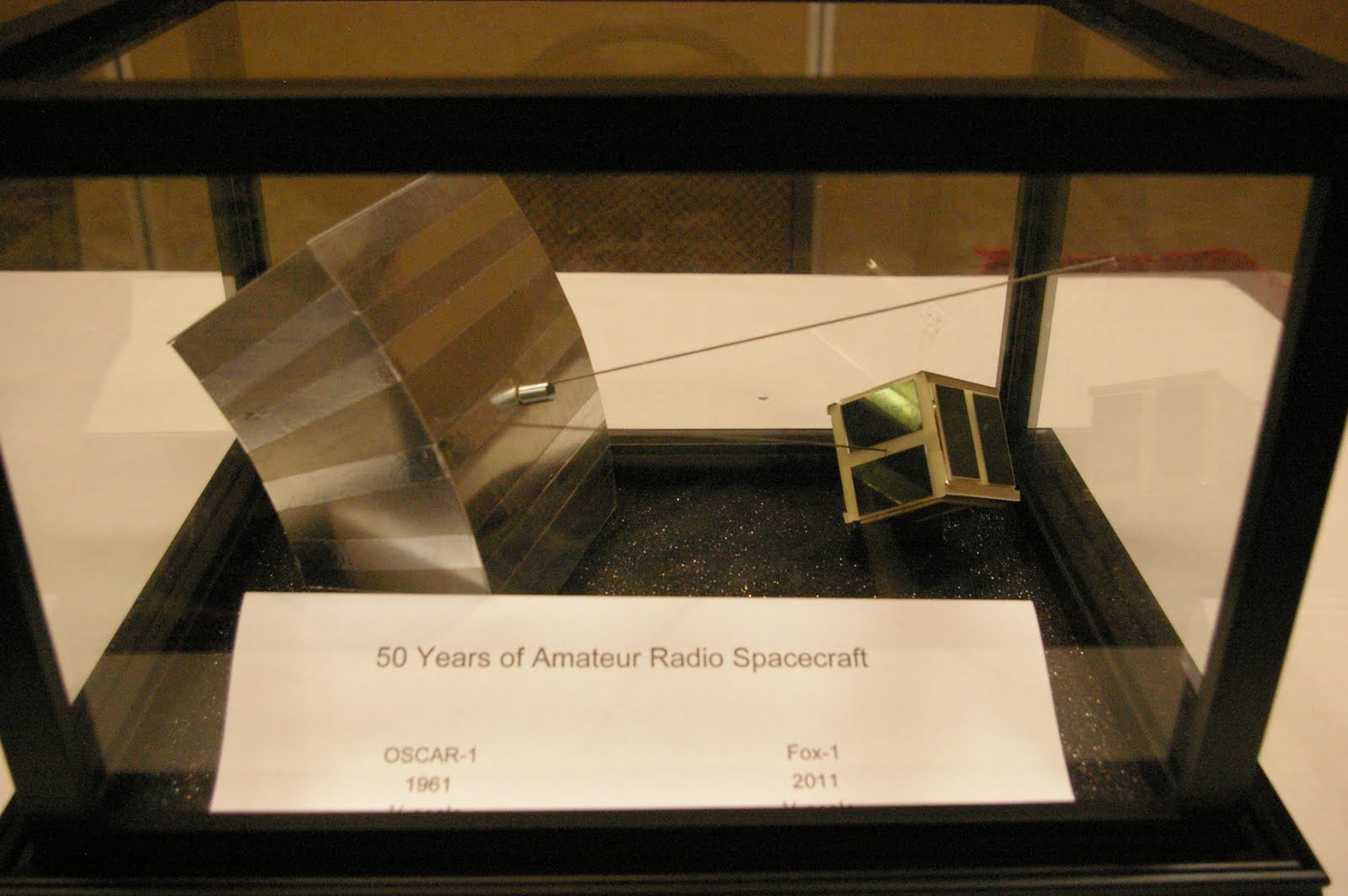
Fox-1 kommer att ha upplänk på 70 cm samt nedlänk på 2M. En av dom smartare detaljerna är att om batterierna kraschar så kommer satelliten fortfarande vara körbar i solbelysning. Ombord datorn ska heller inte gå ner och behöva ha ny uppladdning av programvara då satelliten ska ha ett så kallat zombiemode.

Bilden föreställer Oscar-1 samt FOX-1 i halvskala .

För att läsa vidare om FOX-1   http://www.amsat.org/amsat-new/fox/